Related Books
Filter by Era
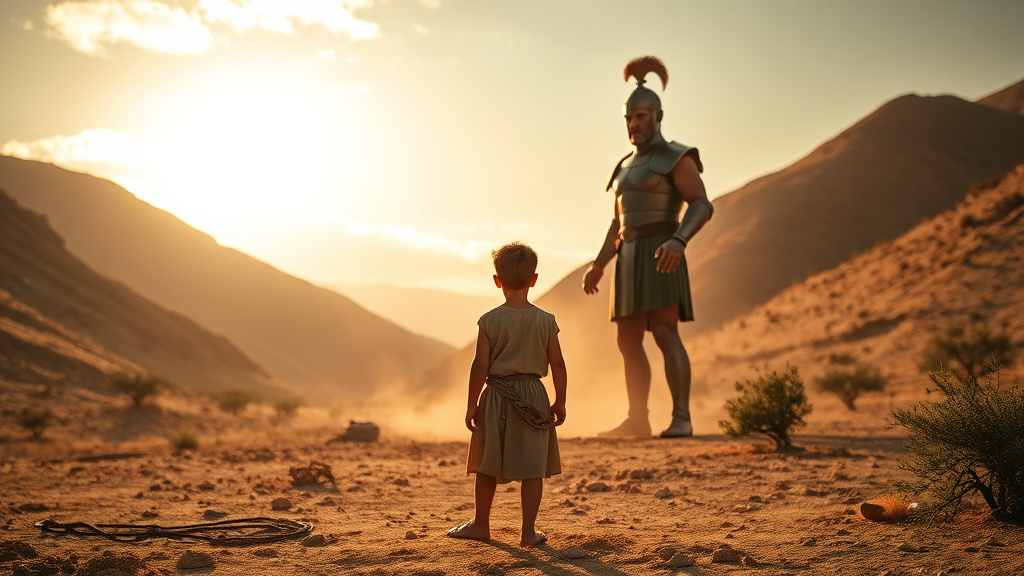
1samuel 17
1samuel · Ch.17
Stone Against the Champion
1 Samuel 7:5
judaism「Samuel said, “Assemble all Israel at Mizpah, and I will pray to GOD for you.”」
Why was David unafraid when he faced Goliath?
From shepherd boy to battlefield champion—where did David's confidence come from?
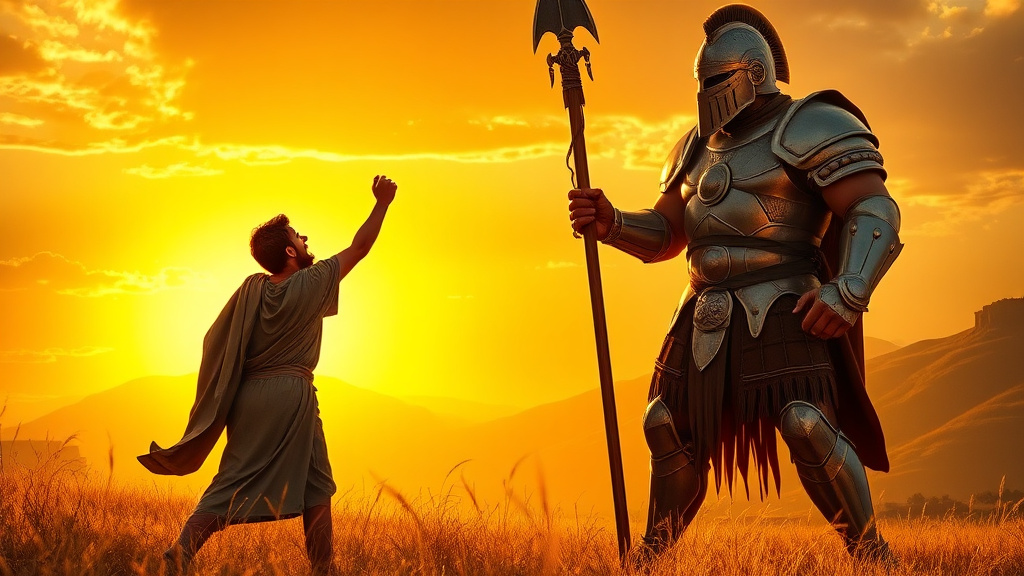
1samuel 17
1samuel · Ch.17
David vs Goliath: A Battle of Faith
1 Samuel 25:17
protestant「Now therefore know and consider what thou wilt do; for evil is determined against our master, and against all his house: for he is such a worthless fellow, that one cannot speak to him.」
How does 1 Samuel 17:4 describe Goliath's physical dimensions (six cubits and a span), and why do ancient textual traditions (MT, LXX, the Dead Sea Scrolls' 4QSamuela) report different numbers? What does this variance tell us about the transmission of the David and Goliath story?
Was Goliath really over nine feet tall—or not? Compare the manuscripts and trace how the story of David and Goliath is preserved and adapted.
1 Samuel 31:10
judaism「They placed his armor in the temple of Ashtaroth, and they impaled his body on the wall of Beth-shan.」
Where did David's faith originate when he declared he came in the name of the Lord of Hosts?
How did a teenager possess greater spiritual conviction than seasoned soldiers?
1 Samuel 20:4
judaism「Jonathan said to David, “Whatever you want, I will do it for you.”」
Goliath's challenge continued for forty days — does this number carry symbolic weight in the Hebrew tradition?
Forty days in Hebrew scripture often signals a turning point.
1 Samuel 26:12
judaism「So David took away the spear and the water jar at Saul’s head, and they left. No one saw or knew or woke up; all remained asleep; a deep sleep from GOD had fallen upon them.」
In 1 Samuel 17:45-47, David declares to Goliath, 'You come against me with sword and spear... but I come against you in the name of the LORD Almighty.' How does David's theological framing of the battle shape our understanding of spiritual warfare?
How David's words frame the nature of true conflict.
1 Samuel 9:2
judaism「He had a son whose name was Saul, an excellent young man; no one among the Israelites was handsomer than he; he was a head taller than any of the people.」
How do David's words before facing Goliath demonstrate his trust in God?
"I come against you in the name of the Lord of hosts"—how deep is the spiritual meaning of this declaration?
1 Samuel 8:2
protestant「Now the name of his first-born was Joel; and the name of his second, Abijah: they were judges in Beer-sheba.」
Why did no one in Israel's army dare to face Goliath for forty days?
Fear gripped the whole army, yet opened a door of victory for a youth.
1 Samuel 16:1
judaism「And GOD said to Samuel, “How long will you grieve over Saul, since I have rejected him as king over Israel? Fill your horn with oil and set out; I am sending you to Jesse the Bethlehemite, for I have decided on one of his sons to be king.”」
David famously declared he would fight Goliath in the name of the Lord of Armies. How does his statement in verse 37 shape the way we understand the outcome of the battle?
Consider how faith, not military strategy, defines David's confidence before the Philistine.
1 Samuel 24:7
protestant「So David checked his men with these words, and suffered them not to rise against Saul. And Saul rose up out of the cave, and went on his way.」
When David declares he comes 'in the name of the LORD of hosts,' how does this declaration embody the principle of faith alone in the battle?
Victory belongs not to the mighty, but to the One who commands the armies of heaven.
1 Samuel 8:14
judaism「He will seize your choice fields, vineyards, and olive groves, and give them to his courtiers.」
What was the source of David's confidence when confronting Goliath?
From shepherd to warrior, David's courage was rooted in his firsthand experience of God.
1 Samuel 29:10
judaism「So rise early in the morning, you and your lord’s servants who came with you—rise early in the morning, and leave as soon as it is light.”」
Why had Israel's army hesitated before Goliath for forty days, and what was the source of David's courage?
Faith versus fear in the camp of Israel.
1 Samuel 14:2
judaism「Now Saul was staying on the outskirts of Gibeah, under the pomegranate tree at Migron, and the troops with him numbered about 600.」
Why does David repeatedly invoke the name of YHWH when confronting Goliath, and what theological point is being made?
The true opponent is not the giant, but what he represents.
1 Samuel 20:2
protestant「And he said unto him, Far from it; thou shalt not die: behold, my father doeth nothing either great or small, but that he discloseth it unto me; and why should my father hide this thing from me? it is not so.」
How does Catholic tradition read the David and Goliath battle as a type of faith?
Patristic and medieval interpreters find in 1 Samuel 17 lessons for spiritual warfare.
1 Samuel 15:13
judaism「When Samuel came to Saul, Saul said to him, “Blessed are you of GOD! I have fulfilled GOD’s command.”」
How does David's confrontation with Goliath in 1 Samuel 17 shape your understanding of courage when facing overwhelming odds?
Explore what 1 Samuel 17 reveals about courage rooted in faith rather than military strength.
1 Samuel 5:12
protestant「And the men that died not were smitten with the tumors; and the cry of the city went up to heaven.」
After David defeats Goliath, the women of Israel sing, 'Saul has struck down his thousands, and David his ten thousands' (1 Samuel 18:7). How does this public song foreshadow the future tension between Saul and David?
Tracing the literary bridge from victory to jealousy.
1 Samuel 1:17
protestant「Then Eli answered and said, Go in peace; and the God of Israel grant thy petition that thou hast asked of him.」
How does the Talmudic tradition interpret the confrontation between David and Goliath?
How do the rabbis draw spiritual lessons from the unlikely victory of the young shepherd?
1 Samuel 2:13
judaism「This is how the priests used to deal with the people: Whenever anyone brought a sacrifice, the priest’s boy would come along with a three-pronged fork while the meat was boiling,」
From where did David draw the courage to declare, 'I come against you in the name of the LORD of hosts'?
How could such a bold declaration come from a shepherd boy?
1 Samuel 6:11
protestant「and they put the ark of Jehovah upon the cart, and the coffer with the mice of gold and the images of their tumors.」
In 1 Samuel 17:50, the text says David 'prevailed over the Philistine' with a sling and a stone, 'but there was no sword in David's hand.' How does this detail of unarmed victory shape Christian reflections on relying on God's power rather than human instruments?
Reflect on how the absence of a sword in David's hand speaks to faith over force.
1 Samuel 11:11
judaism「The next day, Saul divided the troops into three columns; at the morning watch they entered the camp and struck down the Ammonites until the day grew hot. The survivors scattered; no two were left together.」
Saul had once been moved by the Spirit of the Lord — why does he lose courage before Goliath?
A king once anointed, now trembling — where did the contrast begin?
1 Samuel 4:13
judaism「When he arrived, he found Eli sitting on a seat, waiting beside the road—his heart trembling for the Ark of God. The man entered the city to spread the news, and the whole city broke out in a cry.」
1 Samuel 17:45–47 records David's declaration that the battle belongs to the Lord. How does this theological conviction differ from the Philistine worldview expressed through Goliath's taunts, and what does it say about the nature of true power?
Compare two radically different worldviews meeting on a battlefield, and what each reveals about power.
1 Samuel 21:14
judaism「So he concealed his good sense from them; he feigned madness for their benefit. He scratched marks on the doors of the gate and let his saliva run down his beard.」
1 Samuel 17:26 asks, 'Who is this uncircumcised Philistine that he should defy the armies of the living God?' How does David frame the conflict in theological terms rather than military ones, and what does this reveal about his understanding of Israel's identity?
David doesn't ask who can win the fight — he asks who can honor God's name. A discussion on faith versus strategy.
1 Samuel 26:8
protestant「Then said Abishai to David, God hath delivered up thine enemy into thy hand this day: now therefore let me smite him, I pray thee, with the spear to the earth at one stroke, and I will not smite him the second time.」
Why did no one dare to face Goliath as he challenged Israel for forty days?
Forty days of fear and the arrival of one young man—what a stark contrast of hearts.
1 Samuel 23:6
protestant「And it came to pass, when Abiathar the son of Ahimelech fled to David to Keilah, that he came down with an ephod in his hand.」
What spiritual condition does it reveal that no one in Israel's army answered the challenge for forty days?
What contrast emerges between the silent army and the solitary youth?
1 Samuel 2:10
protestant「They that strive with Jehovah shall be broken to pieces; Against them will he thunder in heaven: Jehovah will judge the ends of the earth; And he will give strength unto his king, And exalt the horn of his anointed.」
How does David's declaration in 1 Samuel 17:47 — 'the battle is the Lord's' — shape a Protestant understanding of providence and human responsibility?
If the victory belongs to God, what is David actually doing when he runs toward Goliath?