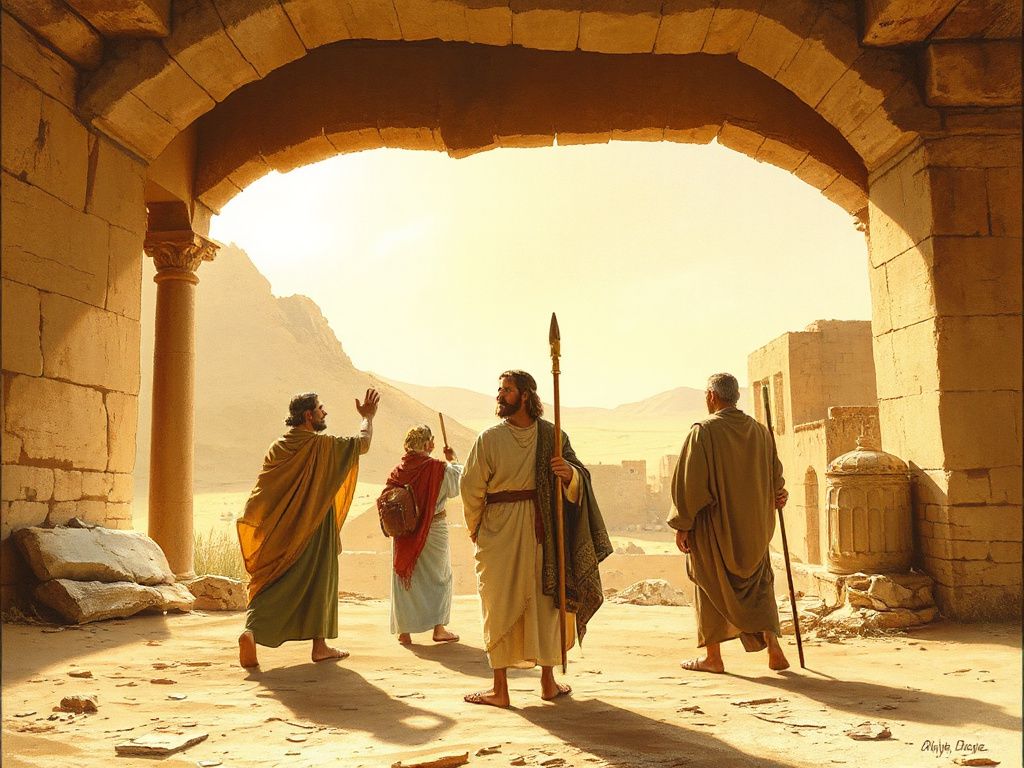
BIBLE CHAPTER STUDY
Exodus 5 — Pharaoh Refuses and Doubles the Burden
Moses and Aaron deliver God's demand that Israel be released to worship in the wilderness. Pharaoh rejects it, claiming ignorance of Jehovah, and retaliates by withdrawing the straw provided for brickmaking while keeping the brick quota fixed.
Scripture
1And afterward Moses and Aaron came, and said unto Pharaoh, Thus saith Jehovah, the God of Israel, Let my people go, that they may hold a feast unto me in the wilderness.
2And Pharaoh said, Who is Jehovah, that I should hearken unto his voice to let Israel go? I know not Jehovah, and moreover I will not let Israel go.
3And they said, The God of the Hebrews hath met with us: let us go, we pray thee, three days' journey into the wilderness, and sacrifice unto Jehovah our God, lest he fall upon us with pestilence, or with the sword.
4And the king of Egypt said unto them, Wherefore do ye, Moses and Aaron, loose the people from their works? get you unto your burdens.
5And Pharaoh said, Behold, the people of the land are now many, and ye make them rest from their burdens.
6And the same day Pharaoh commanded the taskmasters of the people, and their officers, saying,
7Ye shall no more give the people straw to make brick, as heretofore: let them go and gather straw for themselves.
8And the number of the bricks, which they did make heretofore, ye shall lay upon them; ye shall not diminish aught thereof: for they are idle; therefore they cry, saying, Let us go and sacrifice to our God.
9Let heavier work be laid upon the men, that they may labor therein; and let them not regard lying words.
10And the taskmasters of the people went out, and their officers, and they spake to the people, saying, Thus saith Pharaoh, I will not give you straw.
11Go yourselves, get you straw where ye can find it; for nought of your work shall be diminished.
12So the people were scattered abroad throughout all the land of Egypt to gather stubble for straw.
13And the taskmasters were urgent, saying, Fulfil your works, your daily tasks, as when there was straw.
14And the officers of the children of Israel, whom Pharaoh's taskmasters had set over them, were beaten, and demanded, Wherefore have ye not fulfilled your task both yesterday and to-day, in making brick as heretofore?
15Then the officers of the children of Israel came and cried unto Pharaoh, saying, Wherefore dealest thou thus with thy servants?
16There is no straw given unto thy servants, and they say to us, Make brick: and, behold, thy servants are beaten; but the fault is in thine own people.
17But he said, Ye are idle, ye are idle: therefore ye say, Let us go and sacrifice to Jehovah.
18Go therefore now, and work; for there shall no straw be given you, yet shall ye deliver the number of bricks.
19And the officers of the children of Israel did see that they were in evil case, when it was said, Ye shall not diminish aught from your bricks, your daily tasks.
20And they met Moses and Aaron, who stood in the way, as they came forth from Pharaoh:
21and they said unto them, Jehovah look upon you, and judge; because ye have made our savor to be abhorred in the eyes of Pharaoh, and in the eyes of his servants, to put a sword in their hand to slay us.
22And Moses returned unto Jehovah, and said, Lord, wherefore hast thou dealt ill with this people? why is it that thou hast sent me?
23For since I came to Pharaoh to speak in thy name, he hath dealt ill with this people; neither hast thou delivered thy people at all.
What this passage means
The chapter sets up the confrontation between the covenant God and an empire that does not know Him. Pharaoh's question "Who is Jehovah, that I should hearken unto his voice?" is itself the theological issue the following chapters answer. By the end of the book of Exodus, this same question has been answered by acts that the Egyptians themselves recognize (see 2 Kings 18:35 in the provided cross references).
Verse 1 states the request plainly: "Let my people go, that they may hold a feast unto me in the wilderness." The reason given for the release is worship, not national liberation in the modern sense. Pharaoh then reduces worship to a pretext for idleness (vv. 8, 17), an interpretive move that becomes the basis for his counter-policy: keep the workers producing, but remove the supplied raw material so they must gather stubble on their own while still meeting the same daily quota (vv. 7, 11, 18).
When the Israelite officers are beaten and blamed, they turn on Moses and Aaron (vv. 20–21). Moses then "returned unto Jehovah" with a complaint that combines confusion about the mission ("why is it that thou hast sent me?") and the honest observation that nothing has changed for the people yet. The chapter ends without resolution, leaving the reader between the divine promise and an immediate worsening of conditions.
Context
The chapter stands at the opening of the conflict between Moses and Pharaoh that continues through Exodus 7–14. The refusal recorded here matches what the Lord had already told Moses before the confrontation: "the king of Egypt will not give you leave to go, no, not by a mighty hand" (Exodus 3:19 in the provided cross references). The phrasing "The God of the Hebrews hath met with us" in verse 3 matches the instruction given in Exodus 3:18, also in the provided list.
The brick-making setting ties back to Exodus 1:11 (in the cross references), where taskmasters were set over Israel and the people built store-cities. The new policy of verse 7 keeps the labor structure intact while withdrawing a supplied resource, so the apparatus of oppression shown earlier is intensified rather than replaced.
Key words in the original
- H7971 Hebrew שָׁלַח (šallaḥ), glossed "let ~ go" in verses 1 and 2. The same verb frames both the divine demand ("Let my people go") and Pharaoh's refusal ("I will not let Israel go"), so the whole chapter's conflict turns on this one verb.
- H3068 Hebrew יהוה (yhwh), the covenant name rendered "Jehovah" in verses 1 and 2. Pharaoh's "Who is Jehovah?" turns the divine name into the very question the plagues and the exodus are about to address.
- H2287 Hebrew חָגַג (ḥāgag), "hold a festival," used in verse 1 with the unusual form transliterated "yāḥōgû." The root suggests moving in a circle or procession, underlining that the requested journey is for a sacred assembly, not a political one.
Related verses
- Exodus 3:19 God had told Moses in advance that the Egyptian king would not let the people go "no, not by a mighty hand," so the refusal in Exodus 5 is the predicted first move, not an unexpected setback.
- Job 21:15 Pharaoh's "Who is Jehovah, that I should hearken unto his voice?" parallels Job 21:15 "What is the Almighty, that we should serve him?" Both speeches treat the Lord's authority as something one can weigh and dismiss.
- Exodus 10:9 The brief worship request in Exodus 5:1 expands later into the full family-and-flock declaration of Exodus 10:9, where Moses insists that the feast requires young and old, sons and daughters, flocks and herds.
Common questions
Why does Pharaoh say "Who is Jehovah" in verse 2?
As recorded in verses 1–2, Pharaoh explicitly says "I know not Jehovah." Within the chapter's own words, his question is a statement of disavowal: he refuses to recognize the authority of a God he does not acknowledge, and this refusal is what the rest of the confrontation answers.
What changed for the Israelites after Moses and Aaron spoke to Pharaoh?
According to verses 7, 11, and 18, the supplied straw for brickmaking was withdrawn, the people had to gather stubble on their own, yet the daily brick quota stayed the same. Verses 14 and 19 add that the Israelite officers were beaten when they fell short.
How does the chapter end, and why does Moses complain?
Verses 22–23 record Moses returning to Jehovah with the complaint that the people have been made to suffer more, not less, and asking "why is it that thou hast sent me?" The chapter closes with the mission still unresolved: the divine promise stands, but the immediate condition of the people has worsened.