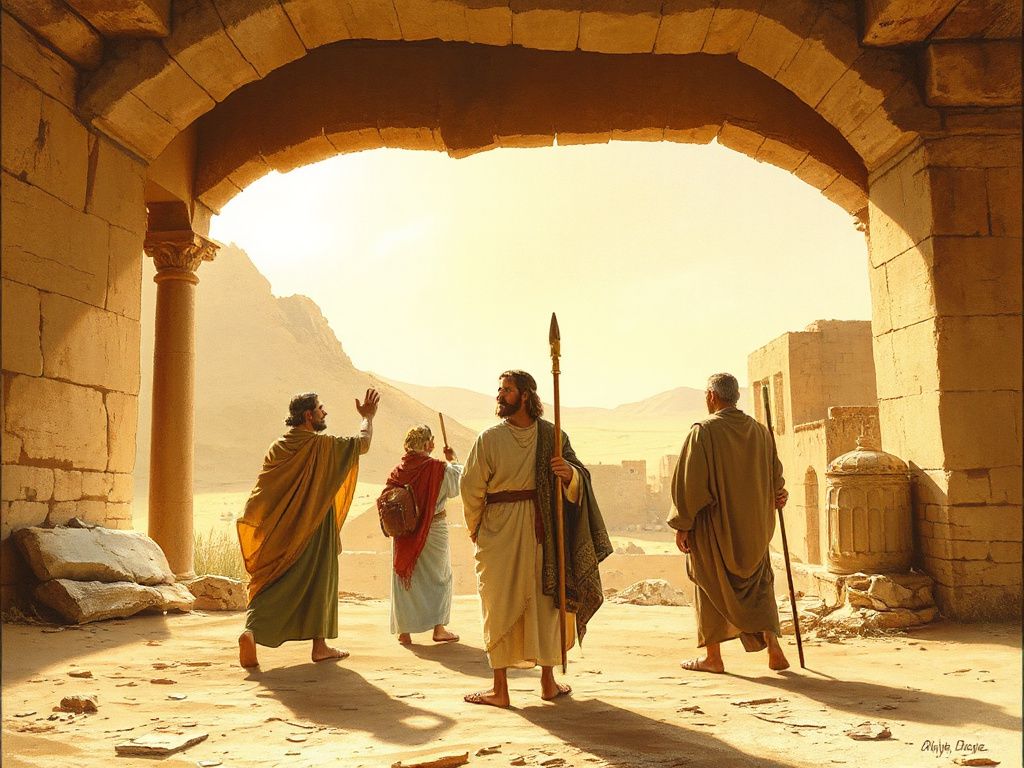
BIBLE CHAPTER STUDY
Exodus 6 — God's Name and the Genealogy of Moses
God reaffirms His name Jehovah, restates the four promises of redemption and land, and confirms Moses and Aaron's commission — then inserts the tribal genealogy that anchors those leaders in Israel's lineage.
Scripture
1And Jehovah said unto Moses, Now shalt thou see what I will do to Pharaoh: for by a strong hand shall he let them go, and by a strong hand shall he drive them out of his land.
2And God spake unto Moses, and said unto him, I am Jehovah:
3and I appeared unto Abraham, unto Isaac, and unto Jacob, as God Almighty; but by my name Jehovah I was not known to them.
4And I have also established my covenant with them, to give them the land of Canaan, the land of their sojournings, wherein they sojourned.
5And moreover I have heard the groaning of the children of Israel, whom the Egyptians keep in bondage; and I have remembered my covenant.
6Wherefore say unto the children of Israel, I am Jehovah, and I will bring you out from under the burdens of the Egyptians, and I will rid you out of their bondage, and I will redeem you with an outstretched arm, and with great judgments:
7and I will take you to me for a people, and I will be to you a God; and ye shall know that I am Jehovah your God, who bringeth you out from under the burdens of the Egyptians.
8And I will bring you in unto the land which I sware to give to Abraham, to Isaac, and to Jacob; and I will give it you for a heritage: I am Jehovah.
9And Moses spake so unto the children of Israel: but they hearkened not unto Moses for anguish of spirit, and for cruel bondage.
10And Jehovah spake unto Moses, saying,
11Go in, speak unto Pharaoh king of Egypt, that he let the children of Israel go out of his land.
12And Moses spake before Jehovah, saying, Behold, the children of Israel have not hearkened unto me; how then shall Pharaoh hear me, who am of uncircumcised lips?
13And Jehovah spake unto Moses and unto Aaron, and gave them a charge unto the children of Israel, and unto Pharaoh king of Egypt, to bring the children of Israel out of the land of Egypt.
14These are the heads of their fathers' houses. The sons of Reuben the first-born of Israel: Hanoch, and Pallu, Hezron, and Carmi; these are the families of Reuben.
15And the sons of Simeon: Jemuel, and Jamin, and Ohad, and Jachin, and Zohar, and Shaul the son of a Canaanitish woman; these are the families of Simeon.
16And these are the names of the sons of Levi according to their generations: Gershon, and Kohath, and Merari; and the years of the life of Levi were a hundred thirty and seven years.
17The sons of Gershon: Libni and Shimei, according to their families.
18And the sons of Kohath: Amram, and Izhar, and Hebron, and Uzziel; and the years of the life of Kohath were a hundred thirty and three years.
19And the sons of Merari: Mahli and Mushi. These are the families of the Levites according to their generations.
20And Amram took him Jochebed his father's sister to wife; and she bare him Aaron and Moses: and the years of the life of Amram were a hundred and thirty and seven years.
21And the sons of Izhar: Korah, and Nepheg, and Zichri.
22And the sons of Uzziel: Mishael, and Elzaphan, and Sithri.
23And Aaron took him Elisheba, the daughter of Amminadab, the sister of Nahshon, to wife; and she bare him Nadab and Abihu, Eleazar and Ithamar.
24And the sons of Korah: Assir, and Elkanah, and Abiasaph; these are the families of the Korahites.
25And Eleazar Aaron's son took him one of the daughters of Putiel to wife; and she bare him Phinehas. These are the heads of the fathers' houses of the Levites according to their families.
26These are that Aaron and Moses, to whom Jehovah said, Bring out the children of Israel from the land of Egypt according to their hosts.
27These are they that spake to Pharaoh king of Egypt, to bring out the children of Israel from Egypt: these are that Moses and Aaron.
28And it came to pass on the day when Jehovah spake unto Moses in the land of Egypt,
29that Jehovah spake unto Moses, saying, I am Jehovah: speak thou unto Pharaoh king of Egypt all that I speak unto thee.
30And Moses said before Jehovah, Behold, I am of uncircumcised lips, and how shall Pharaoh hearken unto me?
What this passage means
The chapter opens with a self-revelation formula: 'I am Jehovah' (vv. 2, 6, 7, 8, 29). In the Hebrew text, the covenant name YHWH (יהוה) is placed in deliberate contrast with the title 'God Almighty' (אֵל שַׁדַּי, v. 3). The text states that the patriarchs knew Him as El Shaddai but did not know Him 'by my name Jehovah.' Read within the flow of Exodus itself, this explains why God now speaks the name openly to Moses — Exodus 3:14 already records the 'I AM' self-identification at the burning bush, so chapter 6 is presenting the name as something Moses is to proclaim to Israel and to Pharaoh, not as a name newly coined in chapter 6.
The four-fold promise in verses 6–8 is structured as a chain of redemption: (1) bringing Israel out from under Egyptian burdens, (2) ridding them of bondage, (3) redeeming them with an outstretched arm and great judgments, and (4) taking them as God's own people and giving them the land sworn to the patriarchs. The repeated formula 'I am Jehovah' brackets each clause, tying the act of deliverance to the identity of the covenant God. Verse 9 then notes the stark gap between promise and audience response: Israel would not listen because of 'anguish of spirit' (literally, shortness of breath) and cruel bondage, and Moses protests again that he has 'uncircumcised lips' (v. 12).
Verses 14–27 form a tightly bounded genealogy that is not a full census but a selective list: Reuben, Simeon, and Levi are named because they are the three tribes of Moses' and Aaron's lineage — Reuben and Simeon to establish Levi's older brothers, and Levi expanded to give the genealogy of Moses, Aaron, and Aaron's descendants including Phinehas. The genealogy ends by circling back: 'These are that Aaron and Moses' (vv. 26, 27), tying the family record directly to the commissioning statement. The chapter closes (vv. 28–30) by returning to the moment when God told Moses to speak 'all' His words to Pharaoh, ending on Moses' renewed objection about his speech.
Context
The chapter divides into two halves: the divine speech to Moses (vv. 1–13) and the genealogy of Moses and Aaron (vv. 14–27), followed by a brief narrative bridge (vv. 28–30). The genealogy lists the heads of three tribes — Reuben, Simeon, and Levi — which connects backward to Genesis 49's patriarchal blessings and forward to the priestly and Levitical duties given later in Exodus and Leviticus. The genealogy ends with Eleazar's son Phinehas (v. 25), a name that reappears at Exodus 25:7 and later in Numbers 25.
The opening 'I am Jehovah' speech responds directly to Exodus 5, where Moses' first appeal to Pharaoh produced harsher labor rather than relief. Verse 9 acknowledges that Israel's refusal to listen is rooted in the immediate suffering, and verse 12 connects Moses' complaint about 'uncircumcised lips' back to the objection he first raised in Exodus 4:10. The genealogical insertion between the two complaint scenes (vv. 9–12 and 28–30) functions as a structural marker rather than a historical detour: it grounds the two named spokesmen, Moses and Aaron, in Israel's own family lines so that their authority as 'the heads of their fathers' houses' (v. 14) is established on Israelite terms.
Key words in the original
- H3068 The covenant name YHWH (יהוה), rendered 'LORD' in many English translations but 'Jehovah' here. In chapter 6 it is repeated as a self-identifying formula: 'I am Jehovah' (vv. 2, 6, 7, 8, 29). The contrast with 'God Almighty' (אֵל שַׁדַּי) in v. 3 makes the name itself the focus of this speech.
- H0430 The general Hebrew term for God, אֱלֹהִים (ʾĕlōhiym), used in v. 2 alongside the covenant name YHWH in the sentence 'God spake unto Moses … I am Jehovah.' The pairing of the generic title with the personal covenant name is a recurring pattern in this chapter.
- H2389 The adjective חָזָק (ḥăzāqāh), 'strong,' used in v. 1 in the phrase 'by a strong hand' (בְּיָד חֲזָקָה) twice, once for Pharaoh letting Israel go and once for Pharaoh driving them out. The doubled expression marks the force that will compel Pharaoh's eventual compliance.
Related verses
- Exodus 3:14 Records the earlier 'I AM THAT I AM' self-identification at the burning bush. The covenant name Jehovah, repeated throughout Exodus 6, is grounded in this prior revelation; chapter 6 presents the name as something Moses now proclaims to Israel and Pharaoh.
- Genesis 17:1 Records the first appearance of 'God Almighty' (אֵל שַׁדַּי) to Abraham. Exodus 6:3 deliberately contrasts this patriarchal title with the name Jehovah, stating that the patriarchs knew God by the former but not by the latter.
- Deuteronomy 26:8 Echoes the language of Exodus 6:6 — 'mighty hand,' 'outstretched arm,' 'great judgments' — in the creedal recital Israel is to give when presenting the firstfruits. The promise and the later creedal summary share the same vocabulary of redemption.
Common questions
Why does Exodus 6:3 say the patriarchs did not know God's name Jehovah if Genesis uses the name earlier?
The text's claim is not about the vocabulary used in earlier books, but about the kind of relationship the patriarchs had with God. It states that Abraham, Isaac, and Jacob knew Him as 'God Almighty' but did not know Him 'by my name Jehovah' — that is, they had not experienced Him in the specific way that name is now being revealed: as the God who delivers His people from bondage. The chapter itself presents the name as something Moses now proclaims (vv. 6–8, 29), so the contrast is between patriarchal experience of promise and the present experience of redemption. Scholars differ on how to reconcile this with earlier uses of the name in Genesis, and the text as it stands does not resolve that tension.
What is the purpose of the genealogy in Exodus 6:14–25?
The list is selective, not comprehensive: it names the heads of Reuben, Simeon, and Levi, with Levi expanded to give the line of Moses, Aaron, Aaron's sons (including Eleazar), and Eleazar's son Phinehas. By bracketing the genealogy with the statements 'These are that Aaron and Moses' (vv. 26, 27), the chapter grounds the two spokesmen in Israel's own family structure, identifying them as 'heads of their fathers' houses' (v. 14) so that their authority to address both Israel and Pharaoh is established on Israelite lineage rather than imposed from outside.
How does chapter 6 connect to Moses' speech complaint in Exodus 4:10 and 6:12, 30?
Moses first protests his inadequate speech in Exodus 4:10. After his failed mission to Pharaoh (chapter 5), God reaffirms His name and promises in Exodus 6:1–8, but Israel refuses to listen (v. 9), and Moses repeats his speech objection in v. 12. The genealogy (vv. 14–27) is then placed between the two objection scenes, and v. 30 closes the chapter with the same complaint. The repeated 'uncircumcised lips' formula frames Moses' reluctance as a continuing obstacle that the chapter's genealogy and covenant speech do not resolve — the narrative tension carries forward into the subsequent encounter with Pharaoh.