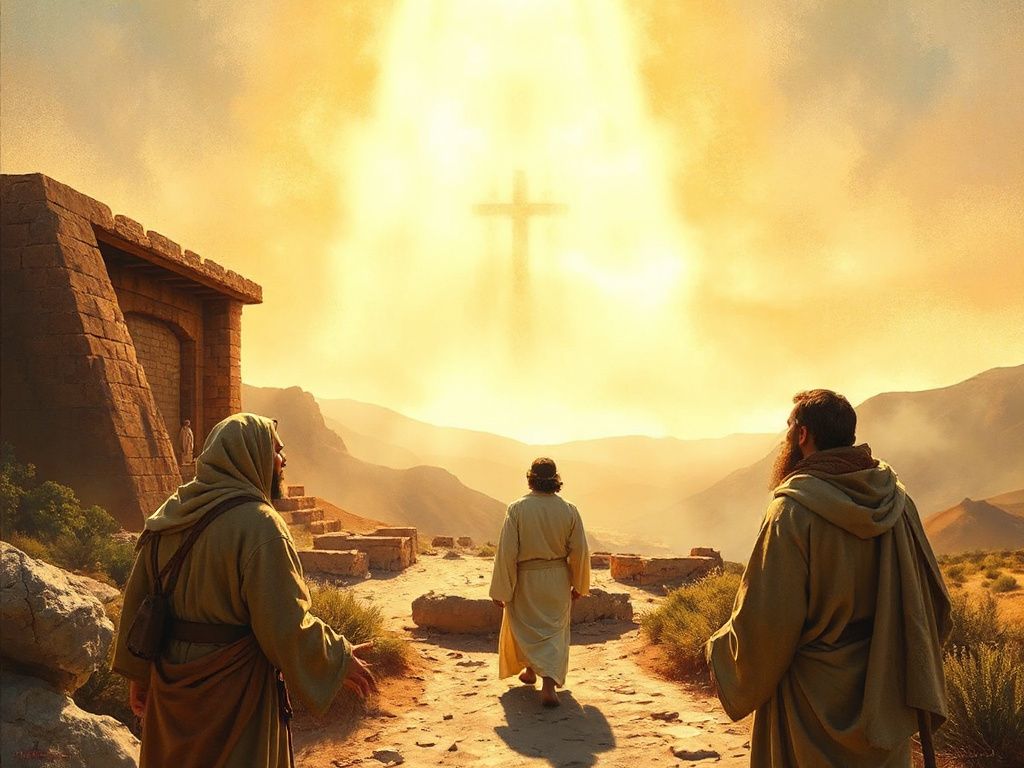
John 14:8 — Philip's Request to See the Father
Philip asks Jesus to show the disciples the Father, saying that this would be enough for them, prompting Jesus' reply that seeing Him is seeing the Father.
Scripture
8Philip saith unto him, Lord, show us the Father, and it sufficeth us.
What this passage means
John 14:8 records Philip's interruption of Jesus' discourse: "Lord, show us the Father, and it sufficeth us." The request echoes a long tradition of longing to see God, and Jesus' reply in the next verses makes clear that the request misunderstands what has already been given in His presence. The clause "and it sufficeth us" indicates that Philip treats a visible manifestation of the Father as the single need that would settle the disciples' uncertainty.
The request follows directly on Jesus' statement in 14:7 that those who have known Him have known the Father and have seen Him. Philip's words therefore function as a request for something more tangible than what Jesus has just affirmed is already available. Jesus responds by pointing to the union between Himself and the Father: "he that hath seen me hath seen the Father" (14:9) and the mutual indwelling described in 14:10-11.
At the level of the discourse, the verse sets up the central claim of John 14: the visible presence of the Son is itself the revelation of the Father. The request "show us the Father" is not ignored but reframed, so that what Philip asks for is answered by what he has already been given.
Context
Verses 5-7 frame the request: Thomas asks how the disciples can know the way (14:5), Jesus answers "I am the way, and the truth, and the life" (14:6), and states that knowing Him is knowing and seeing the Father (14:7). Philip's request in 14:8 stands inside this exchange as a concrete follow-up, even though it repeats what Jesus has just said. The chapter opens with the call not to let hearts be troubled and the promise of many dwelling places (14:1-3), and the rest of the chapter extends this comfort through the promise of another Comforter (14:16-17, 26) and the gift of peace (14:27).
Jesus' answer to Philip in 14:9-11 turns the request into a teaching about mutual indwelling and about works as evidence, then opens into 14:12-14 on the works believers will do and on asking in Jesus' name. In this flow, 14:8 is the hinge between the disciples' uncertainty and Jesus' exposition of His union with the Father.
Key words in the original
- G5376 Φίλιππος (Philip). The name identifies the speaker as the Philip called by Jesus earlier in John's Gospel, who in turn brought Nathanael to Jesus.
- G1166 δεῖξον (deixon), from δείκνυμι. The request form of the verb, meaning "show" — used here for a visible display of the Father.
- G0714 ἀρκεῖ (arkei), from ἀρκέω. The verb expresses that the single requested sight would be sufficient or enough for the disciples.
Related verses
- Exodus 33:18 Moses asks, "Show me, I pray thee, thy glory" — a parallel request to see God that John 14:8 echoes in the disciples' voice.
- John 1:43 Earlier in John, Jesus finds Philip and says, "Follow me" — background that identifies the same Philip now speaking in 14:8.
- John 16:25 Jesus speaks of an hour when He will tell the disciples plainly of the Father — a forward look that continues the teaching prompted by Philip's request.
Common questions
Why does Philip ask to see the Father in John 14:8?
The request follows Jesus' claim in 14:7 that knowing Him is knowing the Father. Philip treats a visible manifestation of the Father as the single thing that would settle the disciples' uncertainty, which is why he adds "and it sufficeth us."
How does Jesus answer Philip's request?
In 14:9-11 Jesus answers by pointing to His own person and works: "he that hath seen me hath seen the Father," and by describing the mutual indwelling of Father and Son. The request is reframed rather than granted as a separate vision.
What does "and it sufficeth us" mean in this verse?
The phrase expresses that a single sight of the Father would be enough for the disciples' needs, treating the requested revelation as the one thing that would resolve their uncertainty.