BIBLE BOOK GUIDE
Song of Solomon
8 chapters
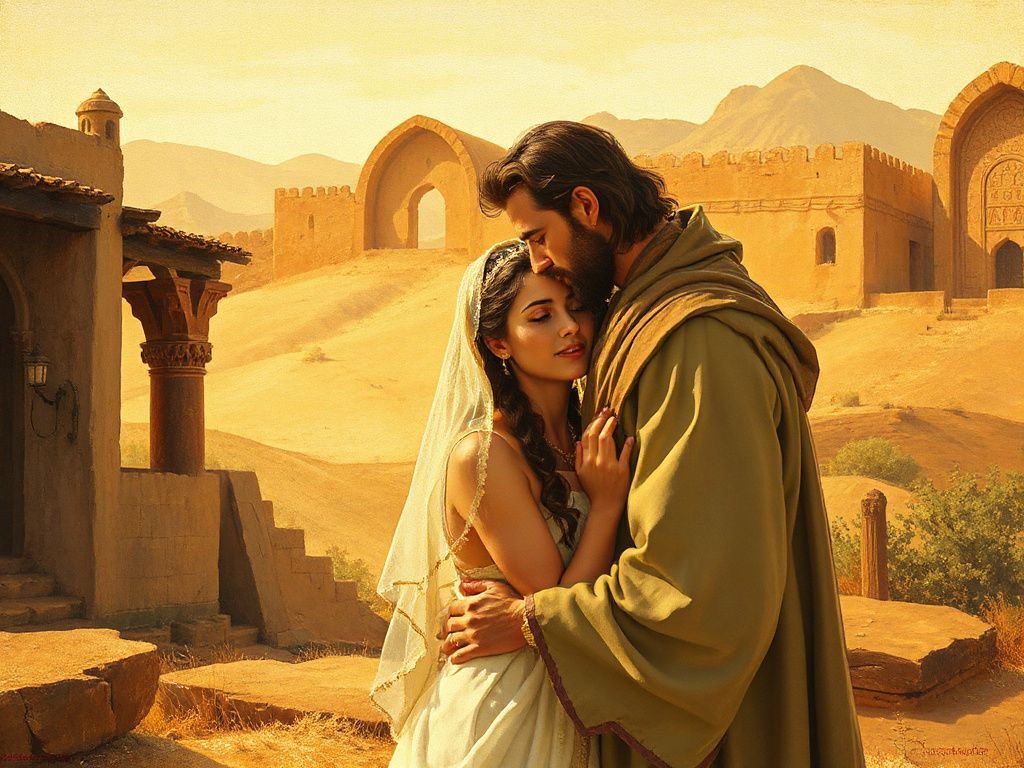
Song of Solomon celebrates the passionate, holy love between bridegroom and bride, revealing the beauty of God's covenant of marriage and foreshadowing Christ's love for His church.
Song of Solomon
Choose a chapter
Pick a chapter and it opens in the Current chapter tab. Come back here whenever you want to choose another one.
Why this book was written
Composed in the era of Solomon, Song of Solomon was preserved in the canon to affirm that marriage, instituted by God between one man and one woman, unites body, emotion, and spirit. It teaches that love is to be cherished as pure, faithful, and stronger than death, while pointing earthly love toward God's unwavering love for His people.
Structure
- 1Longing and First Meeting: Prologue to the Song of Songs
- 2–3Courtship and Seeking: Mutual Attraction of the Bride and Bridegroom
- 4–5Union and Separation: Married Joy and the Test of Absence
- 6Search and Praise: Reunion of the Beloved
- 7–8Maturity and Eternity: The Enduring Love
Major themes
The Fire of Love
The book repeatedly portrays the burning, intimate love between bride and groom, celebrating the beauty, joy, and exclusivity of marital love (Song 1:2-4; 8:6-7).
Longing and Seeking
The bride actively seeks her beloved, showing that love involves longing, pursuit, and patient waiting (Song 1:7; 3:1-4; 5:6-8).
The Dignity of the Body
The poetic descriptions of the body are reverent and beautiful, revealing that the body and intimacy are good gifts from God (Song 4:1-7; 7:1-9).
Covenant and Fidelity
Love is described as unyielding and beyond price, calling for faithfulness and steadfast commitment in marriage (Song 2:15-16; 8:7).
Spiritual Longing as Metaphor
In the Protestant tradition, the book is often read typologically as depicting the believer's intimate relationship with God and the soul's longing for the Lord (Song 2:4; 5:16; 8:5).
Seasons and Growth
Love passes through seasons of newness, separation, testing, and maturity, showing that intimacy requires time and cultivation (Song 2:11-13; 4:12-16; 6:10).
How it points to Christ
In Christian interpretation, the Song of Solomon is read as a picture of the intimate relationship between Christ and His Church. The Beloved represents Christ, and the bride represents the Church—called to follow Him in self-denial (Song 2:10; 5:2), seeking Him even in darkness (Song 3:1-4), and growing in deeper love through trials (Song 8:5-7). Christ's love for the Church is self-giving, protective, and unrestrained, as seen in His death on the cross. The book calls believers into a close, exclusive, and faithful relationship with the Lord, moving beyond mere duty into loving communion.
Key verses
- 2:16My beloved is mine, and I am his—the mutual belonging that echoes throughout the song as its central theme.
- 4:7You are altogether beautiful, my love; there is no flaw in you—the bridegroom's full acceptance foreshadows Christ's love for the church.
- 5:6I sought him but found him not—the loss of love warns believers to guard intimacy with the Lord.
- 6:3The covenant of belonging is reaffirmed after separation, renewing exclusive devotion.
- 8:6–7Set me as a seal upon your heart; many waters cannot quench love—the climax revealing love's death-strong, God-given nature.
- 8:7Love is a flame of Yah—a divine fire that no wealth can buy, declaring the sacred source of true love.
- 1:2Let him kiss me with the kisses of his mouth—the opening line sets the song's tone of longing.
Questions for reflection
- ·How can I, like the bride, actively pursue intimacy with the Lord rather than passively waiting?
- ·In the 'winter' or difficult seasons of my life (Song 2:11), do I still trust that the Lord is present and at work?
- ·Do I allow busyness and distractions to interrupt the loving moments with the Lord? What does the Beloved's plea 'Do not stir up nor awaken My love' mean for me?
- ·In my marriage or friendships, do I express love with respect, honor, and patience, rather than treating intimacy as a given?
- ·How does the declaration 'love is as strong as death' (Song 8:6) shape my understanding of love, sacrifice, and commitment?
Where Song of Solomon fits in the Bible's storyline
This book appears in the 12-stop storyline at:
Where to start reading the Bible? See the full 12-stop storyline
Want to read Song of Solomon start to finish? Open the reader for parallel Chinese/English text and ask anything as you go.
Start reading Song of SolomonSong of Solomon
Chapter 4
1Behold, thou art fair, my love; behold, thou art fair; Thine eyes are as doves behind thy veil. Thy hair is as a flock of goats, That lie along the side of mount Gilead.
2Thy teeth are like a flock of ewes that are newly shorn, Which are come up from the washing, Whereof every one hath twins, And none is bereaved among them.
3Thy lips are like a thread of scarlet, And thy mouth is comely. Thy temples are like a piece of a pomegranate behind thy veil.
4Thy neck is like the tower of David builded for an armory, Whereon there hang a thousand bucklers, All the shields of the mighty men.
5Thy two breasts are like two fawns That are twins of a roe, Which feed among the lilies.
6Until the day be cool, and the shadows flee away, I will get me to the mountain of myrrh, And to the hill of frankincense.
7Thou art all fair, my love; And there is no spot in thee.
8Come with me from Lebanon, my bride, With me from Lebanon: Look from the top of Amana, From the top of Senir and Hermon, From the lions' dens, From the mountains of the leopards.
9Thou hast ravished my heart, my sister, my bride; Thou hast ravished my heart with one of thine eyes, With one chain of thy neck.
10How fair is thy love, my sister, my bride! How much better is thy love than wine! And the fragrance of thine oils than all manner of spices!
11Thy lips, O my bride, drop as the honeycomb: Honey and milk are under thy tongue; And the smell of thy garments is like the smell of Lebanon.
12A garden shut up is my sister, my bride; A spring shut up, a fountain sealed.
13Thy shoots are an orchard of pomegranates, with precious fruits; Henna with spikenard plants,
14Spikenard and saffron, Calamus and cinnamon, with all trees of frankincense; Myrrh and aloes, with all the chief spices.
15Thou art a fountain of gardens, A well of living waters, And flowing streams from Lebanon.
16Awake, O north wind; And come, thou south; Blow upon my garden, that the spices thereof may flow out. Let my beloved come into his garden, And eat his precious fruits.