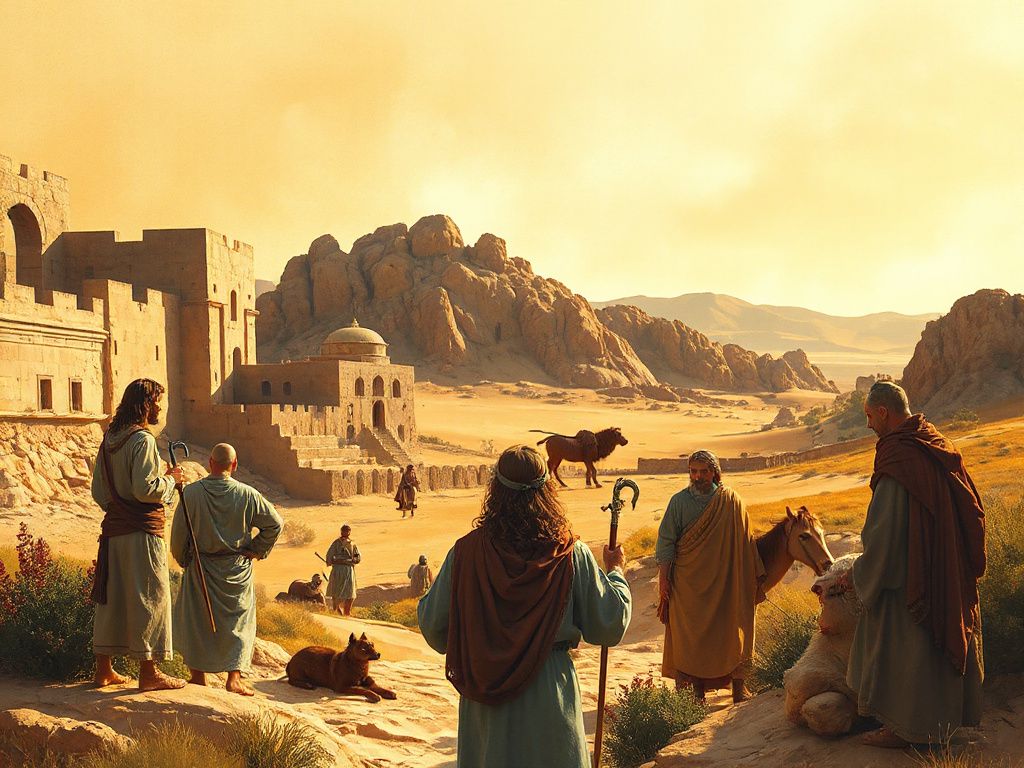
ESTUDIO DEL CAPÍTULO
Génesis 31 — La huida de Jacob de Labán
Jacob, impulsado por el Señor, reúne a sus esposas y rebaños y huye de Paddán-aram hacia Canaán; Labán lo persigue, pero es advertido por Dios en un sueño de no hacer daño a Jacob; tras buscar en vano sus dioses domésticos, ambos hacen un pacto en Galaad.
Escritura
- 1.Y oía Jacob las palabras de los hijos de Labán, que decían: Jacob ha tomado todo lo que era de nuestro padre, y de lo que era de nuestro padre ha adquirido toda esta riqueza.And he heard the words of Laban's sons, saying, Jacob hath taken away all that was our father's; and of that which was our father's hath he gotten all this glory.
- 2.Miraba también Jacob el semblante de Labán, y veía que no era para con él como había sido antes.And Jacob beheld the countenance of Laban, and, behold, it was not toward him as beforetime.
- 3.También Jehová dijo a Jacob: Vuélvete a la tierra de tus padres, y a tu parentela, y yo estaré contigo.And Jehovah said unto Jacob, Return unto the land of thy fathers, and to thy kindred; and I will be with thee.
- 4.Envió, pues, Jacob, y llamó a Raquel y a Lea al campo donde estaban sus ovejas,And Jacob sent and called Rachel and Leah to the field unto his flock,
- 5.y les dijo: Veo que el semblante de vuestro padre no es para conmigo como era antes; mas el Dios de mi padre ha estado conmigo.and said unto them, I see your father's countenance, that it is not toward me as beforetime; but the God of my father hath been with me.
- 6.Vosotras sabéis que con todas mis fuerzas he servido a vuestro padre;And ye know that with all my power I have served your father.
- 7.y vuestro padre me ha engañado, y me ha cambiado el salario diez veces; pero Dios no le ha permitido que me hiciese mal.And your father hath deceived me, and changed my wages ten times; but God suffered him not to hurt me.
- 8.Si él decía así: Los pintados serán tu salario, entonces todas las ovejas parían pintados; y si decía así: Los listados serán tu salario; entonces todas las ovejas parían listados.If he said thus, The speckled shall be thy wages; then all the flock bare speckled: and if he said thus, The ringstreaked shall be thy wages; then bare all the flock ringstreaked.
- 9.Así quitó Dios el ganado de vuestro padre, y me lo dio a mí.Thus God hath taken away the cattle of your father, and given them to me.
- 10.Y sucedió que al tiempo que las ovejas estaban en celo, alcé yo mis ojos y vi en sueños, y he aquí los machos que cubrían a las hembras eran listados, pintados y abigarrados.And it came to pass at the time that the flock conceive, that I lifted up mine eyes, and saw in a dream, and, behold, the he-goats which leaped upon the flock were ringstreaked, speckled, and grizzled.
- 11.Y me dijo el ángel de Dios en sueños: Jacob. Y yo dije: Heme aquí.And the angel of God said unto me in the dream, Jacob: and I said, Here am I.
- 12.Y él dijo: Alza ahora tus ojos, y verás que todos los machos que cubren a las hembras son listados, pintados y abigarrados; porque yo he visto todo lo que Labán te ha hecho.And he said, Lift up now thine eyes, and see: all the he-goats which leap upon the flock are ringstreaked, speckled, and grizzled: for I have seen all that Laban doeth unto thee.
- 13.Yo soy el Dios de Bet-el, donde tú ungiste la piedra, y donde me hiciste un voto. Levántate ahora y sal de esta tierra, y vuélvete a la tierra de tu nacimiento.I am the God of Beth-el, where thou anointedst a pillar, where thou vowedst a vow unto me: now arise, get thee out from this land, and return unto the land of thy nativity.
- 14.Respondieron Raquel y Lea, y le dijeron: ¿Tenemos acaso parte o heredad en la casa de nuestro padre?And Rachel and Leah answered and said unto him, Is there yet any portion or inheritance for us in our father's house?
- 15.¿No nos tiene ya como por extrañas, pues que nos vendió, y aun se ha comido del todo nuestro precio?Are we not accounted by him as foreigners? for he hath sold us, and hath also quite devoured our money.
- 16.Porque toda la riqueza que Dios ha quitado a nuestro padre, nuestra es y de nuestros hijos; ahora, pues, haz todo lo que Dios te ha dicho.For all the riches which God hath taken away from our father, that is ours and our children's: now then, whatsoever God hath said unto thee, do.
- 17.Entonces se levantó Jacob, y subió sus hijos y sus mujeres sobre los camellos,Then Jacob rose up, and set his sons and his wives upon the camels;
- 18.y puso en camino todo su ganado, y todo cuanto había adquirido, el ganado de su ganancia que había obtenido en Padan-aram, para volverse a Isaac su padre en la tierra de Canaán.and he carried away all his cattle, and all his substance which he had gathered, the cattle of his getting, which he had gathered in Paddan-aram, to go to Isaac his father unto the land of Canaan.
- 19.Pero Labán había ido a trasquilar sus ovejas; y Raquel hurtó los ídolos de su padre.Now Laban was gone to shear his sheep: and Rachel stole the teraphim that were her father's.
- 20.Y Jacob engañó a Labán arameo, no haciéndole saber que se iba.And Jacob stole away unawares to Laban the Syrian, in that he told him not that he fled.
- 21.Huyó, pues, con todo lo que tenía; y se levantó y pasó el Eufrates, y se dirigió al monte de Galaad.So he fled with all that he had; and he rose up, and passed over the River, and set his face toward the mountain of Gilead.
- 22.Y al tercer día fue dicho a Labán que Jacob había huido.And it was told Laban on the third day that Jacob was fled.
- 23.Entonces Labán tomó a sus parientes consigo, y fue tras Jacob camino de siete días, y le alcanzó en el monte de Galaad.And he took his brethren with him, and pursued after him seven days' journey; and he overtook him in the mountain of Gilead.
- 24.Y vino Dios a Labán arameo en sueños aquella noche, y le dijo: Guárdate que no hables a Jacob descomedidamente.And God came to Laban the Syrian in a dream of the night, and said unto him, Take heed to thyself that thou speak not to Jacob either good or bad.
- 25.Alcanzó, pues, Labán a Jacob; y éste había fijado su tienda en el monte; y Labán acampó con sus parientes en el monte de Galaad.And Laban came up with Jacob. Now Jacob had pitched his tent in the mountain: and Laban with his brethren encamped in the mountain of Gilead.
- 26.Y dijo Labán a Jacob: ¿Qué has hecho, que me engañaste, y has traído a mis hijas como prisioneras de guerra?And Laban said to Jacob, What hast thou done, that thou hast stolen away unawares to me, and carried away my daughters as captives of the sword?
- 27.¿Por qué te escondiste para huir, y me engañaste, y no me lo hiciste saber para que yo te despidiera con alegría y con cantares, con tamborín y arpa?Wherefore didst thou flee secretly, and steal away from me, and didst not tell me, that I might have sent thee away with mirth and with songs, with tabret and with harp;
- 28.Pues ni aun me dajaste besar a mis hijos y mis hijas. Ahora, locamente has hecho.and didst not suffer me to kiss my sons and my daughters? now hast thou done foolishly.
- 29.Poder hay en mi mano para haceros mal; mas el Dios de tu padre me habló anoche diciendo: Guárdate que no hables a Jacob descomedidamente.It is in the power of my hand to do you hurt: but the God of your father spake unto me yesternight, saying, Take heed to thyself that thou speak not to Jacob either good or bad.
- 30.Y ya que te ibas, porque tenías deseo de la casa de tu padre, ¿por qué me hurtaste mis dioses?And now, though thou wouldest needs be gone, because thou sore longedst after thy father's house, yet wherefore hast thou stolen my gods?
- 31.Respondió Jacob y dijo a Labán: Porque tuve miedo; pues pensé que quizá me quitarías por fuerza tus hijas.And Jacob answered and said to Laban, Because I was afraid: for I said, Lest thou shouldest take thy daughters from me by force.
- 32.Aquel en cuyo poder hallares tus dioses, no viva; delante de nuestros hermanos reconoce lo que yo tenga tuyo, y llévatelo. Jacob no sabía que Raquel los había hurtado.With whomsoever thou findest thy gods, he shall not live: before our brethren discern thou what is thine with me, and take it to thee. For Jacob knew not that Rachel had stolen them.
- 33.Entró Labán en la tienda de Jacob, en la tienda de Lea, y en la tienda de las dos siervas, y no los halló; y salió de la tienda de Lea, y entró en la tienda de Raquel.And Laban went into Jacob's tent, and into Leah's tent, and into the tent of the two maid-servants; but he found them not. And he went out of Leah's tent, and entered into Rachel's tent.
- 34.Pero tomó Raquel los ídolos y los puso en una albarda de un camello, y se sentó sobre ellos; y buscó Labán en toda la tienda, y no los halló.Now Rachel had taken the teraphim, and put them in the camel's saddle, and sat upon them. And Laban felt about all the tent, but found them not.
- 35.Y ella dijo a su padre: No se enoje mi señor, porque no me puedo levantar delante de ti; pues estoy con la costumbre de las mujeres. Y él buscó, pero no halló los ídolos.And she said to her father, Let not my lord be angry that I cannot rise up before thee; for the manner of women is upon me. And he searched, but found not the teraphim.
- 36.Entonces Jacob se enojó, y riñó con Labán; y respondió Jacob y dijo a Labán: ¿Qué transgresión es la mía? ¿Cuál es mi pecado, para que con tanto ardor hayas venido en mi persecución?And Jacob was wroth, and chode with Laban: and Jacob answered and said to Laban, What is my trespass? what is my sin, that thou hast hotly pursued after me?
- 37.Pues que has buscado en todas mis cosas, ¿qué has hallado de todos los enseres de tu casa? Ponlo aquí delante de mis hermanos y de los tuyos, y juzguen entre nosotros.Whereas thou hast felt about all my stuff, what hast thou found of all thy household stuff? Set it here before my brethren and thy brethren, that they may judge betwixt us two.
- 38.Estos veinte años he estado contigo; tus ovejas y tus cabras nunca abortaron, ni yo comí carnero de tus ovejas.These twenty years have I been with thee; thy ewes and thy she-goats have not cast their young, and the rams of thy flocks have I not eaten.
- 39.Nunca te traje lo arrebatado por las fieras: yo pagaba el daño; lo hurtado así de día como de noche, a mí me lo cobrabas.That which was torn of beasts I brought not unto thee; I bare the loss of it; of my hand didst thou require it, whether stolen by day or stolen by night.
- 40.De día me consumía el calor, y de noche la helada, y el sueño huía de mis ojos.Thus I was; in the day the drought consumed me, and the frost by night; and my sleep fled from mine eyes.
- 41.Así he estado veinte años en tu casa; catorce años te serví por tus dos hijas, y seis años por tu ganado, y has cambiado mi salario diez veces.These twenty years have I been in thy house; I served thee fourteen years for thy two daughters, and six years for thy flock: and thou hast changed my wages ten times.
- 42.Si el Dios de mi padre, Dios de Abraham y temor de Isaac, no estuviera conmigo, de cierto me enviarías ahora con las manos vacías; pero Dios vio mi aflicción y el trabajo de mis manos, y te reprendió anoche.Except the God of my father, the God of Abraham, and the Fear of Isaac, had been with me, surely now hadst thou sent me away empty. God hath seen mine affliction and the labor of my hands, and rebuked thee yesternight.
- 43.Respondió Labán y dijo a Jacob: Las hijas son hijas mías, y los hijos, hijos míos son, y las ovejas son mis ovejas, y todo lo que tú ves es mío: ¿y qué puedo yo hacer hoy a estas mis hijas, o a sus hijos que ellas han dado a luz?And Laban answered and said unto Jacob, The daughters are my daughters, and the children are my children, and the flocks are my flocks, and all that thou seest is mine: and what can I do this day unto these my daughters, or unto their children whom they have borne?
- 44.Ven, pues, ahora, y hagamos pacto tú y yo, y sea por testimonio entre nosotros dos.And now come, let us make a covenant, I and thou; and let it be for a witness between me and thee.
- 45.Entonces Jacob tomó una piedra, y la levantó por señal.And Jacob took a stone, and set it up for a pillar.
- 46.Y dijo Jacob a sus hermanos: Recoged piedras. Y tomaron piedras e hicieron un majano, y comieron allí sobre aquel majano.And Jacob said unto his brethren, Gather stones; and they took stones, and made a heap: and they did eat there by the heap.
- 47.Y lo llamó Labán, Jegar Sahaduta; y lo llamó Jacob, Galaad.And Laban called it Jegar-saha-dutha: but Jacob called it Galeed.
- 48.Porque Labán dijo: Este majano es testigo hoy entre nosotros dos; por eso fue llamado su nombre Galaad;And Laban said, This heap is witness between me and thee this day. Therefore was the name of it called Galeed:
- 49.y Mizpa, por cuanto dijo: Atalaye Jehová entre tú y yo, cuando nos apartemos el uno del otro.and Mizpah, for he said, Jehovah watch between me and thee, when we are absent one from another.
- 50.Si afligieres a mis hijas, o si tomares otras mujeres además de mis hijas, nadie está con nosotros; mira, Dios es testigo entre nosotros dos.If thou shalt afflict my daughters, and if thou shalt take wives besides my daughters, no man is with us; see, God is witness betwixt me and thee.
- 51.Dijo más Labán a Jacob: He aquí este majano, y he aquí esta señal, que he erigido entre tú y yo.And Laban said to Jacob, Behold this heap, and behold the pillar, which I have set betwixt me and thee.
- 52.Testigo sea este majano, y testigo sea esta señal, que ni yo pasaré de este majano contra ti, ni tú pasarás de este majano ni de esta señal contra mí, para mal.This heap be witness, and the pillar be witness, that I will not pass over this heap to thee, and that thou shalt not pass over this heap and this pillar unto me, for harm.
- 53.El Dios de Abraham y el Dios de Nacor juzgue entre nosotros, el Dios de sus padres. Y Jacob juró por aquel a quien temía Isaac su padre.The God of Abraham, and the God of Nahor, the God of their father, judge betwixt us. And Jacob sware by the Fear of his father Isaac.
- 54.Entonces Jacob inmoló víctimas en el monte, y llamó a sus hermanos a comer pan; y comieron pan, y durmieron aquella noche en el monte.And Jacob offered a sacrifice in the mountain, and called his brethren to eat bread: and they did eat bread, and tarried all night in the mountain.
- 55.Y se levantó Labán de mañana, y besó sus hijos y sus hijas, y los bendijo; y regresó y se volvió a su lugar.And early in the morning Laban rose up, and kissed his sons and his daughters, and blessed them: and Laban departed, and returned unto his place.
Qué significa este pasaje
Jacob actúa por mandato directo del Señor de regresar a la tierra de sus padres (v. 3), y el capítulo presenta su partida como obediencia y no como robo: dice a Raquel y Lea que 'el Dios de mi padre ha estado conmigo' (v. 5) y relata cómo el Señor anuló los reiterados cambios de salario de Labán (vv. 7-9).
La persecución de Labán no se detiene por la estratagema de Jacob, sino por una advertencia divina nocturna: 'Guárdate de no hablar a Jacob ni bien ni mal' (v. 24). Esta misma expresión se repite en boca de Labán en el v. 29, mostrando que Labán reconoce la restricción divina sobre la disputa.
La resolución es un pacto señalado por una columna de piedra, un montón y nombres compartidos — Galaad y Mizpa (vv. 45-49). El capítulo cierra con Labán besando y bendiciendo a sus nietos y partiendo, dejando la relación disputada formalmente resuelta y atestiguada por 'el Temor de Isaac' (v. 53).
Contexto
El capítulo se sitúa dentro del ciclo de Jacob (Génesis 25-36), inmediatamente después de la negociación de salarios en Génesis 30 y del nacimiento de los hijos de Jacob con Lea, Raquel, Bilha y Zilpa. No se ha utilizado ningún material de fondo más allá del propio capítulo y las referencias cruzadas proporcionadas.
Las referencias cruzadas proporcionadas (Génesis 28:15, 30:29, y paralelos en 1 Samuel 19:13 sobre los terafines) provienen de dentro de Génesis y de otras partes del Antiguo Testamento, confirmando los temas del acompañamiento divino y los ídolos domésticos que reaparecen en las narrativas patriarcales.
Palabras clave del original
- H3947 Lema hebreo laqach, 'tomar', usado en el v. 1 donde los hijos de Labán afirman que Jacob 'ha tomado todo lo que era de nuestro padre'. El mismo verbo reaparece para la partida de Jacob y para la toma de los terafines por Raquel, dando al capítulo un eco deliberado entre acusaciones y acciones.
- H3519 Hebreo kabod, traducido como 'gloria' en el v. 1 (KJV) y como 'riqueza' en la glosa proporcionada. El versículo vincula así la acusación familiar con el esplendor material: los rebaños de Jacob son presentados como honor/riqueza robados.
- H6440 Hebreo paneh, 'rostro'. Jacob 'contempló el rostro de Labán' (v. 2) y el mismo sustantivo se usa para el rostro de Labán en el v. 5. Esta familia de palabras subyace a la advertencia del v. 24 ('hablar... bien o mal') y a la invocación de Mizpa (v. 49), vinculando el escrutinio divino con las expresiones humanas.
Versículos relacionados
- Genesis 28:15 Recuerda la promesa del Señor a Jacob en Bet-el. El 'Yo estaré contigo' de 28:15 se repite en 31:3, enmarcando la partida como el cumplimiento del voto anterior junto a la columna.
- Genesis 31:29 Reformulación por Labán de la advertencia divina que recibió en el v. 24. La repetición subraya que Labán reconoce a Dios como la verdadera parte que restringe el conflicto.
- Genesis 31:53 Identifica al dios del juramento como 'el Dios de Abraham, y el Dios de Naor... y el Temor de Isaac'. Estos títulos para la divinidad enmarcan el pacto y lo conectan con la herencia patriarcal compartida por ambas familias.
Preguntas frecuentes
¿Por qué Jacob se va secretamente en lugar de decírselo a Labán?
Según el propio capítulo, Jacob dice a Raquel y Lea que temía que Labán le quitara a sus hijas por la fuerza (v. 31). El cambio de semblante de Labán (vv. 2, 5) y la acusación de los hijos (v. 1) proporcionan el contexto de ese temor.
¿Qué son los terafines que tomó Raquel?
El capítulo solo los llama 'dioses' de Labán (v. 30) y 'terafines' (vv. 19, 34-35). El texto mismo no describe su forma, número ni función; cualquier identificación adicional proviene de fuera del material proporcionado y no se utiliza aquí.
¿Qué significa el nombre Mizpa en este pacto?
Labán explica el nombre en el v. 49: 'Jehová vigile entre tú y yo, cuando estemos ausentes el uno del otro'. La columna y el montón (Galaad) sirven como testigo físico, mientras que Mizpa invoca al Señor como testigo permanente.