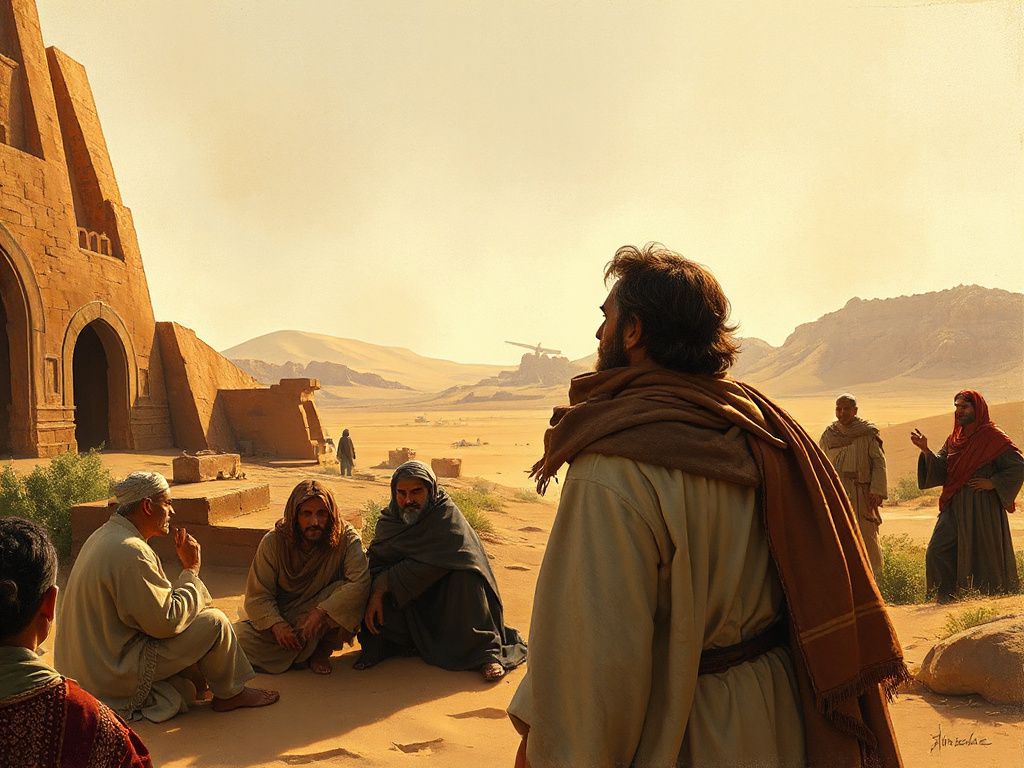
ESTUDIO DEL CAPÍTULO
Job 2 — El segundo asalto de Satanás y la integridad firme de Job
Después de un segundo concilio celestial en el que Dios nuevamente elogia la integridad de Job, se le permite a Satanás afligir la carne de Job con llagas dolorosas; Job responde con integridad y en silencio, mientras su esposa maldice y tres amigos llegan para guardar luto en silencio durante siete días.
Escritura
- 1.Aconteció que otro día vinieron los hijos de Dios para presentarse delante de Jehová, y Satanás vino también entre ellos presentándose delante de Jehová.Again it came to pass on the day when the sons of God came to present themselves before Jehovah, that Satan came also among them to present himself before Jehovah.
- 2.Y dijo Jehová a Satanás: ¿De dónde vienes? Respondió Satanás a Jehová, y dijo: De rodear la tierra, y de andar por ella.And Jehovah said unto Satan, From whence comest thou? And Satan answered Jehovah, and said, From going to and fro in the earth, and from walking up and down in it.
- 3.Y Jehová dijo a Satanás: ¿No has considerado a mi siervo Job, que no hay otro como él en la tierra, varón perfecto y recto, temeroso de Dios y apartado del mal, y que todavía retiene su integridad, aun cuando tú me incitaste contra él para que lo arruinara sin causa?And Jehovah said unto Satan, Hast thou considered my servant Job? for there is none like him in the earth, a perfect and an upright man, one that feareth God, and turneth away from evil: and he still holdeth fast his integrity, although thou movedst me against him, to destroy him without cause.
- 4.Respondiendo Satanás, dijo a Jehová: Piel por piel, todo lo que el hombre tiene dará por su vida.And Satan answered Jehovah, and said, Skin for skin, yea, all that a man hath will he give for his life.
- 5.Pero extiende ahora tu mano, y toca su hueso y su carne, y verás si no blasfema contra ti en tu misma presencia.But put forth thy hand now, and touch his bone and his flesh, and he will renounce thee to thy face.
- 6.Y Jehová dijo a Satanás: He aquí, él está en tu mano; mas guarda su vida.And Jehovah said unto Satan, Behold, he is in thy hand; only spare his life.
- 7.Entonces salió Satanás de la presencia de Jehová, e hirió a Job con una sarna maligna desde la planta del pie hasta la coronilla de la cabeza.So Satan went forth from the presence of Jehovah, and smote Job with sore boils from the sole of his foot unto his crown.
- 8.Y tomaba Job un tiesto para rascarse con él, y estaba sentado en medio de ceniza.And he took him a potsherd to scrape himself therewith; and he sat among the ashes.
- 9.Entonces le dijo su mujer: ¿Aún retienes tu integridad? Maldice a Dios, y muérete.Then said his wife unto him, Dost thou still hold fast thine integrity? renounce God, and die.
- 10.Y él le dijo: Como suele hablar cualquiera de las mujeres fatuas, has hablado. ¿Qué? ¿Recibiremos de Dios el bien, y el mal no lo recibiremos? En todo esto no pecó Job con sus labios.But he said unto her, Thou speakest as one of the foolish women speaketh. What? shall we receive good at the hand of God, and shall we not receive evil? In all this did not Job sin with his lips.
- 11.Y tres amigos de Job, Elifaz temanita, Bildad suhita, y Zofar naamatita, luego que oyeron todo este mal que le había sobrevenido, vinieron cada uno de su lugar; porque habían convenido en venir juntos para condolerse de él y para consolarle.Now when Job's three friends heard of all this evil that was come upon him, they came every one from his own place: Eliphaz the Temanite, and Bildad the Shuhite, and Zophar the Naamathite, and they made an appointment together to come to bemoan him and to comfort him.
- 12.Los cuales, alzando los ojos desde lejos, no lo conocieron, y lloraron a gritos; y cada uno de ellos rasgó su manto, y los tres esparcieron polvo sobre sus cabezas hacia el cielo.And when they lifted up their eyes afar off, and knew him not, they lifted up their voice, and wept; and they rent every one his robe, and sprinkled dust upon their heads toward heaven.
- 13.Así se sentaron con él en tierra por siete días y siete noches, y ninguno le hablaba palabra, porque veían que su dolor era muy grande.So they sat down with him upon the ground seven days and seven nights, and none spake a word unto him: for they saw that his grief was very great.
Qué significa este pasaje
Job 2 refleja la estructura de Job 1: una asamblea celestial, una commendación divina de Job, una provocación de Satanás y un asalto permitido. La repetición hace que el argumento central sea inequívoco: la justicia de Job no se sostiene por sus posesiones ni por su comodidad, porque Dios mismo responde por él una segunda vez, y el propio Satanás reconoce que lo que aún no ha sido probado es el propio cuerpo del que sufre (versículos 3-5). El límite permitido —«solo spare su vida» (versículo 6)— muestra que la aflicción opera dentro de un límite fijado por Dios, no por el adversario.
El capítulo luego se traslada a la tierra. Job se rasca sus llagas con un tejarro en medio de la ceniza (versículo 8), una imagen de completa humillación social: ya no está sentado entre los ancianos, sino entre la basura. Las palabras de su esposa, «renuncia a Dios y muere» (versículo 9), hacen eco de la lógica de la serpiente en el huerto y anticipan la acusación que los amigos de Job presentarán. La respuesta de Job es el corazón teológico del capítulo: recibir el bien de la mano de Dios sin recibir también el mal nos haría «necios» (versículo 10). El narrador enfatiza dos veces que en todo esto Job no pecó con sus labios.
Finalmente, la llegada de Elifaz, Bildad y Zofar, y su silencio de siete días (versículos 11-13), abre el largo diálogo poético que llena el resto del libro. Los amigos aún no hablan, pero su llegada prepara la prueba de si el consejo humano, incluso de parte de quienes lo aman, se convertirá en una segunda fuente de presión sobre el que sufre. El capítulo termina en silencio, dejando al lector a la espera de las voces que intentarán explicar lo que ha sucedido.
Contexto
La nota del capítulo suministrada para Job lo describe como un capítulo de relleno fuera del conjunto prioritario P0/P1; no se proporciona más trasfondo literario o histórico en el material proporcionado. Se sitúa al lector dentro del marco en prosa que se abrió en el capítulo 1: los «hijos de Dios» que se presentan ante Jehová, el título recurrente «Satanás», y la fórmula «de ir y venir por la tierra», todo repetido aquí. Teológicamente, el capítulo se apoya en el capítulo 1 donde Job perdió a sus hijos y posesiones y, sin embargo, «no pecó» (cf. Job 1:22), y mira hacia adelante a los diálogos de los capítulos 3-31 en los que los amigos interpretarán el sufrimiento de Job.
Dentro del mismo Job 2, el texto proporciona su propio contexto: el diálogo entre Dios y Satanás (versículos 1-6) aporta la perspectiva divina sobre el sufrimiento, mientras que los versículos 7-13 dan la imagen visible, a escala humana, de ese sufrimiento: el cuerpo de Job, su matrimonio y su comunidad. El silencio de siete días al final forma el puente de la prosa a la poesía.
Palabras clave del original
- H7854 El término hebreo śāṭān, suministrado aquí con el artículo (haśśāṭān), denota un oponente o adversario y en este contexto en prosa funciona como título propio para la figura que desafía a Job. El capítulo lo usa repetidamente mientras Satanás está entre los hijos de Dios, es interrogado por Jehová y recibe permiso para actuar, presentándolo como un miembro del concilio divino cuya autoridad está delimitada por la palabra de Dios.
- H0430 ʾĕlōhîm es la palabra hebrea genérica para Dios, usada aquí junto al nombre del pacto Jehová (H3068) en el versículo 1, donde los hijos de Dios (bənê ʾĕlōhîm) se presentan. La combinación distingue el escenario del concilio y el Dios supremo que preside sobre él, una distinción que el capítulo mantiene a lo largo de todo el texto.
- H3068 El nombre del pacto Jehová (yəhwāh) señala al Dios que interroga a Satanás, elogia a Job y limita la aflicción («solo spare su vida»). La aparición repetida de este nombre —más que de ʾĕlōhîm— en el papel de hablante enfatiza que el que preside en el concilio es el mismo Señor del pacto que está siendo públicamente vindicado por medio de la resistencia de Job.
Versículos relacionados
- Job 1:21 Job 1:21 registra la confesión anterior de Job de que Jehová dio y Jehová quitó; Job 2:10 hace eco de esa postura generalizándola: tanto el bien como el mal vienen de la mano de Dios, haciendo de los dos versículos un par emparejado que enmarca la teología del libro sobre el recibir.
- James 5:11 Santiago 5:11 presenta a Job como ejemplo de paciencia cuyo «fin» el Señor lleva a cabo, y remite a los lectores a la representación que hace Job 2 de un sufriente que, en lo profundo de sus llagas y su dolor, «no pecó con sus labios». El texto del Nuevo Testamento usa Job 2 como el caso paradigmático de la resistencia bajo prueba.
- Lamentations 3:38 Lamentaciones 3:38 pregunta si el mal y el bien no provienen ambos de la boca del Altísimo. Job 2:10 responde esa pregunta de manera afirmativa antes de que Lamentaciones la formule: las palabras de Job a su esposa se cuentan entre las primeras afirmaciones canónicas de que la aflicción y la bendición comparten una misma fuente divina, aun cuando esa fuente esté oculta a la vista.
Preguntas frecuentes
¿Por qué la escena celestial en Job 2 repite tanto de Job 1?
La repetición es el argumento del capítulo: Dios mismo elogia a Job una segunda vez como «perfecto y recto», y Satanás reconoce de nuevo que lo que aún no ha sido probado es el propio Job. Al ofrecer dos veces el mismo escenario, el texto insiste en que la próxima ronda de aflicción no es una corrección divina, sino una vindicación adicional del mismo hombre intachable.
¿Qué significa «solo spare su vida» en el versículo 6?
La frase establece un límite fijo sobre lo que se le permite hacer a Satanás. El cuerpo de Job, sus posesiones y su posición social pueden ser atacados, pero su vida —el punto en que la aflicción se convertiría en destrucción permanente— queda excluida. La línea muestra que incluso el mal permitido en el libro opera dentro de los límites que Dios define.
¿Por qué Job llama «necia» la advertencia de su esposa?
En el versículo, Job enmarca la aceptación selectiva de los dones de Dios como el patrón de habla de «una de las mujeres necias», es decir, aceptar el bien de la mano de Dios mientras se rechaza el mal asume que Dios nos debe consuelo y que no es soberano sobre el sufrimiento. Por el contrario, Job trata el bien y el mal como recibidos de la misma mano, y el narrador confirma que al decir esto no pecó con sus labios.