Related Books
Filter by Era
1samuel 17
1samuel · Ch.17
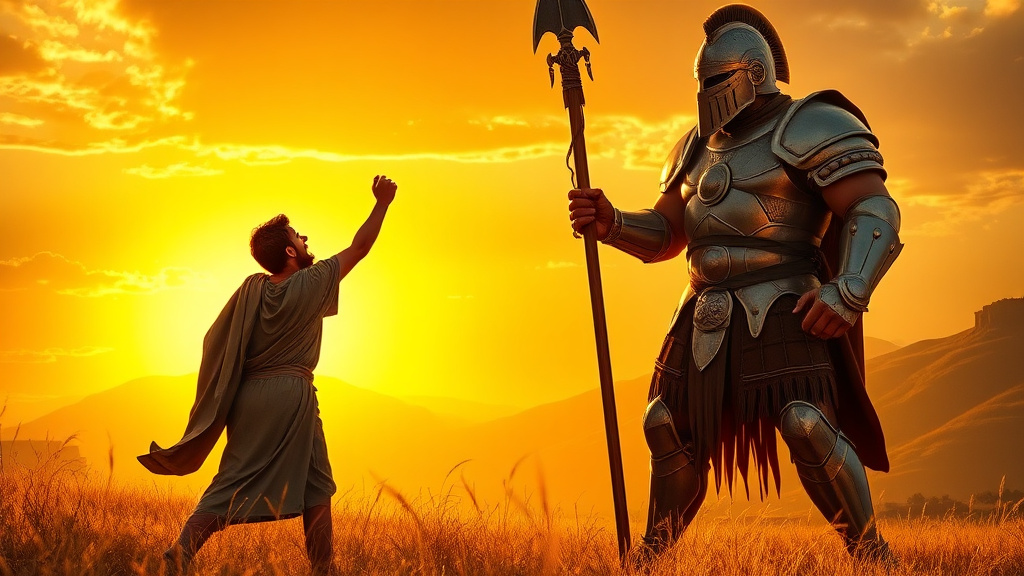
David vs Goliath: A Battle of Faith
1 Samuel 7:2
judaism「A long time elapsed from the day that the Ark was housed in Kiriath-jearim, twenty years in all; and all the House of Israel yearned after GOD.」
Why was David unafraid when he faced Goliath?
From shepherd boy to battlefield champion—where did David's confidence come from?
1samuel 17
1samuel · Ch.17
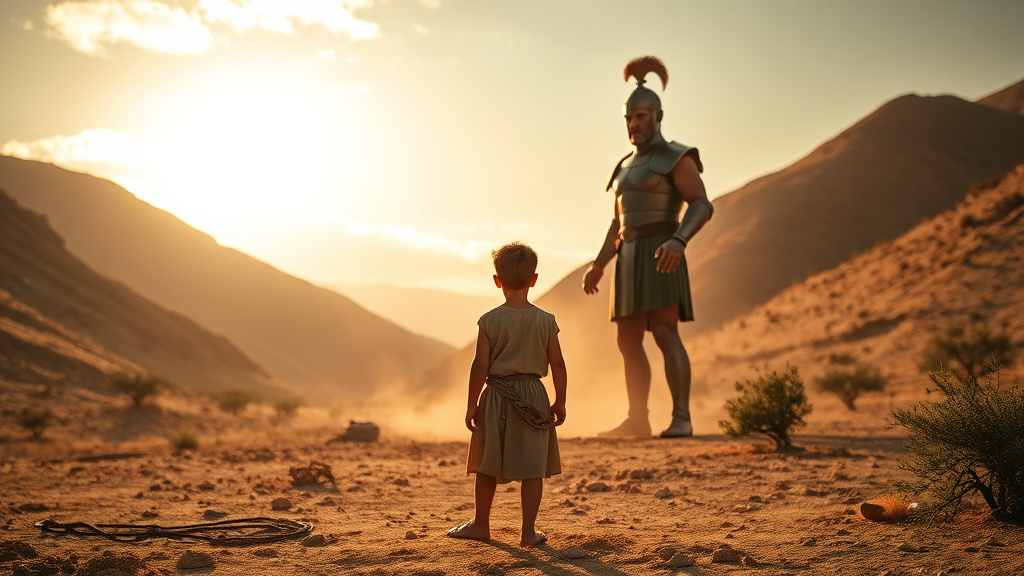
Stone Against the Champion
1 Samuel 25:14
protestant「But one of the young men told Abigail, Nabal's wife, saying, Behold, David sent messengers out of the wilderness to salute our master; and he railed at them.」
How does 1 Samuel 17:4 describe Goliath's physical dimensions (six cubits and a span), and why do ancient textual traditions (MT, LXX, the Dead Sea Scrolls' 4QSamuela) report different numbers? What does this variance tell us about the transmission of the David and Goliath story?
Was Goliath really over nine feet tall—or not? Compare the manuscripts and trace how the story of David and Goliath is preserved and adapted.
1 Samuel 31:12
judaism「the stalwarts among them set out and marched all night; they removed the bodies of Saul and his sons from the wall of Beth-shan and came to Jabesh and burned them there.」
Where did David's faith originate when he declared he came in the name of the Lord of Hosts?
How did a teenager possess greater spiritual conviction than seasoned soldiers?
1 Samuel 20:5
judaism「David said to Jonathan, “Tomorrow is the new moon, and I am to sit with the king at the meal. Instead, let me go and I will hide in the countryside until the third evening.」
Goliath's challenge continued for forty days — does this number carry symbolic weight in the Hebrew tradition?
Forty days in Hebrew scripture often signals a turning point.
1 Samuel 26:11
judaism「But GOD forbid that I should lay a hand on GOD’s anointed! Just take the spear and the water jar at his head and let’s be off.”」
In 1 Samuel 17:45-47, David declares to Goliath, 'You come against me with sword and spear... but I come against you in the name of the LORD Almighty.' How does David's theological framing of the battle shape our understanding of spiritual warfare?
How David's words frame the nature of true conflict.
1 Samuel 9:2
judaism「He had a son whose name was Saul, an excellent young man; no one among the Israelites was handsomer than he; he was a head taller than any of the people.」
How do David's words before facing Goliath demonstrate his trust in God?
"I come against you in the name of the Lord of hosts"—how deep is the spiritual meaning of this declaration?
1 Samuel 8:7
protestant「And Jehovah said unto Samuel, Hearken unto the voice of the people in all that they say unto thee; for they have not rejected thee, but they have rejected me, that I should not be king over them.」
Why did no one in Israel's army dare to face Goliath for forty days?
Fear gripped the whole army, yet opened a door of victory for a youth.
1 Samuel 16:6
judaism「When they arrived and he saw Eliab, he thought: “Surely GOD’s anointed stands here.”」
David famously declared he would fight Goliath in the name of the Lord of Armies. How does his statement in verse 37 shape the way we understand the outcome of the battle?
Consider how faith, not military strategy, defines David's confidence before the Philistine.
1 Samuel 24:12
protestant「Jehovah judge between me and thee, and Jehovah avenge me of thee; but my hand shall not be upon thee.」
When David declares he comes 'in the name of the LORD of hosts,' how does this declaration embody the principle of faith alone in the battle?
Victory belongs not to the mighty, but to the One who commands the armies of heaven.
1 Samuel 8:20
judaism「that we may be like all the other nations: Let our king rule over us and go out at our head and fight our battles.”」
What was the source of David's confidence when confronting Goliath?
From shepherd to warrior, David's courage was rooted in his firsthand experience of God.
1 Samuel 29:1
judaism「The Philistines mustered all their forces at Aphek, while Israel was encamping at the spring in Jezreel.」
Why had Israel's army hesitated before Goliath for forty days, and what was the source of David's courage?
Faith versus fear in the camp of Israel.
1 Samuel 14:13
judaism「And Jonathan clambered up on his hands and feet, his arms-bearer behind him; [the Philistines] fell before Jonathan, and his arms-bearer finished them off behind him.」
Why does David repeatedly invoke the name of YHWH when confronting Goliath, and what theological point is being made?
The true opponent is not the giant, but what he represents.
1 Samuel 20:7
protestant「If he say thus, It is well; thy servant shall have peace: but if he be wroth, then know that evil is determined by him.」
How does Catholic tradition read the David and Goliath battle as a type of faith?
Patristic and medieval interpreters find in 1 Samuel 17 lessons for spiritual warfare.
1 Samuel 15:18
judaism「and GOD sent you on a mission, saying, ‘Go and proscribe the sinful Amalekites; make war on them until you have exterminated them.’」
How does David's confrontation with Goliath in 1 Samuel 17 shape your understanding of courage when facing overwhelming odds?
Explore what 1 Samuel 17 reveals about courage rooted in faith rather than military strength.
1 Samuel 5:12
protestant「And the men that died not were smitten with the tumors; and the cry of the city went up to heaven.」
After David defeats Goliath, the women of Israel sing, 'Saul has struck down his thousands, and David his ten thousands' (1 Samuel 18:7). How does this public song foreshadow the future tension between Saul and David?
Tracing the literary bridge from victory to jealousy.
1 Samuel 1:13
protestant「Now Hannah, she spake in her heart; only her lips moved, but her voice was not heard: therefore Eli thought she had been drunken.」
How does the Talmudic tradition interpret the confrontation between David and Goliath?
How do the rabbis draw spiritual lessons from the unlikely victory of the young shepherd?
1 Samuel 2:19
judaism「His mother would also make a little robe for him and bring it up to him every year, when she made the pilgrimage with her husband to offer the annual sacrifice.」
From where did David draw the courage to declare, 'I come against you in the name of the LORD of hosts'?
How could such a bold declaration come from a shepherd boy?
1 Samuel 6:19
protestant「And he smote of the men of Beth-shemesh, because they had looked into the ark of Jehovah, he smote of the people seventy men, and fifty thousand men; and the people mourned, because Jehovah had smitten the people with a great slaughter.」
In 1 Samuel 17:50, the text says David 'prevailed over the Philistine' with a sling and a stone, 'but there was no sword in David's hand.' How does this detail of unarmed victory shape Christian reflections on relying on God's power rather than human instruments?
Reflect on how the absence of a sword in David's hand speaks to faith over force.
1 Samuel 11:7
judaism「He took a yoke of oxen and cut them into pieces, which he sent by messengers throughout the territory of Israel, with the warning, “Thus shall be done to the cattle of anyone who does not follow Saul and Samuel into battle!” Terror from GOD fell upon the people, and they came out united.」
Saul had once been moved by the Spirit of the Lord — why does he lose courage before Goliath?
A king once anointed, now trembling — where did the contrast begin?
1 Samuel 4:19
judaism「His daughter-in-law, the wife of Phinehas, was pregnant, about to give birth. When she heard the report that the Ark of God was captured and that her father-in-law and her husband were dead, she was seized with labor pains, and she crouched down and gave birth.」
1 Samuel 17:45–47 records David's declaration that the battle belongs to the Lord. How does this theological conviction differ from the Philistine worldview expressed through Goliath's taunts, and what does it say about the nature of true power?
Compare two radically different worldviews meeting on a battlefield, and what each reveals about power.
1 Samuel 21:9
judaism「David said to Ahimelech, “Haven’t you got a spear or sword on hand? I didn’t take my sword or any of my weapons with me, because the king’s mission was urgent.”」
1 Samuel 17:26 asks, 'Who is this uncircumcised Philistine that he should defy the armies of the living God?' How does David frame the conflict in theological terms rather than military ones, and what does this reveal about his understanding of Israel's identity?
David doesn't ask who can win the fight — he asks who can honor God's name. A discussion on faith versus strategy.
1 Samuel 26:11
protestant「Jehovah forbid that I should put forth my hand against Jehovah's anointed: but now take, I pray thee, the spear that is at his head, and the cruse of water, and let us go.」
Why did no one dare to face Goliath as he challenged Israel for forty days?
Forty days of fear and the arrival of one young man—what a stark contrast of hearts.
1 Samuel 23:15
protestant「And David saw that Saul was come out to seek his life: and David was in the wilderness of Ziph in the wood.」
What spiritual condition does it reveal that no one in Israel's army answered the challenge for forty days?
What contrast emerges between the silent army and the solitary youth?
1 Samuel 2:18
protestant「But Samuel ministered before Jehovah, being a child, girded with a linen ephod.」
How does David's declaration in 1 Samuel 17:47 — 'the battle is the Lord's' — shape a Protestant understanding of providence and human responsibility?
If the victory belongs to God, what is David actually doing when he runs toward Goliath?