
BIBLE FILM GUIDE
Peter and Paul
Series · 1981 · 120 min
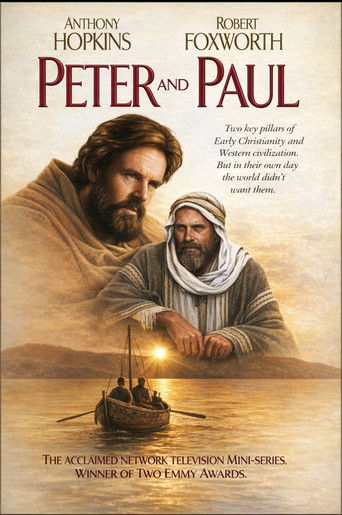
Peter and Paul (1981) dramatizes the leadership of Peter and Paul in the early Church as they face violent opposition and personal conflicts.
What the story covers
According to the overview, Peter and Paul (1981) takes up the story of the two apostles assuming leadership of the early Church. The series centers on the struggles they face: violent opposition to the teachings of Christ, and personal conflicts between the leaders themselves.
Peter and Paul appear across the New Testament, but their shared ministry to the early Church is told primarily in the book of Acts. The provided passage range, Acts 9–28, follows Paul from his conversion through his missionary journeys and arrival in Rome, the period in which both Peter and Paul establish churches, appoint leaders, and carry the gospel beyond the Jewish population. The series is listed as covering Peter, Paul, Barnabas, and Silas.
Where it is in the Bible
- Acts 13:46-47In this passage Paul and Barnabas announce a turning point in the mission: they turn from speaking to Jews first and direct the message to the Gentiles, citing the Lord's command to be 'a light of the Gentiles.' For this series, the passage marks the moment the gospel explicitly widens beyond its original audience, a theme that shapes both Peter's and Paul's later leadership.
- Acts 15:7-10At the Jerusalem Council, Peter stands and argues that God already chose him to bring the gospel to Gentiles and gave them the Holy Spirit without distinction. The passage shows Peter exercising the leadership the series dramatizes, and grounds the 'personal conflicts' the overview describes in a concrete textual debate about who belongs in the Church.
- Acts 16:31The short declaration 'Believe on the Lord Jesus, and thou shalt be saved, thou and thy house' is one of the most quoted summary statements of the apostolic message. It captures the core of the teaching the series says Peter and Paul are defending against violent resistance: a call to faith in the Lord Jesus as the ground of salvation.
- Acts 20:28Speaking to the Ephesian elders, Paul warns them to 'take heed... to all the flock, in which the Holy Spirit hath made you bishops, to feed the church of the Lord which he purchased with his own blood.' The charge to feed and guard the congregation fits the series' focus on the apostles assuming leadership of the Church and shepherding it through opposition.
How it differs from the Bible
Because the provided overview only describes the general arc of the series and not specific scenes, the main differences to watch for are the compressions any dramatisation of Acts tends to make. Acts 13–20, for example, records many years of travel, sermons, and decisions; a TV miniseries typically condenses these into a handful of dramatic moments. Viewers may notice that conversations, council debates, and missionary journeys that the Bible spreads across chapters and companions are merged or shortened.
It can also help to compare how the series handles Peter's and Paul's relationship with the Gentile mission. In Acts, Peter is shown speaking first to Gentiles (Acts 15:7) and Paul carries that mission across the empire; debates at the Jerusalem Council shape how the early Church understood inclusion of non-Jews. Watching for how the series frames the tension between the two apostles, and the role of companions like Barnabas and Silas, can be a useful comparison point with the scripture.
Discussion questions
- 1
How does the series portray the relationship between Peter and Paul, and how does that compare with Acts?
Acts shows both apostles working toward the same goal of bringing the gospel to Jews and Gentiles, but also recording sharp debates, such as the Jerusalem Council in Acts 15. Compare moments of tension in the series with passages like Acts 15:7-10 to see how the dramatization frames agreement and conflict.
- 2
What role do Barnabas and Silas play in the missions the film depicts?
In Acts, Barnabas is Paul's early missionary companion (Acts 13) and Silas joins Paul later (Acts 15–18), sharing in preaching, imprisonment, and travel. Check passages such as Acts 15:7-10 and Acts 16:31 to see how the scriptures present their partnership with Paul compared with their appearance in the series.
- 3
Why is the mission to the Gentiles such a focal point of early Church leadership?
Acts presents the Gentile mission as the explicit result of the Lord's command, cited in Acts 13:46-47, and as a question settled through apostolic debate in Acts 15:7-10. Reading these passages shows how the expansion of the message shaped the leadership conflicts and decisions the series dramatizes.
Where to watch
Availability is for Canada and changes over time — check the platform before watching. TMDb ↗
Reflections on Acts
After watching, read the passage itself — you will find details no film has time to show.