
What the story covers
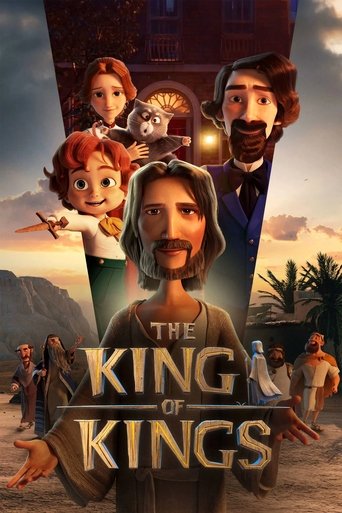
The film is built around a storyteller: the novelist Charles Dickens tells his youngest son Walter, who admires King Arthur, about the true King, Jesus. As the telling unfolds, Walter is drawn into the first-century world — the moment of Jesus' birth, his miracles and his unbounded love — and then into the trials that come upon Jesus and his calm acceptance of them, through which Walter grasps what his father's story is really saying. Peter, Mary and John the Baptist are among the biblical figures the film covers.
The life, teaching, death and resurrection of Jesus are recorded in the four Gospels, and the passages used on this page all come from the Gospel of John (chapters 1-21). John does not begin at Bethlehem: it opens with the Word who was in the beginning, then gathers Jesus' signs, his 'I am' sayings, his passion and his resurrection appearances.
Where it is in the Bible
- John 1:1The Gospel's opening line, coming before any scene in Bethlehem: the Word was with God and was God. It is the framework John gives to everything that follows, and a point of comparison with the film's storytelling frame.
- John 3:16Spoken in Jesus' conversation with Nicodemus, this verse states the motive and the gift at the centre of the story: God's love for the world and the giving of his only Son.
- John 6:35One of the 'I am' sayings, given after the sign of the bread; it identifies Jesus himself as what ends hunger and thirst.
- John 10:10-11A contrast between the thief who steals, kills and destroys and the shepherd who lays down his life; read alongside the film's portrayal of Jesus' sacrifice.
- John 14:6Part of Jesus' farewell words to his disciples, answering Thomas: he is the way, the truth and the life, and no one comes to the Father except through him.
How it differs from the Bible
The framing device — Dickens in nineteenth-century England telling the tale to his son — has no counterpart in the scripture. The Gospel of John opens in eternity, with the Word who was with God, and moves to the testimony of John the Baptist; it has no storyteller and no child companion walking through the events. John also does not narrate the birth at Bethlehem, which is told in Matthew and Luke; John 1:1 states the incarnation theologically rather than as a scene.
What to watch for: adaptations commonly compress a ministry of several years into a single arc and merge figures the Gospel text keeps distinct. Compare how the film handles the 'I am' sayings of John — the bread of life, the good shepherd, the way and the truth and the life — and how much weight it gives to the passion and resurrection, which in John occupy the closing chapters.
Discussion questions
- 1
The film has Walter travel to the moment Jesus is born. How does John's Gospel begin its account instead?
John has no nativity scene. John 1:1 begins 'In the beginning was the Word, and the Word was with God, and the Word was God' — placing Jesus before creation rather than at a stable.
- 2
The film centres on Jesus' miracles and his sacrifice. Which passage states the purpose behind that sacrifice?
John 3:16 — 'For God so loved the world, that he gave his only begotten Son, that whosoever believeth on him should not perish, but have eternal life.'
- 3
Jesus' 'I am' sayings are scattered through John. Which one would you use to explain who he is to someone else?
Compare John 6:35 ('I am the bread of life'), John 10:10-11 ('I am the good shepherd: the good shepherd layeth down his life for the sheep'), John 14:6 ('I am the way, and the truth, and the life') and John 15:5 ('I am the vine').
Where to watch
Availability is for Canada and changes over time — check the platform before watching. TMDb ↗
Reflections on John
After watching, read the passage itself — you will find details no film has time to show.