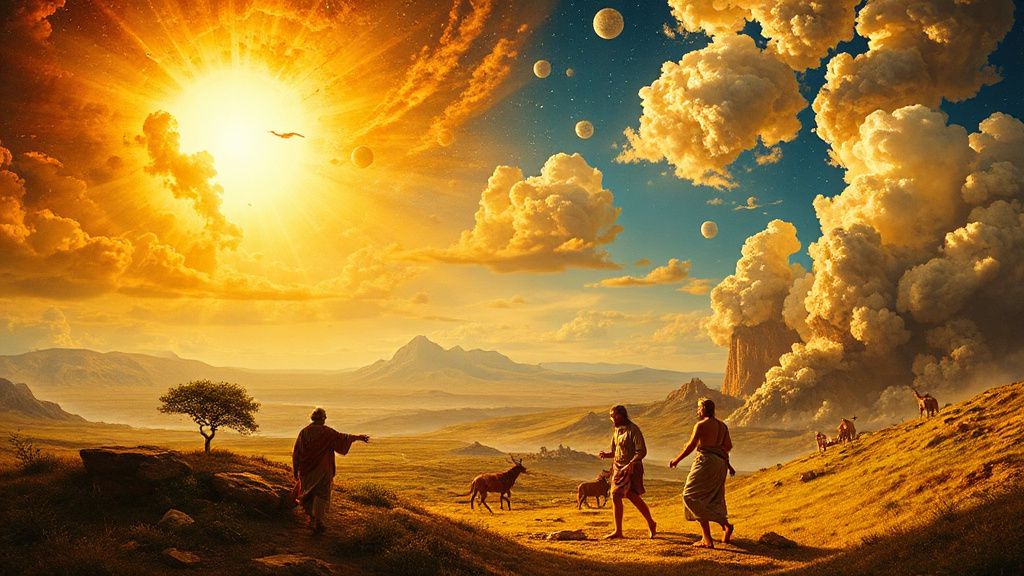
Genesis 28:17
protestant「And he was afraid, and said, How dreadful is this place! this is none other than the house of God, and this is the gate of heaven.」
Genesis 24:24
protestant「And she said unto him, I am the daughter of Bethuel the son of Milcah, whom she bare unto Nahor.」
Genesis 12:12
protestant「and it will come to pass, when the Egyptians shall see thee, that they will say, This is his wife: and they will kill me, but they will save thee alive.」
Genesis 11:28
protestant「And Haran died before his father Terah in the land of his nativity, in Ur of the Chaldees.」
Genesis 30:24
protestant「and she called his name Joseph, saying, Jehovah add to me another son.」
Genesis 4:17
protestant「And Cain knew his wife; and she conceived, and bare Enoch: and he builded a city, and called the name of the city, after the name of his son, Enoch.」
Image of God
allHumans are made in God's image (tselem) and likeness (demut), conferring inherent dignity, rationality, morality, and dominion. Even Adam's descendants carry this imprint (Gen 5:3).
Light
allGod's first creative act, signifying truth's triumph over darkness and prefiguring Christ as the Light of the world (John 1).
Image of God
protestantCreation
allThe Hebrew verb 'bara' is used exclusively of God's creative activity, emphasizing that creation arises wholly from divine sovereignty and power.
Light
protestantFormless and Void
allDescribes the pre-ordered chaos before God's six days of forming, serving as the contrast against which divine ordering is highlighted.
Why did God create humanity on Day 6, and what did the preceding days prepare for humanity's arrival?
From cosmos to humanity, consider the deliberate order of the Creator's design.
When God said 'Let there be light' in Genesis, what was the nature of this light before the sun?
Before the sun was created, where did this light originate — physical or spiritual?
What does being created 'in the image of God' specifically mean?
Exploring the theological significance of human uniqueness in Genesis
Was Joseph wise to report his dreams to his father?
The tension between young Joseph's innocence and family politics.
Does the 'after its kind' principle (Gen 1:24) imply creation was bounded and ordered?
Does God's classification of creatures limit the possibilities of evolution and biological boundaries?
How should we understand the plural “let us” in Genesis 1:26, and what does it reveal about the Godhead?
A single “us” sparks centuries of theological reflection.
🎬 Courseprotestant
Genesis 1:1-5
Genesis · Ch.1
Genesis 1:1-5 First Five Days
V 02min
Creation and PatriarchsBabel/Ur
🎬 Courseprotestant
Genesis 1:6-25
Genesis · Ch.1
Genesis 1:6-25 The Sixth Day
V 102min
Creation and PatriarchsBabel/Ur