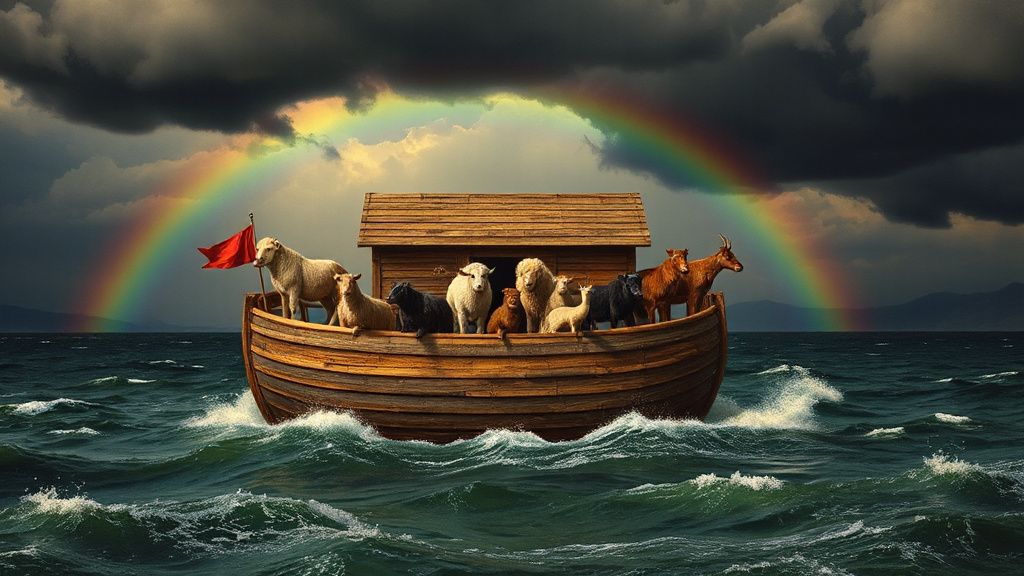
Genesis 20:8
judaism「Early next morning, Abimelech called his servants and told them all that had happened; and they were greatly frightened.」
Genesis 1:5
judaism「God called the light Day—and called the darkness Night. And there was evening and there was morning, a first day.」
Genesis 11:1
judaism「Everyone on earth had the same language and the same words.」
Genesis 30:1
judaism「When Rachel saw that she had borne Jacob no children, she became envious of her sister; and Rachel said to Jacob, “Give me children, or I shall die.”」
Genesis 18:5
judaism「And let me fetch a morsel of bread that you may refresh yourselves; then go on—seeing that you have come your servant’s way.” They replied, “Do as you have said.”」
Genesis 9:19
judaism「These three were the sons of Noah, and from these the whole world branched out.」
Righteous
allNoah is called ṣaddîq (righteous) amid a corrupt generation, highlighting covenant faithfulness. OT righteousness blends trust and obedience, anticipating the NT doctrine of justification by faith.
Serpent
allThe serpent, described as more subtle than any beast of the field, acts as the tempter in the Fall narrative; Revelation further identifies it with Satan, revealing the origin of sin.
Blessing (Berakhah)
allA key theological concept in Scripture: the declared favor, power, and peace bestowed by God or His authorized agents, conveying life and prosperity.
Fear Not
allA recurring divine command in Scripture, always accompanied by God's presence and promises, revealing His protection over His people.
Latter Days
allAn Old Testament eschatological term referring to the end of the era and the fulfillment of God's redemptive plan, used by Jacob to prophesy future events to his sons.
Burial in Canaan
allJacob's insistence on being buried in his tomb in Canaan demonstrates his faith in God's promised land, showing belief in God's covenant even beyond death.
When God said 'Let there be light' on the first day, in what kind of 'darkness' was He speaking before light existed?
The coexistence of light and darkness in Genesis 1 sparks reflection on the state before God acted.
What interpretations arise from the geography and symbolism of the four rivers flowing from Eden?
The description of four branching rivers has become a major topic in subsequent interpretation.
What interpretations arise from the geography and symbolism of the four rivers flowing from Eden?
The description of four branching rivers has become a major topic in subsequent interpretation.
What does it mean that humans are created in God's image?
An ancient declaration that humanity bears God's image—how does this shape our ethics and dignity today?
When God said 'Let there be light' on the first day, in what kind of 'darkness' was He speaking before light existed?
The coexistence of light and darkness in Genesis 1 sparks reflection on the state before God acted.
What state does 'formless and void' actually describe at the beginning of creation?
The Hebrew tohu wa-bohu has sparked countless interpretations—chaos, potential, or theological statement?