Exodus 21:10
protestant「If he take him another wife; her food, her raiment, and her duty of marriage, shall he not diminish.」
Exodus 11:1
protestant「And Jehovah said unto Moses, Yet one plague more will I bring upon Pharaoh, and upon Egypt; afterwards he will let you go hence: when he shall let you go, he shall surely thrust you out hence altogether.」
Exodus 30:14
protestant「Every one that passeth over unto them that are numbered, from twenty years old and upward, shall give the offering of Jehovah.」
Exodus 9:3
protestant「behold, the hand of Jehovah is upon thy cattle which are in the field, upon the horses, upon the asses, upon the camels, upon the herds, and upon the flocks: there shall be a very grievous murrain.」
Exodus 27:4
protestant「And thou shalt make for it a grating of network of brass; and upon the net shalt thou make four brazen rings in the four corners thereof.」
Exodus 17:12
protestant「But Moses' hands were heavy; and they took a stone, and put it under him, and he sat thereon; and Aaron and Hur stayed up his hands, the one on the one side, and the other on the other side; And his hands were steady until the going down of the sun.」
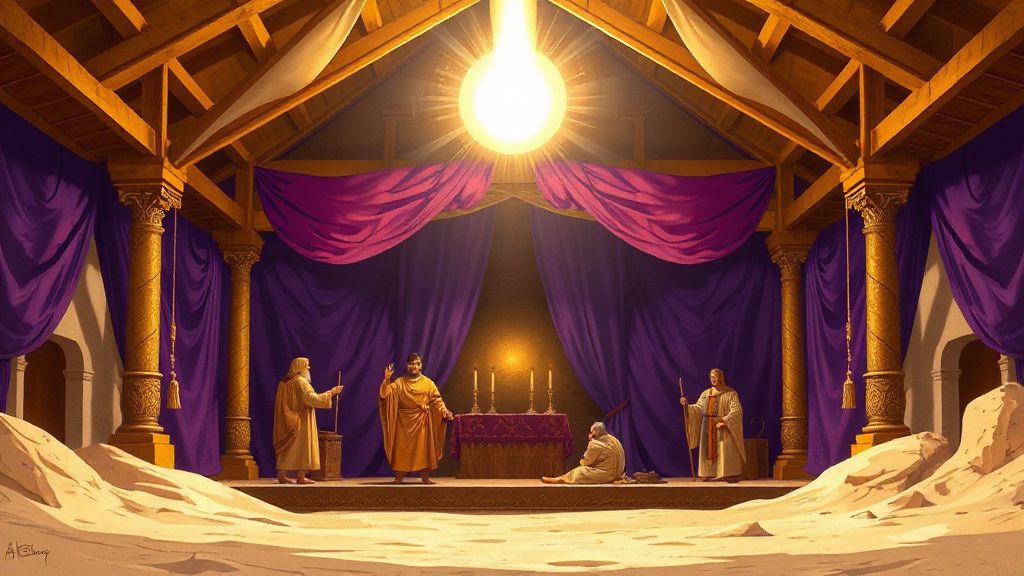
Tent of Meeting
allThe sacred tent where God met with Moses and His people, symbolizing divine presence and the center of Israelite worship in the wilderness.
Altar of Burnt Offering
allThe square bronze altar in the tabernacle courtyard used for sacrifices and atonement, central to Israel's worship as the place where sin is atoned through sacrifice.
Heave Offering (terumah)
allתְּרוּמָה denotes a portion lifted and separated for God; used here for voluntary gifts toward the Tabernacle, symbolizing willing devotion.
Tabernacle
allThe dwelling place God commanded Israel to build so He might dwell among them. Central OT symbol of divine presence, later seen as typological of Christ tabernacling among humanity.
Anointing Oil
allSacred oil used to consecrate the tabernacle and its furnishings, symbolizing the Holy Spirit's presence and consecration.
Ark of the Covenant
allThe most sacred Israelite object, containing the tablets of the Ten Commandments, symbolizing God's presence with Israel. Its acacia wood overlaid with pure gold reflects the union of divine and human.
Why did Moses and Aaron wait for God's specific command before each plague, rather than acting on their own initiative?
The rhythm of obedience behind each plague reveals God's precise sovereignty.
How does Catholic tradition understand the 'I AM' revelation from the burning bush?
The self-disclosure in the fire—how does it connect to core Christological truth?
How does Catholic tradition understand the 'I AM' revelation from the burning bush?
The self-disclosure in the fire—how does it connect to core Christological truth?
What attribute of God does Exodus 33:20 reveal—Moses cannot see His face?
The unseen God reveals Himself to Moses in the most intimate way.
How does Judaism emphasize the commandment to honor parents?
Honoring parents is a foundational ethic in Judaism.
What does it mean to "remember" and "keep" the Sabbath today?
Two seemingly opposed commandments unite in Jewish observance.
Exodus 20:1-17
Exodus · Ch.20
Exodus 20:1-17 The Ten Commandments