Related Books
Filter by Era
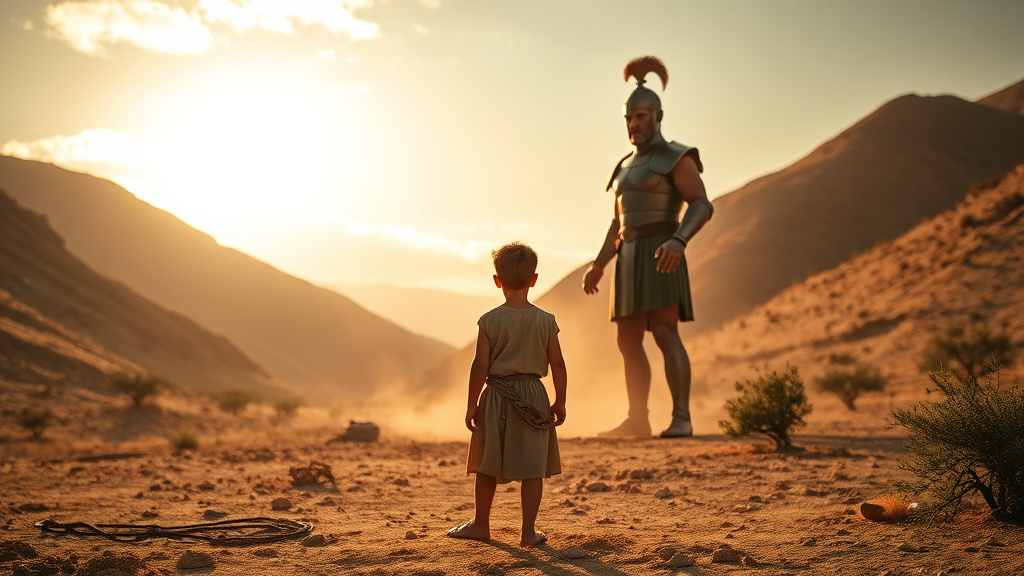
1samuel 17
1samuel · Ch.17
Stone Against the Champion
1 Samuel 7:2
judaism「A long time elapsed from the day that the Ark was housed in Kiriath-jearim, twenty years in all; and all the House of Israel yearned after GOD.」
Why was David unafraid when he faced Goliath?
From shepherd boy to battlefield champion—where did David's confidence come from?
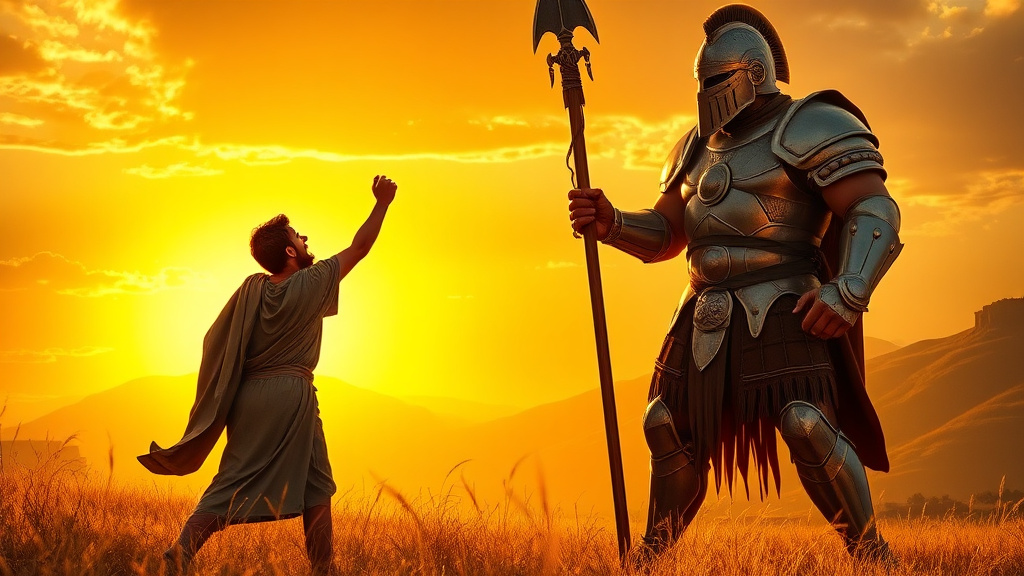
1samuel 17
1samuel · Ch.17
David vs Goliath: A Battle of Faith
1 Samuel 25:6
protestant「and thus shall ye say to him that liveth in prosperity, Peace be unto thee, and peace be to thy house, and peace be unto all that thou hast.」
How does 1 Samuel 17:4 describe Goliath's physical dimensions (six cubits and a span), and why do ancient textual traditions (MT, LXX, the Dead Sea Scrolls' 4QSamuela) report different numbers? What does this variance tell us about the transmission of the David and Goliath story?
Was Goliath really over nine feet tall—or not? Compare the manuscripts and trace how the story of David and Goliath is preserved and adapted.
1 Samuel 31:1
judaism「The Philistines attacked Israel, and the men of Israel fled before the Philistines and [many] fell on Mount Gilboa.」
Where did David's faith originate when he declared he came in the name of the Lord of Hosts?
How did a teenager possess greater spiritual conviction than seasoned soldiers?
1 Samuel 20:18
judaism「Jonathan said to him, “Tomorrow will be the new moon; and you will be missed when your seat remains vacant.」
Goliath's challenge continued for forty days — does this number carry symbolic weight in the Hebrew tradition?
Forty days in Hebrew scripture often signals a turning point.
1 Samuel 26:7
judaism「So David and Abishai approached the troops by night, and found Saul fast asleep inside the barricade, his spear stuck in the ground at his head, and Abner and the troops sleeping around him.」
In 1 Samuel 17:45-47, David declares to Goliath, 'You come against me with sword and spear... but I come against you in the name of the LORD Almighty.' How does David's theological framing of the battle shape our understanding of spiritual warfare?
How David's words frame the nature of true conflict.
1 Samuel 9:16
judaism「“At this time tomorrow, I will send a man to you from the territory of Benjamin, and you shall anoint him ruler of My people Israel. He will deliver My people from the hands of the Philistines; for I have taken note of My people, their outcry has come to Me.”」
How do David's words before facing Goliath demonstrate his trust in God?
"I come against you in the name of the Lord of hosts"—how deep is the spiritual meaning of this declaration?
1 Samuel 8:20
protestant「that we also may be like all the nations, and that our king may judge us, and go out before us, and fight our battles.」
Why did no one in Israel's army dare to face Goliath for forty days?
Fear gripped the whole army, yet opened a door of victory for a youth.
1 Samuel 16:13
judaism「Samuel took the horn of oil and anointed him in the presence of his brothers; and the spirit of GOD gripped David from that day on. Samuel then set out for Ramah.」
David famously declared he would fight Goliath in the name of the Lord of Armies. How does his statement in verse 37 shape the way we understand the outcome of the battle?
Consider how faith, not military strategy, defines David's confidence before the Philistine.
1 Samuel 24:15
protestant「Jehovah therefore be judge, and give sentence between me and thee, and see, and plead my cause, and deliver me out of thy hand.」
When David declares he comes 'in the name of the LORD of hosts,' how does this declaration embody the principle of faith alone in the battle?
Victory belongs not to the mighty, but to the One who commands the armies of heaven.
1 Samuel 8:7
judaism「and GOD replied to Samuel, “Heed the demand of the people in everything they say to you. For it is not you that they have rejected; it is Me they have rejected to rule over them.」
What was the source of David's confidence when confronting Goliath?
From shepherd to warrior, David's courage was rooted in his firsthand experience of God.
1 Samuel 29:4
judaism「But the Philistine officers were angry with him; and the Philistine officers said to him, “Send the man back; let him go back to the place you assigned him. He shall not march down with us to the battle, or else he may become our adversary in battle. For with what could that fellow appease his master if not with the heads of those involved?」
Why had Israel's army hesitated before Goliath for forty days, and what was the source of David's courage?
Faith versus fear in the camp of Israel.
1 Samuel 14:5
judaism「One crag was located on the north, near Michmas, and the other on the south, near Geba.」
Why does David repeatedly invoke the name of YHWH when confronting Goliath, and what theological point is being made?
The true opponent is not the giant, but what he represents.
1 Samuel 20:2
protestant「And he said unto him, Far from it; thou shalt not die: behold, my father doeth nothing either great or small, but that he discloseth it unto me; and why should my father hide this thing from me? it is not so.」
How does Catholic tradition read the David and Goliath battle as a type of faith?
Patristic and medieval interpreters find in 1 Samuel 17 lessons for spiritual warfare.
1 Samuel 15:18
judaism「and GOD sent you on a mission, saying, ‘Go and proscribe the sinful Amalekites; make war on them until you have exterminated them.’」
How does David's confrontation with Goliath in 1 Samuel 17 shape your understanding of courage when facing overwhelming odds?
Explore what 1 Samuel 17 reveals about courage rooted in faith rather than military strength.
1 Samuel 5:7
protestant「And when the men of Ashdod saw that it was so, they said, The ark of the God of Israel shall not abide with us; for his hand is sore upon us, and upon Dagon our god.」
After David defeats Goliath, the women of Israel sing, 'Saul has struck down his thousands, and David his ten thousands' (1 Samuel 18:7). How does this public song foreshadow the future tension between Saul and David?
Tracing the literary bridge from victory to jealousy.
1 Samuel 1:16
protestant「Count not thy handmaid for a wicked woman; for out of the abundance of my complaint and my provocation have I spoken hitherto.」
How does the Talmudic tradition interpret the confrontation between David and Goliath?
How do the rabbis draw spiritual lessons from the unlikely victory of the young shepherd?
1 Samuel 2:13
judaism「This is how the priests used to deal with the people: Whenever anyone brought a sacrifice, the priest’s boy would come along with a three-pronged fork while the meat was boiling,」
From where did David draw the courage to declare, 'I come against you in the name of the LORD of hosts'?
How could such a bold declaration come from a shepherd boy?
1 Samuel 6:10
protestant「And the men did so, and took two milch kine, and tied them to the cart, and shut up their calves at home;」
In 1 Samuel 17:50, the text says David 'prevailed over the Philistine' with a sling and a stone, 'but there was no sword in David's hand.' How does this detail of unarmed victory shape Christian reflections on relying on God's power rather than human instruments?
Reflect on how the absence of a sword in David's hand speaks to faith over force.
1 Samuel 11:12
judaism「The people then said to Samuel, “Who was it said, ‘Shall Saul be king over us?’ Hand over those involved—and we will put them to death!”」
Saul had once been moved by the Spirit of the Lord — why does he lose courage before Goliath?
A king once anointed, now trembling — where did the contrast begin?
1 Samuel 4:12
judaism「A certain Benjaminite ran from the battlefield and reached Shiloh the same day; his clothes were rent and there was earth on his head.」
1 Samuel 17:45–47 records David's declaration that the battle belongs to the Lord. How does this theological conviction differ from the Philistine worldview expressed through Goliath's taunts, and what does it say about the nature of true power?
Compare two radically different worldviews meeting on a battlefield, and what each reveals about power.
1 Samuel 21:16
judaism「Do I lack madmen that you have brought this one to rave for me? Should he enter my house?”」
1 Samuel 17:26 asks, 'Who is this uncircumcised Philistine that he should defy the armies of the living God?' How does David frame the conflict in theological terms rather than military ones, and what does this reveal about his understanding of Israel's identity?
David doesn't ask who can win the fight — he asks who can honor God's name. A discussion on faith versus strategy.
1 Samuel 26:8
protestant「Then said Abishai to David, God hath delivered up thine enemy into thy hand this day: now therefore let me smite him, I pray thee, with the spear to the earth at one stroke, and I will not smite him the second time.」
Why did no one dare to face Goliath as he challenged Israel for forty days?
Forty days of fear and the arrival of one young man—what a stark contrast of hearts.
1 Samuel 23:10
protestant「Then said David, O Jehovah, the God of Israel, thy servant hath surely heard that Saul seeketh to come to Keilah, to destroy the city for my sake.」
What spiritual condition does it reveal that no one in Israel's army answered the challenge for forty days?
What contrast emerges between the silent army and the solitary youth?
1 Samuel 2:1
protestant「And Hannah prayed, and said: My heart exulteth in Jehovah; My horn is exalted in Jehovah; My mouth is enlarged over mine enemies; Because I rejoice in thy salvation.」
How does David's declaration in 1 Samuel 17:47 — 'the battle is the Lord's' — shape a Protestant understanding of providence and human responsibility?
If the victory belongs to God, what is David actually doing when he runs toward Goliath?