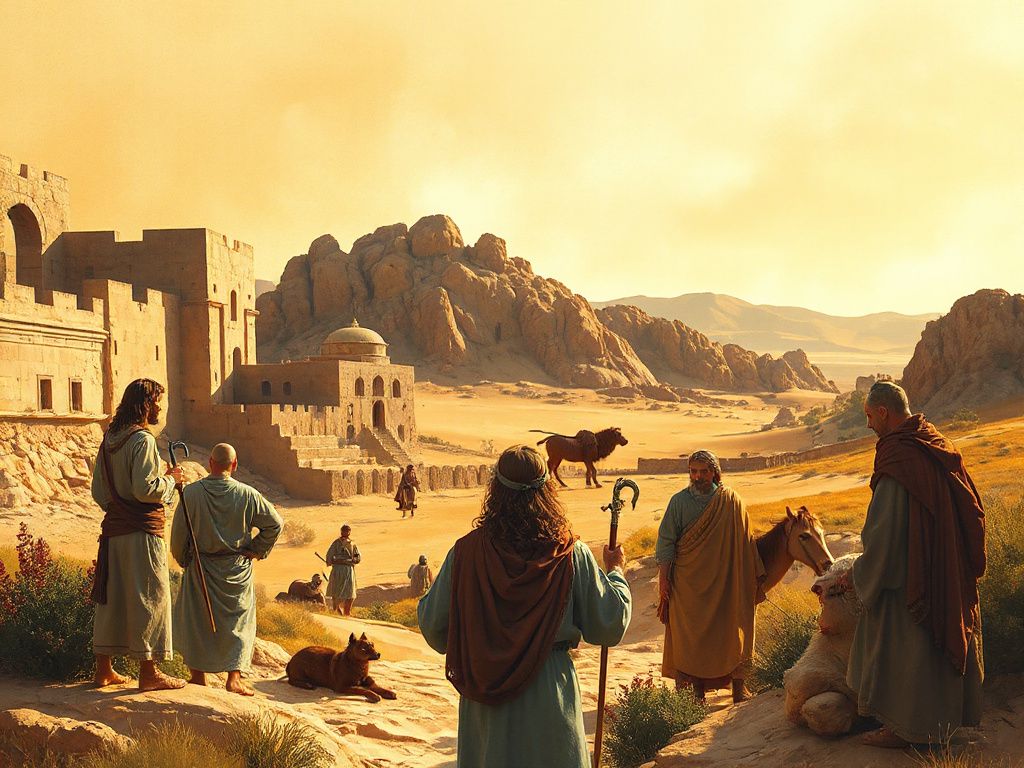
ESTUDIO DEL CAPÍTULO
Génesis 19: La destrucción de Sodoma y el rescate de Lot
Dos ángeles llegan a Sodoma, rescatan a Lot y su familia de la destrucción inminente de la ciudad y ejecutan el juicio del Señor con fuego sobre Sodoma y Gomorra.
Escritura
- 1.Llegaron, pues, los dos ángeles a Sodoma a la caída de la tarde; y Lot estaba sentado a la puerta de Sodoma. Y viéndolos Lot, se levantó a recibirlos, y se inclinó hacia el suelo,And the two angels came to Sodom at even; and Lot sat in the gate of Sodom: and Lot saw them, and rose up to meet them; and he bowed himself with his face to the earth;
- 2.y dijo: Ahora, mis señores, os ruego que vengáis a casa de vuestro siervo y os hospedéis, y lavaréis vuestros pies; y por la mañana os levantaréis, y seguiréis vuestro camino. Y ellos respondieron: No, que en la calle nos quedaremos esta noche.and he said, Behold now, my lords, turn aside, I pray you, into your servant's house, and tarry all night, and wash your feet, and ye shall rise up early, and go on your way. And they said, Nay; but we will abide in the street all night.
- 3.Mas él porfió con ellos mucho, y fueron con él, y entraron en su casa; y les hizo banquete, y coció panes sin levadura, y comieron.And he urged them greatly; and they turned in unto him, and entered into his house; and he made them a feast, and did bake unleavened bread, and they did eat.
- 4.Pero antes que se acostasen, rodearon la casa los hombres de la ciudad, los varones de Sodoma, todo el pueblo junto, desde el más joven hasta el más viejo.But before they lay down, the men of the city, even the men of Sodom, compassed the house round, both young and old, all the people from every quarter;
- 5.Y llamaron a Lot, y le dijeron: ¿Dónde están los varones que vinieron a ti esta noche? Sácalos, para que los conozcamos.and they called unto Lot, and said unto him, Where are the men that came in to thee this night? bring them out unto us, that we may know them.
- 6.Entonces Lot salió a ellos a la puerta, y cerró la puerta tras sí,And Lot went out unto them to the door, and shut the door after him.
- 7.y dijo: Os ruego, hermanos míos, que no hagáis tal maldad.And he said, I pray you, my brethren, do not so wickedly.
- 8.He aquí ahora yo tengo dos hijas que no han conocido varón; os las sacaré fuera, y haced de ellas como bien os pareciere; solamente que a estos varones no hagáis nada, pues que vinieron a la sombra de mi tejado.Behold now, I have two daughters that have not known man; let me, I pray you, bring them out unto you, and do ye to them as is good in your eyes: only unto these men do nothing, forasmuch as they are come under the shadow of my roof.
- 9.Y ellos respondieron: Quita allá; y añadieron: Vino este extraño para habitar entre nosotros, ¿y habrá de erigirse en juez? Ahora te haremos más mal que a ellos. Y hacían gran violencia al varón, a Lot, y se acercaron para romper la puerta.And they said, Stand back. And they said, This one fellow came in to sojourn, and he will needs be a judge: now will we deal worse with thee, than with them. And they pressed sore upon the man, even Lot, and drew near to break the door.
- 10.Entonces los varones alargaron la mano, y metieron a Lot en casa con ellos, y cerraron la puerta.But the men put forth their hand, and brought Lot into the house to them, and shut to the door.
- 11.Y a los hombres que estaban a la puerta de la casa hirieron con ceguera desde el menor hasta el mayor, de manera que se fatigaban buscando la puertaAnd they smote the men that were at the door of the house with blindness, both small and great, so that they wearied themselves to find the door.
- 12.Y dijeron los varones a Lot: ¿Tienes aquí alguno más? Yernos, y tus hijos y tus hijas, y todo lo que tienes en la ciudad, sácalo de este lugar;And the men said unto Lot, Hast thou here any besides? son-in-law, and thy sons, and thy daughters, and whomsoever thou hast in the city, bring them out of the place:
- 13.porque vamos a destruir este lugar, por cuanto el clamor contra ellos ha subido de punto delante de Jehová; por tanto, Jehová nos ha enviado para destruirlo.for we will destroy this place, because the cry of them is waxed great before Jehovah; and Jehovah hath sent us to destroy it.
- 14.Entonces salió Lot y habló a sus yernos, los que habían de tomar sus hijas, y les dijo: Levantaos, salid de este lugar; porque Jehová va a destruir esta ciudad. Mas pareció a sus yernos como que se burlaba.And Lot went out, and spake unto his sons-in-law, who married his daughters, and said, Up, get you out of this place; for Jehovah will destroy the city. But he seemed unto his sons-in-law as one that mocked.
- 15.Y al rayar el alba, los ángeles daban prisa a Lot, diciendo: Levántate, toma tu mujer, y tus dos hijas que se hallan aquí, para que no perezcas en el castigo de la ciudad.And when the morning arose, then the angels hastened Lot, saying, Arise, take thy wife, and thy two daughters that are here, lest thou be consumed in the iniquity of the city.
- 16.Y deteniéndose él, los varones asieron de su mano, y de la mano de su mujer y de las manos de sus dos hijas, según la misericordia de Jehová para con él; y lo sacaron y lo pusieron fuera de la ciudad.But he lingered; and the men laid hold upon his hand, and upon the hand of his wife, and upon the hand of his two daughters, Jehovah being merciful unto him: and they brought him forth, and set him without the city.
- 17.Y cuando los hubieron llevado fuera, dijeron: Escapa por tu vida; no mires tras ti, ni pares en toda esta llanura; escapa al monte, no sea que perezcas.And it came to pass, when they had brought them forth abroad, that he said, Escape for thy life; look not behind thee, neither stay thou in all the Plain; escape to the mountain, lest thou be consumed.
- 18.Pero Lot les dijo: No, yo os ruego, señores míos.And Lot said unto them, Oh, not so, my lord:
- 19.He aquí ahora ha hallado vuestro siervo gracia en vuestros ojos, y habéis engrandecido vuestra misericordia que habéis hecho conmigo dándome la vida; mas yo no podré escapar al monte, no sea que me alcance el mal, y muera.behold now, thy servant hath found favor in thy sight, and thou hast magnified thy lovingkindness, which thou hast showed unto me in saving my life; and I cannot escape to the mountain, lest evil overtake me, and I die:
- 20.He aquí ahora esta ciudad está cerca para huir allá, la cual es pequeña; dejadme escapar ahora allá (¿no es ella pequeña?), y salvaré mi vida.behold now, this city is near to flee unto, and it is a little one. Oh let me escape thither (is it not a little one?), and my soul shall live.
- 21.Y le respondió: He aquí he recibido también tu súplica sobre esto, y no destruiré la ciudad de que has hablado.And he said unto him, See, I have accepted thee concerning this thing also, that I will not overthrow the city of which thou hast spoken.
- 22.Date prisa, escápate allá; porque nada podré hacer hasta que hayas llegado allí. Por eso fue llamado el nombre de la ciudad, Zoar.Haste thee, escape thither; for I cannot do anything till thou be come thither. Therefore the name of the city was called Zoar.
- 23.El sol salía sobre la tierra, cuando Lot llegó a Zoar.The sun was risen upon the earth when Lot came unto Zoar.
- 24.Entonces Jehová hizo llover sobre Sodoma y sobre Gomorra azufre y fuego de parte de Jehová desde los cielos;Then Jehovah rained upon Sodom and upon Gomorrah brimstone and fire from Jehovah out of heaven;
- 25.y destruyó las ciudades, y toda aquella llanura, con todos los moradores de aquellas ciudades, y el fruto de la tierra.and he overthrew those cities, and all the Plain, and all the inhabitants of the cities, and that which grew upon the ground.
- 26.Entonces la mujer de Lot miró atrás, a espaldas de él, y se volvió estatua de sal.But his wife looked back from behind him, and she became a pillar of salt.
- 27.Y subió Abraham por la mañana al lugar donde había estado delante de Jehová.And Abraham gat up early in the morning to the place where he had stood before Jehovah:
- 28.Y miró hacia Sodoma y Gomorra, y hacia toda la tierra de aquella llanura miró; y he aquí que el humo subía de la tierra como el humo de un horno.and he looked toward Sodom and Gomorrah, and toward all the land of the Plain, and beheld, and, lo, the smoke of the land went up as the smoke of a furnace.
- 29.Así, cuando destruyó Dios las ciudades de la llanura, Dios se acordó de Abraham, y envió fuera a Lot de en medio de la destrucción, al asolar las ciudades donde Lot estaba.And it came to pass, when God destroyed the cities of the Plain, that God remembered Abraham, and sent Lot out of the midst of the overthrow, when he overthrew the cities in which Lot dwelt.
- 30.Pero Lot subió de Zoar y moró en el monte, y sus dos hijas con él; porque tuvo miedo de quedarse en Zoar, y habitó en una cueva él y sus dos hijas.And Lot went up out of Zoar, and dwelt in the mountain, and his two daughters with him; for he feared to dwell in Zoar: and he dwelt in a cave, he and his two daughters.
- 31.Entonces la mayor dijo a la menor: Nuestro padre es viejo, y no queda varón en la tierra que entre a nosotras conforme a la costumbre de toda la tierra.And the first-born said unto the younger, Our father is old, and there is not a man in the earth to come in unto us after the manner of all the earth:
- 32.Ven, demos a beber vino a nuestro padre, y durmamos con él, y conservaremos de nuestro padre descendencia.come, let us make our father drink wine, and we will lie with him, that we may preserve seed of our father.
- 33.Y dieron a beber vino a su padre aquella noche, y entró la mayor, y durmió con su padre; mas él no sintió cuándo se acostó ella, ni cuándo se levantó.And they made their father drink wine that night: and the first-born went in, and lay with her father; and he knew not when she lay down, nor when she arose.
- 34.El día siguiente, dijo la mayor a la menor: He aquí, yo dormí la noche pasada con mi padre; démosle a beber vino también esta noche, y entra y duerme con él, para que conservemos de nuestro padre descendencia.And it came to pass on the morrow, that the first-born said unto the younger, Behold, I lay yesternight with my father: let us make him drink wine this night also; and go thou in, and lie with him, that we may preserve seed of our father.
- 35.Y dieron a beber vino a su padre también aquella noche, y se levantó la menor, y durmió con él; pero él no echó de ver cuándo se acostó ella, ni cuándo se levantó.And they made their father drink wine that night also: and the younger arose, and lay with him; and he knew not when she lay down, nor when she arose.
- 36.Y las dos hijas de Lot concibieron de su padre.Thus were both the daughters of Lot with child by their father.
- 37.Y dio a luz la mayor un hijo, y llamó su nombre Moab, el cual es padre de los moabitas hasta hoy.And the first-born bare a son, and called his name Moab: the same is the father of the Moabites unto this day.
- 38.La menor también dio a luz un hijo, y llamó su nombre Ben- ammi, el cual es padre de los amonitas hasta hoy.And the younger, she also bare a son, and called his name Ben-ammi: the same is the father of the children of Ammon unto this day.
Qué significa este pasaje
El capítulo presenta un marcado contraste entre la misericordia divina extendida a Lot y el terrible juicio derramado sobre Sodoma y Gomorra. La llegada de los ángeles desencadena tanto protección como destrucción: Lot es sacado físicamente de la ciudad (19:16), mientras que las ciudades son demolidas por "azufre y fuego de parte de Jehová desde el cielo" (19:24). La súplica repetida "no sea que seas consumido" (19:15, 17) enmarca la urgencia de la obediencia ante el juicio.
En la puerta de Lot se desarrolla una crisis ética central, donde ofrece a sus dos hijas vírgenes a la multitud que lo rodea para proteger a sus huéspedes angélicos (19:8). Esta decisión impactante expone la profundidad de la corrupción de Sodoma, aunque también muestra el honor debido a los huéspedes bajo el techo propio, un valor al que Lot se aferra incluso a un costo terrible. El cegamiento de la multitud (19:11) demuestra que la violencia humana solo se contiene mediante la intervención divina.
Las consecuencias revelan la trágica trayectoria de la familia de Lot. Su esposa se convierte en "una columna de sal" por mirar atrás (19:26), y sus hijas, creyéndose las últimas personas sobre la tierra, conspiran para preservar descendencia a través de su padre (19:31-36). Estos descendientes se convierten en Moab y Ben-ammi (19:37-38). El capítulo vincula así el juicio sobre la maldad con los orígenes complicados y comprometidos de las naciones vecinas de Israel.
Contexto
Los acontecimientos de Génesis 19 siguen directamente a la aparición de los visitantes divinos ante Abraham en Génesis 18, donde el Señor anuncia que Sara dará a luz un hijo y revela que el clamor contra Sodoma y Gomorra ha crecido mucho. Abraham intercede por las ciudades, y el capítulo se abre con los dos ángeles llegando a Sodoma al atardecer. El texto del capítulo completo no muestra contenido anterior ni posterior dentro de los datos proporcionados, por lo que la lectura depende del propio capítulo más las referencias cruzadas y la nota seleccionada.
Las referencias cruzadas sitúan a la esposa de Lot dentro de un motivo bíblico más amplio de mirar atrás hacia lo que Dios está destruyendo: Lucas 17:32 ordena "Acordaos de la esposa de Lot". La imaginería del fuego de Sodoma se convierte en un signo recurrente del juicio escatológico en Mateo 24 y Lucas 17. La declaración resumida de que "Dios se acordó de Abraham y sacó a Lot de en medio de la destrucción" (19:29) vincula el rescate de Lot con la intercesión de Abraham realizada antes en la narrativa circundante.
Palabras clave del original
- H4397 Hebreo מַלְאָךִים (malʾāḵiym), "ángeles" o "mensajeros". En Génesis 19:1 estos dos visitantes se presentan por primera vez simplemente como "los dos ángeles", vinculándose con los tres hombres de Génesis 18 que visitaron a Abraham.
- H8179 Hebreo שַׁעַר (šaʿar), "puerta" o "portal". Lot "se sentó a la puerta de Sodoma" (19:1), que en el mundo del Antiguo Testamento es un lugar de decisiones legales y presencia comunitaria, lo que indica el papel establecido de Lot entre los líderes de la ciudad.
- H3876 Hebreo לוֹט (Lôṭ), el nombre personal "Lot", sobrino de Abraham. El nombre se repite a lo largo del capítulo como el personaje central, particularmente en la narrativa del rescate donde su vacilación (19:16) contrasta con la urgencia divina.
Versículos relacionados
- Luke 17:32 Jesús ordena explícitamente: "Acordaos de la esposa de Lot", anclando en el Nuevo Testamento la advertencia contra mirar atrás el juicio de Dios y convirtiendo el acto de la esposa en una imagen universal de cautela.
- Genesis 19:26 La redacción exacta del punto central del capítulo: "su esposa miró atrás desde detrás de él, y se convirtió en una columna de sal", que se convierte en el evento bisagra entre la misericordia (rescate) y el juicio (destrucción).
- Matthew 24:16 Jesús dice a los que están en Judea "huid a los montes" en una crisis escatológica, en eco del mandato angélico a Lot en 19:17 "escapa al monte, no sea que seas consumido", vinculando tipológicamente ambos acontecimientos.
Preguntas frecuentes
¿Por qué Lot ofreció a sus hijas a la multitud en Génesis 19:8?
Dentro del sistema de valores del antiguo Cercano Oriente mostrado en el capítulo, proteger a los huéspedes que han llegado bajo el techo propio es un deber absoluto. Lot apela a este deber en 19:8 cuando dice que los hombres han "venido bajo la sombra de mi techo". Su oferta horrenda revela tanto cuán profundamente la cultura de Sodoma había corrompido la ética ordinaria como hasta dónde está dispuesto a llegar Lot para honrar el derecho de hospitalidad.
¿Por qué la esposa de Lot fue convertida en una columna de sal (Génesis 19:26)?
El texto simplemente declara que "ella miró atrás desde detrás de él, y se convirtió en una columna de sal" (19:26). Los ángeles habían ordenado en 19:17 no mirar atrás. La narrativa presenta su mirar atrás como un acto de desobediencia a un mandato directo durante un evento de juicio, no como mera curiosidad. La frase "desde detrás de él" sugiere que ella físicamente se rezagó respecto a Lot durante el escape.
¿Cuál es la conexión entre Génesis 19 y las palabras de Jesús en Lucas 17:32?
Lucas 17:32 dice "Acordaos de la esposa de Lot", basándose directamente en Génesis 19:26. Jesús sitúa a ella dentro de un contexto escatológico: tal como el juicio vino repentinamente sobre Sodoma, así vendrá el día del Hijo del Hombre. Mirar atrás hacia el mundo que está siendo destruido se plantea como un fracaso espiritual de comprometerse plenamente con el escape, haciendo de la esposa de Lot un paradigma de lealtad dividida.