
BIBLE FILM GUIDE
The Prince of Egypt
Film · 1998 · 99 min
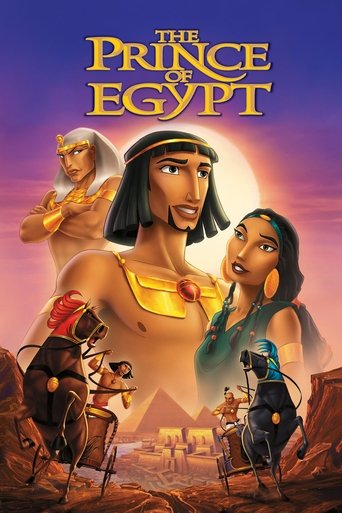
An animated film that dramatizes the story of Moses, from his rescue from the Nile and Egyptian upbringing to the plagues, Passover, and parting of the Red Sea.
What the story covers
The provided overview describes the film as following Moses from infancy — when his family places him in a basket on the Nile — through his discovery by Egyptian royalty, his upbringing alongside Rameses, the killing of an Egyptian overseer, his flight to Midian, his marriage to Tzipporah, the burning bush, the confrontation with Pharaoh, the ten plagues (including the death of the firstborn), and the parting of the Red Sea. Figures named in the source material include Moses, Aaron, and Miriam.
These events correspond to the opening chapters of the Bible's book of Exodus, specifically the range Exodus 1–15 provided in the scripture anchors. The film covers the birth and calling of Moses, the confrontation with Pharaoh over the release of the Hebrews, the plagues culminating in Passover, and the exodus through the divided sea.
Where it is in the Bible
- Exodus 3:14At the burning bush, God reveals his name to Moses: 'I AM THAT I AM.' The overview describes Moses encountering the burning bush in Midian and receiving God's call to deliver the Hebrews from Egypt. This self-disclosure is the theological center of the calling narrative.
- Exodus 12:13The Passover instruction: 'when I see the blood, I will pass over you.' The overview states that the tenth plague killed the Egyptian firstborn, including Rameses' son, after which Pharaoh released the Hebrews. This verse explains the meaning of the 'passover' marking with blood.
- Exodus 14:14As the Hebrews are pursued at the sea, Moses is told: 'Jehovah will fight for you, and ye shall hold your peace.' The overview depicts Rameses pursuing the Israelites and Moses parting the Red Sea. This verse captures the divine promise that precedes that miracle.
How it differs from the Bible
The overview tells us the film portrays a strong bond between Moses and Rameses that becomes the dramatic engine of the conflict — Pharaoh Seti's order to kill Hebrew newborns, Moses' accidental killing of an overseer, and Rameses' reluctant release only when his own son is lost. Compare this to Exodus 1–15 in the provided anchors, which describes the same arc in more compressed legal and covenantal language. Notice how the film foregrounds the personal relationship between the two royal brothers when reading the plague narratives in Exodus 12.
Watch for how the film presents the moment at the burning bush. Exodus 3:14 records God's self-disclosure to him as 'I AM THAT I AM.' The overview shows this encounter being dramatized on screen. Consider also how the death of the firstborn in Exodus 12:13 — marked by the blood as a 'token' so the plague 'passes over' — is rendered visually, and how Exodus 14:14's declaration that 'Jehovah will fight for you' is embodied in the parting of the Red Sea sequence.
Discussion questions
- 1
How does the film portray Moses' discovery of his Hebrew identity, and how does this shape his later confrontation in Exodus 1–15?
The overview shows Moses learning the truth about his birth from Miriam, confirming it with Seti, and killing an Egyptian before fleeing. Read Exodus 2:11–15 alongside the film to compare how each telling introduces the tension between his two identities.
- 2
Why does the overview emphasize the relationship between Moses and Rameses when the scripture centers on God's action?
The overview frames the conflict through two royal brothers, while Exodus 12:13 presents the Passover in covenantal terms. Compare how the personal bond in the film carries the same dramatic weight as the 'token of blood' in the scripture.
- 3
What does Exodus 14:14 add to the film's depiction of the Red Sea crossing?
The overview describes Moses' staff dividing the sea as a visual miracle. Exodus 14:14 — 'Jehovah will fight for you' — adds the theological claim that the miracle is not Moses' own. Consider how the film balances human agency and divine action in this scene.
Where to watch
Availability is for Canada and changes over time — check the platform before watching. TMDb ↗
Reflections on Exodus
After watching, read the passage itself — you will find details no film has time to show.