BIBLE FILM GUIDE
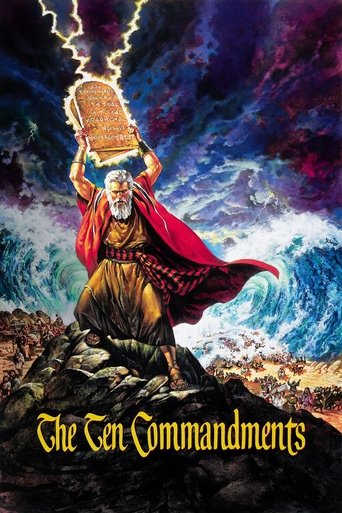
The Ten Commandments
Film · 1956 · 220 min
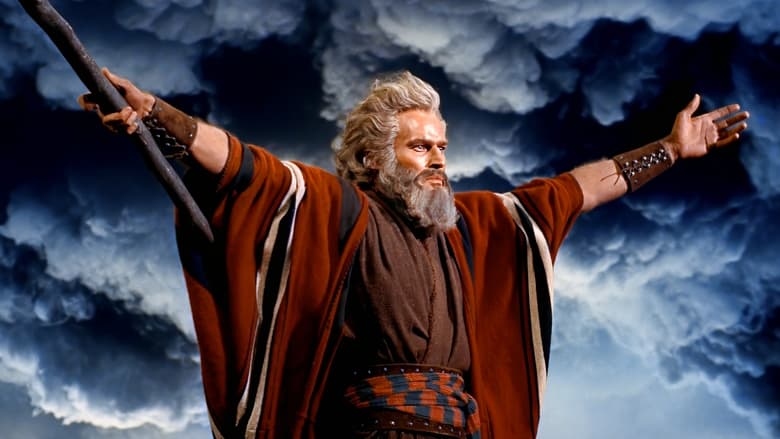
A 1956 dramatisation of the life of Moses, from his rescue as an infant through the Exodus and the giving of the Ten Commandments at Mount Sinai.
What the story covers
According to the overview, the film follows a Hebrew infant who is rescued from Pharaoh's command to kill Hebrew newborns, adopted by Pharaoh's daughter, and raised as an Egyptian prince. On discovering his true heritage, he leaves the palace to share the suffering of his enslaved people and is eventually driven into the wilderness.
The overview also states that in the wilderness Moses receives God's call at Sinai, is told to return to Egypt and deliver his people, and goes on to lead them out of slavery. This corresponds to the biblical books and chapters indicated: Exodus 1 through 20, the span that takes Israel from oppression in Egypt, through the plagues and the crossing of the Red Sea, to the covenant and the Ten Commandments at Sinai. The overview names Moses, Aaron, and Miriam as the biblical figures featured.
Where it is in the Bible
- Exodus 3:14God reveals His name to Moses as 'I AM THAT I AM' and tells him to say to Israel that 'I AM' has sent him. This is the self-identification at the heart of Moses' calling at the burning bush, which the overview says he receives in the wilderness.
- Exodus 12:13The blood on the doorposts is to be a sign so that God will pass over the Israelite houses when He smites Egypt. The Passover institution is the central act of deliverance before the Exodus, and viewers can note whether the film follows the text's description of who applies the blood and how.
- Exodus 14:14'Jehovah will fight for you, and ye shall hold your peace' is spoken to Israel at the Red Sea, where God instructs them to stand still while He delivers them. This frames the Exodus crossing as God's own action on behalf of a quiet people.
- Exodus 19:5-6If Israel obeys God's voice and keeps His covenant, they will be His own possession from all peoples and a kingdom of priests, a holy nation. This is the language of the covenant offered at Sinai, the moment the overview leads toward when Moses receives the law.
- Exodus 20:3'Thou shalt have no other gods before me' is the opening command of the Ten Commandments. It is the first word of the Law given at Sinai and a natural starting point to see how the film presents the giving of the commandments.
How it differs from the Bible
The overview sticks closely to the broad outline of Exodus 1–20, so there is little in it that clearly contradicts the biblical text. As with any feature-length dramatisation, viewers should expect centuries of story and many episodes to be compressed, reordered, or merged into single scenes. Pay attention to which events the film groups together, and compare them to the order in which Exodus presents them: the calling at the burning bush, the plagues, the Passover, the crossing of the Red Sea, and the giving of the Law are distinct moments in the scripture that may be reshaped on screen.
Because the overview does not specify dialogue or scene-by-scene detail, it is best to watch for how the film portrays God's self-revelation to Moses, the institution of the Passover, the people's fear and trust at the sea, the covenant language of a priestly kingdom, and the opening of the Ten Commandments. The provided scripture anchors below point to these exact themes and give a fixed reference for comparison after viewing.
Discussion questions
- 1
How does the film present God's self-revelation to Moses at the burning bush, and how does that compare with Exodus 3:14?
In Exodus 3:14 God names Himself 'I AM THAT I AM' and tells Moses to say to Israel that 'I AM' has sent him. Compare the scene the film gives at Sinai with this exact wording and ask which phrases are spoken verbatim and which are paraphrased.
- 2
What does the Passover passage in Exodus 12:13 say about who is protected, and how does the film show the institution of Passover?
Exodus 12:13 states that the blood on the houses is a token, and when God sees it He will pass over those houses so no plague will destroy them. Watch for whether the film shows the blood applied to the doorposts and who is gathered inside the house, and compare it to the text.
- 3
According to Exodus 14:14, who does the fighting at the Red Sea, and how is that moment shown in the film?
Exodus 14:14 says, 'Jehovah will fight for you, and ye shall hold your peace.' Watch the film's depiction of the crossing and ask whether the emphasis falls on Israel's action or on God's, in line with this verse.
Where to watch
Availability is for Canada and changes over time — check the platform before watching. TMDb ↗
Reflections on Exodus
After watching, read the passage itself — you will find details no film has time to show.