Genesis 23:10
「Now Ephron was sitting in the midst of the children of Heth: and Ephron the Hittite answered Abraham in the audience of the children of Heth, even of all that went in at the gate of his city, saying,」
Genesis 3:22
「And Jehovah God said, Behold, the man is become as one of us, to know good and evil; and now, lest he put forth his hand, and take also of the tree of life, and eat, and live for ever—」
Genesis 5:15
「And Mahalalel lived sixty and five years, and begat Jared:」
Genesis 1:1-5
Genesis · Ch.1
Genesis 1:1-5 First Five Days
Genesis 1:6-25
Genesis 1:6-25 The Sixth Day
Genesis 28:22
「then this stone, which I have set up for a pillar, shall be God's house: and of all that thou shalt give me I will surely give the tenth unto thee.」
Genesis 11:23
「and Serug lived after he begat Nahor two hundred years, and begat sons and daughters.」
Genesis 18:18
「seeing that Abraham shall surely become a great and mighty nation, and all the nations of the earth shall be blessed in him?」
Name
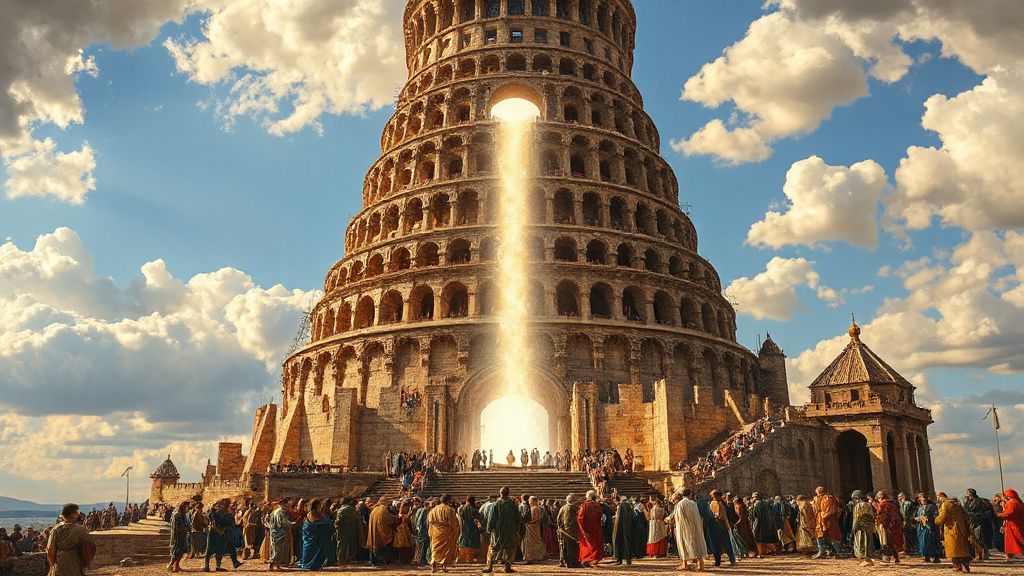
Tower builders' desire to 'make a name for themselves' reflects human ambition, contrasted with God's promise to 'make Abram's name great,' illustrating divine exaltation of the faithful.
Babel
Meaning 'confusion,' named because Jehovah confounded human language there. Symbolizes human pride and divine judgment upon collective rebellion.
Dispersion
The divine scattering of nations at Babel, reversing humanity's attempt to remain unified and make a name for itself apart from God.
Does the 'after its kind' principle (Gen 1:24) imply creation was bounded and ordered?
Does God's classification of creatures limit the possibilities of evolution and biological boundaries?
What does Abraham's obedience on Mount Moriah reveal about the nature of faith and trust in God?
When God asked Abraham to sacrifice Isaac, how did he respond, and what does his obedience teach us today?
What does the institution of Sabbath teach about modern life?
God rested on day seven—is rest the crown of creation, or simply equal to work?
Why does Genesis 1:26 use the plural 'Let us make man in our image'?
The singular Creator speaks in plural—an ancient puzzle inviting reflection.
How do rabbinic traditions interpret the twin-narrative rivalry between Cain and Abel?
Midrash enriches the Cain and Abel story, exploring the spiritual meaning behind land, sacrifice, and humanity's first murder.
What role does the divine word play in the act of creation?
Light emerges from speech—how does this echo John's 'In the beginning was the Word'?