BIBLE BOOK GUIDE
Deuteronomy
34 chapters
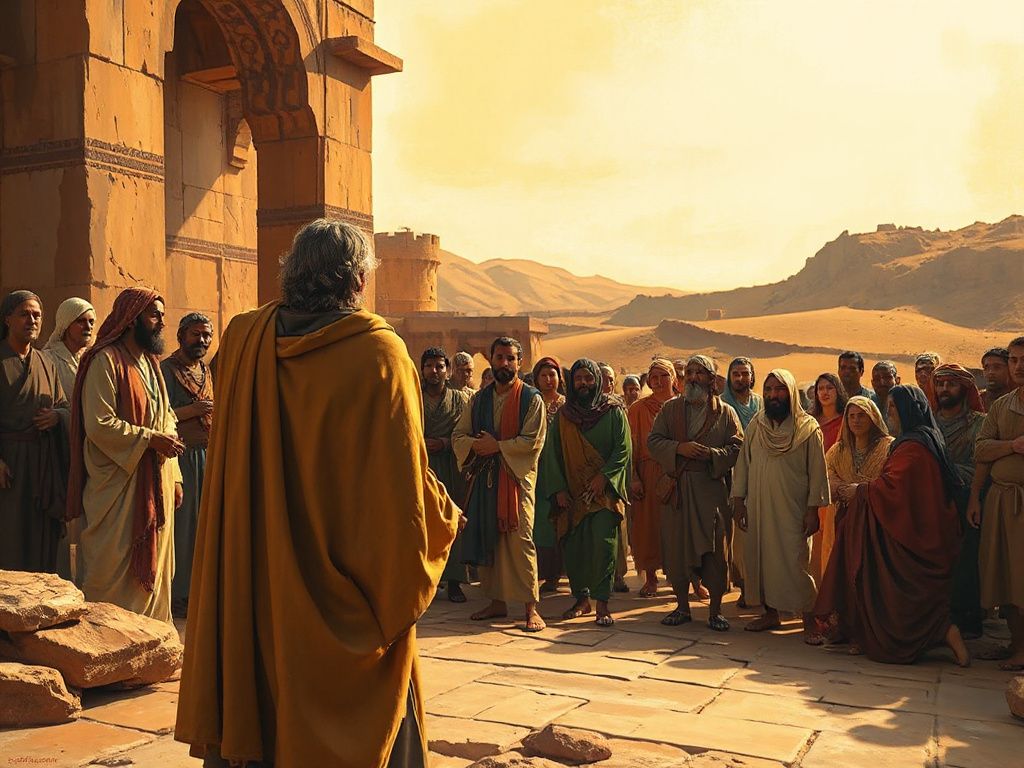
Before entering the Promised Land, Moses restates God's law, covenant, and love, calling the new generation of Israel to love God fully and obey His word.
Deuteronomy
Choose a chapter
Pick a chapter and it opens in the Current chapter tab. Come back here whenever you want to choose another one.
Why this book was written
Written for the new generation of Israelites about to enter Canaan after forty years in the wilderness, Moses restates the law on the plains of Moab, urging them to remember God's guidance, keep the covenant, turn from idolatry, and warning them through blessings and curses that obedience leads to blessing while disobedience brings judgment.
Structure
- 1–4First Sermon: Remembering the Wilderness and the Covenant
- 5–11Second Sermon: The Decalogue and the Command to Love God
- 12–26Third Sermon: Statutes, Judgments, and Covenant Living
- 27–30Covenant Renewal: Blessings, Curses, and the Choice
- 31–34Moses' Final Words, Song, and Death
Major themes
Reaffirmation of the Law and Covenant
Moses restates the Ten Commandments and covenant stipulations to the new generation on the plains of Moab, calling them to recommit to the LORD before entering the promised land (Deut. 5; 28–29).
Love for God with Whole Heart
The Shema (6:5) commands wholehearted love for the LORD, shaping the book's theology of devotion, obedience, and covenant loyalty.
Obedience and the Promised Land
Obedience brings blessing and security in Canaan; rebellion triggers curses and exile. The book starkly contrasts blessing and curse (11:26–28; ch. 28).
One True God and Rejection of Idolatry
The LORD alone is God; Israel must worship Him without images and resist syncretism with Canaanite religion (6:4; ch. 12).
Justice, Mercy, and Social Ethics
The law defends widows, orphans, sojourners, and the poor through sabbath years and debt release, reflecting God's holiness and compassion (14:28–29; ch. 15; 24:17–22).
Passing Down the Faith
Parents must teach children the law and God's deeds, using feasts, symbols, and oral tradition to transmit faith across generations (6:6–9; 11:18–21).
How it points to Christ
Deuteronomy sets the stage for Christ: as the culminating word of Moses, it points to the greater Mediator. Moses foretells a prophet like himself (18:15–18), identified in Acts 3:22 as Jesus. The covenant blessings and curses (chs. 27–28) meet their fulfillment at the cross, where Christ bears the curse so that blessing might come to all nations (Gal. 3:13–14). The promised return and rest (30:1–10) anticipate the ultimate rest and redemption accomplished in Christ.
Key verses
- 6:4–5Hear, O Israel: The LORD our God is one LORD; love the LORD with all heart, soul, and might — the heart of the whole law.
- 6:6–9God's words bound on hand, frontlet between eyes, written on doorposts and gates — a model for embedding God's word in daily life.
- 10:12–13What God requires: to fear Him, walk in His ways, love Him, serve Him with all heart, and keep His commands — a summary of covenant living.
- 28:1–2If you obey the LORD your God and keep His commands, you will be blessed — the promise of blessing through obedience.
- 30:11–20The commandment is not too hard; God calls Israel to choose life between death and blessing — a key text on repentance and choice.
- 31:6Be strong and courageous, for the LORD goes with you — the promise for entering the land and a living hope beyond it.
- 32:4He is the Rock, His work is perfect, all His ways are just — Moses' song proclaims God's faithfulness and justice.
- 34:10No prophet has since arisen in Israel like Moses — the fitting close to Moses' role as mediator and prophet.
Reflections on Deuteronomy
People in this book
Questions for reflection
- ·What does it mean for you today to love the LORD with all your heart, soul, and strength (6:5)? Are there hidden idols competing for your devotion?
- ·As you read the blessings and curses of Deuteronomy 28, which path do you recognize more in your own life? Where is God calling you to turn?
- ·How are you intentionally passing down your faith to the next generation—children, disciples, or others? What concrete step does 6:6–9 prompt in you?
- ·Deuteronomy 16 stresses justice and integrity. In your community, who are the 'widows and orphans' being overlooked, and how can you tangibly care for them?
- ·Moses sets before Israel life and death, blessing and curse (30:15–20). What key choice faces you today, and how will you choose life?
Want to read Deuteronomy start to finish? Open the reader for parallel Chinese/English text and ask anything as you go.
Start reading DeuteronomyDeuteronomy
Chapter 19
1When Jehovah thy God shall cut off the nations, whose land Jehovah thy God giveth thee, and thou succeedest them, and dwellest in their cities, and in their houses;
2thou shalt set apart three cities for thee in the midst of thy land, which Jehovah thy God giveth thee to possess it.
3Thou shalt prepare thee the way, and divide the borders of thy land, which Jehovah thy God causeth thee to inherit, into three parts, that every manslayer may flee thither.
4And this is the case of the manslayer, that shall flee thither and live: whoso killeth his neighbor unawares, and hated him not in time past;
5as when a man goeth into the forest with his neighbor to hew wood, and his hand fetcheth a stroke with the axe to cut down the tree, and the head slippeth from the helve, and lighteth upon his neighbor, so that he dieth; he shall flee unto one of these cities and live:
6lest the avenger of blood pursue the manslayer, while his heart is hot, and overtake him, because the way is long, and smite him mortally; whereas he was not worthy of death, inasmuch as he hated him not in time past.
7Wherefore I command thee, saying, Thou shalt set apart three cities for thee.
8And if Jehovah thy God enlarge thy border, as he hath sworn unto thy fathers, and give thee all the land which he promised to give unto thy fathers;
9if thou shalt keep all this commandment to do it, which I command thee this day, to love Jehovah thy God, and to walk ever in his ways; then shalt thou add three cities more for thee, besides these three:
10that innocent blood be not shed in the midst of thy land, which Jehovah thy God giveth thee for an inheritance, and so blood be upon thee.
11But if any man hate his neighbor, and lie in wait for him, and rise up against him, and smite him mortally so that he dieth, and he flee into one of these cities;
12then the elders of his city shall send and fetch him thence, and deliver him into the hand of the avenger of blood, that he may die.
13Thine eye shall not pity him, but thou shalt put away the innocent blood from Israel, that it may go well with thee.
14Thou shalt not remove thy neighbor's landmark, which they of old time have set, in thine inheritance which thou shalt inherit, in the land that Jehovah thy God giveth thee to possess it.
15One witness shall not rise up against a man for any iniquity, or for any sin, in any sin that he sinneth: at the mouth of two witnesses, or at the mouth of three witnesses, shall a matter be established.
16If an unrighteous witness rise up against any man to testify against him of wrong-doing,
17then both the men, between whom the controversy is, shall stand before Jehovah, before the priests and the judges that shall be in those days;
18and the judges shall make diligent inquisition: and, behold, if the witness be a false witness, and have testified falsely against his brother;
19then shall ye do unto him, as he had thought to do unto his brother: so shalt thou put away the evil from the midst of thee.
20And those that remain shall hear, and fear, and shall henceforth commit no more any such evil in the midst of thee.
21And thine eyes shall not pity; life shall go for life, eye for eye, tooth for tooth, hand for hand, foot for foot.