BIBLE BOOK GUIDE
Deuteronomy
34 chapters
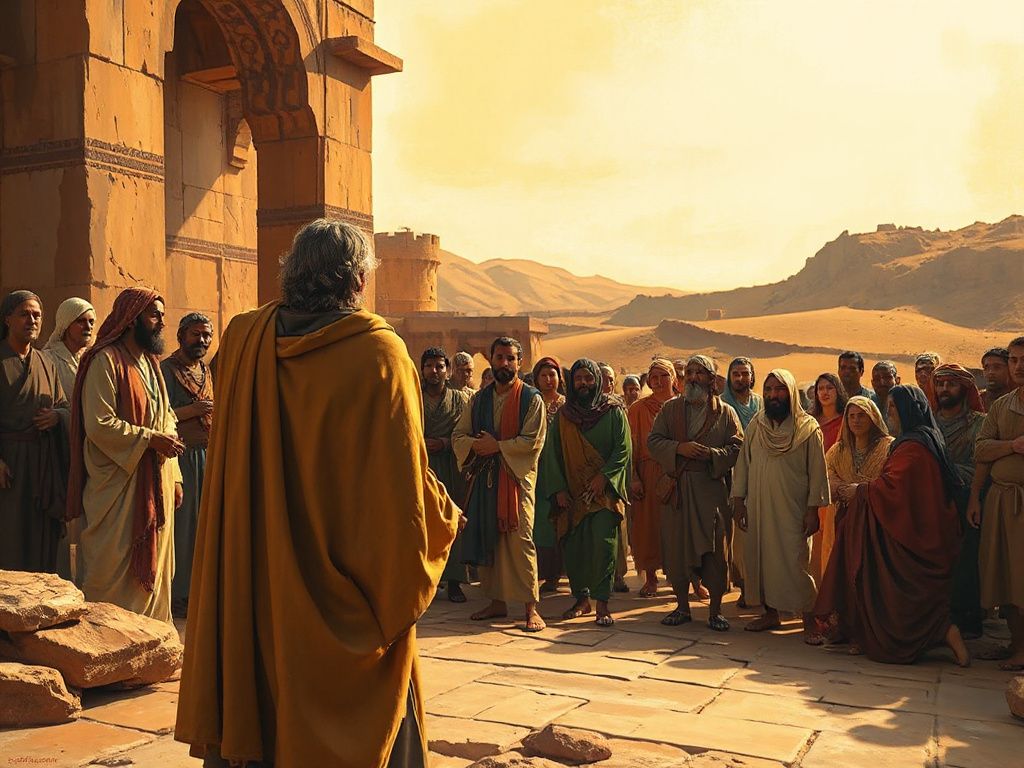
Before entering the Promised Land, Moses restates God's law, covenant, and love, calling the new generation of Israel to love God fully and obey His word.
Deuteronomy
Choose a chapter
Pick a chapter and it opens in the Current chapter tab. Come back here whenever you want to choose another one.
Why this book was written
Written for the new generation of Israelites about to enter Canaan after forty years in the wilderness, Moses restates the law on the plains of Moab, urging them to remember God's guidance, keep the covenant, turn from idolatry, and warning them through blessings and curses that obedience leads to blessing while disobedience brings judgment.
Structure
- 1–4First Sermon: Remembering the Wilderness and the Covenant
- 5–11Second Sermon: The Decalogue and the Command to Love God
- 12–26Third Sermon: Statutes, Judgments, and Covenant Living
- 27–30Covenant Renewal: Blessings, Curses, and the Choice
- 31–34Moses' Final Words, Song, and Death
Major themes
Reaffirmation of the Law and Covenant
Moses restates the Ten Commandments and covenant stipulations to the new generation on the plains of Moab, calling them to recommit to the LORD before entering the promised land (Deut. 5; 28–29).
Love for God with Whole Heart
The Shema (6:5) commands wholehearted love for the LORD, shaping the book's theology of devotion, obedience, and covenant loyalty.
Obedience and the Promised Land
Obedience brings blessing and security in Canaan; rebellion triggers curses and exile. The book starkly contrasts blessing and curse (11:26–28; ch. 28).
One True God and Rejection of Idolatry
The LORD alone is God; Israel must worship Him without images and resist syncretism with Canaanite religion (6:4; ch. 12).
Justice, Mercy, and Social Ethics
The law defends widows, orphans, sojourners, and the poor through sabbath years and debt release, reflecting God's holiness and compassion (14:28–29; ch. 15; 24:17–22).
Passing Down the Faith
Parents must teach children the law and God's deeds, using feasts, symbols, and oral tradition to transmit faith across generations (6:6–9; 11:18–21).
How it points to Christ
Deuteronomy sets the stage for Christ: as the culminating word of Moses, it points to the greater Mediator. Moses foretells a prophet like himself (18:15–18), identified in Acts 3:22 as Jesus. The covenant blessings and curses (chs. 27–28) meet their fulfillment at the cross, where Christ bears the curse so that blessing might come to all nations (Gal. 3:13–14). The promised return and rest (30:1–10) anticipate the ultimate rest and redemption accomplished in Christ.
Key verses
- 6:4–5Hear, O Israel: The LORD our God is one LORD; love the LORD with all heart, soul, and might — the heart of the whole law.
- 6:6–9God's words bound on hand, frontlet between eyes, written on doorposts and gates — a model for embedding God's word in daily life.
- 10:12–13What God requires: to fear Him, walk in His ways, love Him, serve Him with all heart, and keep His commands — a summary of covenant living.
- 28:1–2If you obey the LORD your God and keep His commands, you will be blessed — the promise of blessing through obedience.
- 30:11–20The commandment is not too hard; God calls Israel to choose life between death and blessing — a key text on repentance and choice.
- 31:6Be strong and courageous, for the LORD goes with you — the promise for entering the land and a living hope beyond it.
- 32:4He is the Rock, His work is perfect, all His ways are just — Moses' song proclaims God's faithfulness and justice.
- 34:10No prophet has since arisen in Israel like Moses — the fitting close to Moses' role as mediator and prophet.
Reflections on Deuteronomy
People in this book
Questions for reflection
- ·What does it mean for you today to love the LORD with all your heart, soul, and strength (6:5)? Are there hidden idols competing for your devotion?
- ·As you read the blessings and curses of Deuteronomy 28, which path do you recognize more in your own life? Where is God calling you to turn?
- ·How are you intentionally passing down your faith to the next generation—children, disciples, or others? What concrete step does 6:6–9 prompt in you?
- ·Deuteronomy 16 stresses justice and integrity. In your community, who are the 'widows and orphans' being overlooked, and how can you tangibly care for them?
- ·Moses sets before Israel life and death, blessing and curse (30:15–20). What key choice faces you today, and how will you choose life?
Want to read Deuteronomy start to finish? Open the reader for parallel Chinese/English text and ask anything as you go.
Start reading DeuteronomyDeuteronomy
Chapter 9
1Hear, O Israel: thou art to pass over the Jordan this day, to go in to dispossess nations greater and mightier than thyself, cities great and fortified up to heaven,
2a people great and tall, the sons of the Anakim, whom thou knowest, and of whom thou hast heard say, Who can stand before the sons of Anak?
4Speak not thou in thy heart, after that Jehovah thy God hath thrust them out from before thee, saying, For my righteousness Jehovah hath brought me in to possess this land; whereas for the wickedness of these nations Jehovah doth drive them out from before thee.
5Not for thy righteousness, or for the uprightness of thy heart, dost thou go in to possess their land; but for the wickedness of these nations Jehovah thy God doth drive them out from before thee, and that he may establish the word which Jehovah sware unto thy fathers, to Abraham, to Isaac, and to Jacob.
6Know therefore, that Jehovah thy God giveth thee not this good land to possess it for thy righteousness; for thou art a stiffnecked people.
7Remember, forget thou not, how thou provokedst Jehovah thy God to wrath in the wilderness: from the day that thou wentest forth out of the land of Egypt, until ye came unto this place, ye have been rebellious against Jehovah.
8Also in Horeb ye provoked Jehovah to wrath, and Jehovah was angry with you to destroy you.
9When I was gone up into the mount to receive the tables of stone, even the tables of the covenant which Jehovah made with you, then I abode in the mount forty days and forty nights; I did neither eat bread nor drink water.
10And Jehovah delivered unto me the two tables of stone written with the finger of God; and on them was written according to all the words, which Jehovah spake with you in the mount out of the midst of the fire in the day of the assembly.
11And it came to pass at the end of forty days and forty nights, that Jehovah gave me the two tables of stone, even the tables of the covenant.
12And Jehovah said unto me, Arise, get thee down quickly from hence; for thy people that thou hast brought forth out of Egypt have corrupted themselves; they are quickly turned aside out of the way which I commanded them; they have made them a molten image.
13Furthermore Jehovah spake unto me, saying, I have seen this people, and, behold, it is a stiffnecked people:
14let me alone, that I may destroy them, and blot out their name from under heaven; and I will make of thee a nation mightier and greater than they.
15So I turned and came down from the mount, and the mount was burning with fire: and the two tables of the covenant were in my two hands.
16And I looked, and, behold, ye had sinned against Jehovah your God; ye had made you a molten calf: ye had turned aside quickly out of the way which Jehovah had commanded you.
17And I took hold of the two tables, and cast them out of my two hands, and brake them before your eyes.
18And I fell down before Jehovah, as at the first, forty days and forty nights; I did neither eat bread nor drink water; because of all your sin which ye sinned, in doing that which was evil in the sight of Jehovah, to provoke him to anger.
19For I was afraid of the anger and hot displeasure, wherewith Jehovah was wroth against you to destroy you. But Jehovah hearkened unto me that time also.
20And Jehovah was very angry with Aaron to destroy him: and I prayed for Aaron also at the same time.
21And I took your sin, the calf which ye had made, and burnt it with fire, and stamped it, grinding it very small, until it was as fine as dust: and I cast the dust thereof into the brook that descended out of the mount.
22And at Taberah, and at Massah, and at Kibroth-hattaavah, ye provoked Jehovah to wrath.
23And when Jehovah sent you from Kadesh-barnea, saying, Go up and possess the land which I have given you; then ye rebelled against the commandment of Jehovah your God, and ye believed him not, nor hearkened to his voice.
24Ye have been rebellious against Jehovah from the day that I knew you.
25So I fell down before Jehovah the forty days and forty nights that I fell down, because Jehovah had said he would destroy you.
26And I prayed unto Jehovah, and said, O Lord Jehovah, destroy not thy people and thine inheritance, that thou hast redeemed through thy greatness, that thou hast brought forth out of Egypt with a mighty hand.
27Remember thy servants, Abraham, Isaac, and Jacob; look not unto the stubbornness of this people, nor to their wickedness, nor to their sin,
28lest the land whence thou broughtest us out say, Because Jehovah was not able to bring them into the land which he promised unto them, and because he hated them, he hath brought them out to slay them in the wilderness.
29Yet they are thy people and thine inheritance, which thou broughtest out by thy great power and by thine outstretched arm.