BIBLE BOOK GUIDE
Joshua
24 chapters
God faithfully fulfills His promise by leading Israel into and giving them victory in the promised land, displaying His faithfulness and holiness.
Joshua
Choose a chapter
Pick a chapter and it opens in the Current chapter tab. Come back here whenever you want to choose another one.
Why this book was written
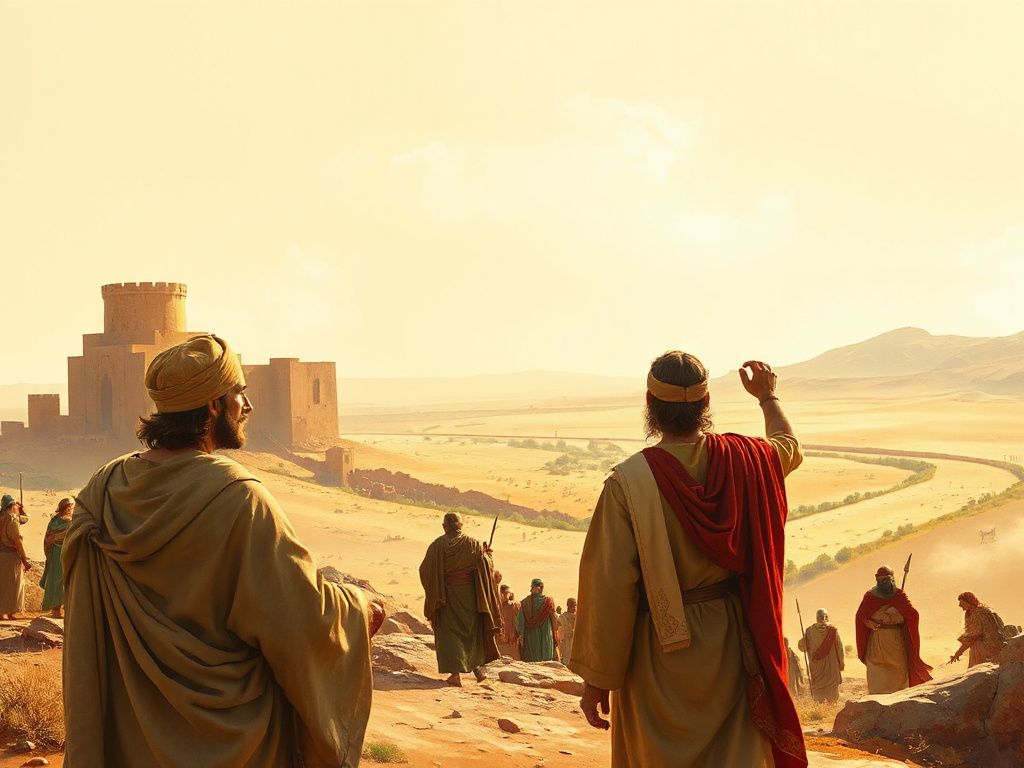
Joshua records Israel's entry into Canaan under Joshua's leadership to assure Israel (likely the post-exilic or struggling community) that the LORD is faithful to His covenant—those who trust and obey will receive His promised inheritance—and to warn that disobedience will forfeit His blessing.
Structure
- 1–5Entering the Promised Land
- 6–12Conquering Canaan
- 13–22Dividing and Settling the Land
- 23–24Joshua's Farewell and Covenant Renewal
Major themes
Faithfulness and Victory
God promised to give Canaan to Israel and called them to fight by faith under Joshua's leadership. God proved faithful, granting victory at Jericho, Ai, and beyond (Josh 1:3; ch. 6; 21:43–45).
Obedience and Holiness
Israel's victories depended on full obedience—circling Jericho, dealing decisively with Achan's sin, and renewing the covenant (Josh 6; ch. 7; 8:30–35).
God's Presence and Sovereignty
Facing mighty Canaanites, Joshua is assured, 'the LORD your God is with you' (Josh 1:5, 9). God sovereignly chose Israel, executed judgment, and apportioned the land.
Land and Rest
God gave Canaan as an inheritance to the twelve tribes, picturing His promised rest—a foreshadowing of the ultimate rest He prepared for His people (Josh 11:23; 21:43–45; Heb 4).
Covenant Renewal and Consecration
Joshua renewed the law at Mount Ebal, built an altar, pronounced blessings and curses (Josh 8:30–35; ch. 24), and called Israel to serve the LORD alone.
Leadership and Succession
From Moses' servant arising (Josh 1:1–2) to Joshua's farewell charges and death (ch. 23; 24:29–33), godly leadership is rooted in God's Word.
How it points to Christ
Joshua ('YHWH saves') prefigures Christ: he leads God's people into the promised inheritance just as Jesus leads us into the heavenly rest (Heb 4). Victories are won by covenant faithfulness, not human might—mirroring the Christian life lived by the cross and resurrection. Achan's judgment shows the wages of sin is death, a curse Christ bore for us (Josh 8:30–35; Gal 3:13). Joshua's rest was only partial; the author of Hebrews notes, 'if Joshua had given them rest, God would not have spoken later about another day' (Heb 4:8). The true rest-giving Joshua is our great High Priest, Jesus Christ.
Key verses
- 1:9God commands Joshua to be strong and courageous because He is with him—a promise that undergirds the entire book.
- 1:8Meditating on the law day and night is the key to Israel's success in possessing the land.
- 4:24The memorial stones declare the LORD's mighty hand so that all peoples may know and fear Him.
- 6:20The fall of Jericho shows victory comes through obedience to God's word, not human strength.
- 21:43–45The narrative climax: the LORD gave Israel all He promised; not one word of His promises failed.
- 22:5Joshua's charge to the eastern tribes—to love, obey, and serve God wholeheartedly—sets the standard of devotion for all Israel.
- 23:11Joshua warns that careful love for the LORD is essential or Israel will lose God's protection in the land.
- 24:14–15Joshua's climactic call to choose the LORD over other gods—a foundational call to exclusive covenant loyalty.
People in this book
Questions for reflection
- ·When God calls you into a new 'promised land,' do you step out in faith like Joshua, or give way to fear like the ten spies?
- ·Have you, like Achan, secretly kept 'devoted things' amid victory? How has God exposed hidden sin in your life?
- ·Joshua declared, 'as for me and my house, we will serve the LORD' (24:15). What does that resolution mean for your household today?
- ·God promised His presence, not an easy path (Josh 1:5–9). Which of His promises do you most need to stand on right now?
- ·Israel's rest was incomplete, pointing to the perfect rest in Christ. Are you living in Christ's rest, or still striving in your own strength?
Where Joshua fits in the Bible's storyline
This book appears in the 12-stop storyline at:
Where to start reading the Bible? See the full 12-stop storyline
Want to read Joshua start to finish? Open the reader for parallel Chinese/English text and ask anything as you go.
Start reading JoshuaJoshua
Chapter 20
1And Jehovah spake unto Joshua, saying,
2Speak to the children of Israel, saying, Assign you the cities of refuge, whereof I spake unto you by Moses,
3that the manslayer that killeth any person unwittingly and unawares may flee thither: and they shall be unto you for a refuge from the avenger of blood.
4And he shall flee unto one of those cities, and shall stand at the entrance of the gate of the city, and declare his cause in the ears of the elders of that city; and they shall take him into the city unto them, and give him a place, that he may dwell among them.
5And if the avenger of blood pursue after him, then they shall not deliver up the manslayer into his hand; because he smote his neighbor unawares, and hated him not beforetime.
6And he shall dwell in that city, until he stand before the congregation for judgment, until the death of the high priest that shall be in those days: then shall the manslayer return, and come unto his own city, and unto his own house, unto the city from whence he fled.
7And they set apart Kedesh in Galilee in the hill-country of Naphtali, and Shechem in the hill-country of Ephraim, and Kiriath-arba (the same is Hebron) in the hill-country of Judah.
8And beyond the Jordan at Jericho eastward, they assigned Bezer in the wilderness in the plain out of the tribe of Reuben, and Ramoth in Gilead out of the tribe of Gad, and Golan in Bashan out of the tribe of Manasseh.
9These were the appointed cities for all the children of Israel, and for the stranger that sojourneth among them, that whosoever killeth any person unwittingly might flee thither, and not die by the hand of the avenger of blood, until he stood before the congregation.