
BIBLE BOOK GUIDE
Ruth
4 chapters
In the chaotic era of the judges, God's covenant loyalty and redemptive purpose unfold through the faith and loyalty of a Moabite woman named Ruth, culminating in the genealogy of David.
Ruth
Choose a chapter
Pick a chapter and it opens in the Current chapter tab. Come back here whenever you want to choose another one.
Why this book was written
Likely composed during the early monarchy, Ruth was written to show that even in an age of apostasy and famine, God remains faithful to His covenant with Abraham; that a foreigner can be grafted into His people through faith, and that loyal kindness (hesed) is the very shape of God's saving purpose, providing historical and theological grounding for the rise of David's dynasty.
Structure
- 1Famine, Loss, and Return to Bethlehem
- 2Ruth Meets Boaz in the Field
- 3The Threshing Floor and the Near Kinsman
- 4Redemption, Marriage, and the Line of David
Major themes
Faithfulness and Kindness (Chesed)
Ruth repeatedly displays God's covenant faithfulness and the human expression of lovingkindness (chêsed). Naomi clings to the LORD despite bitter circumstances (1:13, 20-21), Ruth's pledge to Naomi (1:16-17) becomes the book's iconic act of hesed, and Boaz extends covenant mercy to Ruth and Naomi (2:8-16, 3:10-13).
Divine Providence in Hiddenness
The name of God is never explicitly mentioned in Ruth, yet His presence and guidance saturate the narrative — from famine that drives a family to Moab (1:1), to Ruth's providential arrival at Boaz's field (2:3), to the threshing floor encounter and the gate of redemption (3:1-4:1). The book trains readers to discern God at work in apparent silence.
Inclusion of the Gentile and Universal Salvation
Ruth, a Moabitess excluded from the assembly by the Law (Deut 23:3), is welcomed by faith and loyalty into the messianic lineage. Boaz's prayer that she be 'rewarded by the LORD' (2:12) anticipates the inclusion of Gentiles through faith.
Redemption and the Kinsman-Redeemer
The concepts of the 'close relative' and 'kinsman-redeemer' (gō'ēl) dominate chapters 3 and 4 (3:9; 4:1-14). Boaz steps into the redeemer role to buy back the land and raise up an heir for the dead, prefiguring the deeper redemption Christ would accomplish.
Suffering and Hope
Naomi's laments — 'the LORD has brought me back empty' (1:21) and 'the LORD's hand has turned against me' (1:13) — give voice to real grief, yet the narrative moves from emptiness to fullness (4:13-17), showing hope rising through suffering.
Lineage and the Messianic Thread
The book closes with a genealogy (4:18-22) tracing Obed through Jesse to David, and ultimately to Christ (Matt 1:5, 16). Ruth's story is woven into the messianic fabric of Scripture.
How it points to Christ
Ruth prefigures Christ in striking ways: (1) Boaz as the kinsman-redeemer (gō'ēl) willingly pays the price to redeem Ruth and Naomi, just as Christ gave Himself as a ransom for sinners (Matt 20:28; Gal 3:13); (2) Ruth the Gentile is welcomed by faith, foreshadowing that salvation extends beyond Israel to all nations (Eph 2:11-14); (3) the motif of Ruth 'happening to come' to Boaz's field and gleaning freely (2:3, 8-16) pictures Christ as the generous provider for those who trust Him; (4) the offspring of this union leads to David and ultimately to the Messiah (4:18-22; Matt 1:5, 16), showing that the story of redemption culminates in Christ.
Key verses
- 1:16–17Ruth's pledge of lifelong loyalty to Naomi models a faith that crosses ethnic and national boundaries and becomes a paradigm of conversion and steadfast devotion.
- 2:12Boaz prays that the Lord reward Ruth for taking refuge under the wings of Israel's God, echoing her confession in 1:16 and showing that God blesses those who take shelter in Him.
- 2:20Naomi blesses Boaz as a close redeemer (go'el), first unveiling the figure of the kinsman-redeemer whom God is providentially providing.
- 3:9Ruth asks Boaz to spread his cloak over her, a request for him to act as her go'el, expressing her trust in God's covenant law of redemption.
- 4:14–15The women proclaim that the Lord has not left Naomi empty-handed today, affirming that God accomplishes salvation through humble circumstances.
- 4:17The neighbors name the child Obed, who becomes the grandfather of David, showing that God's redemptive plan advances through generations.
- 4:22The closing genealogy links Ruth's story to David—and ultimately to the Messiah—showing the purpose of incorporating a Gentile into God's saving history.
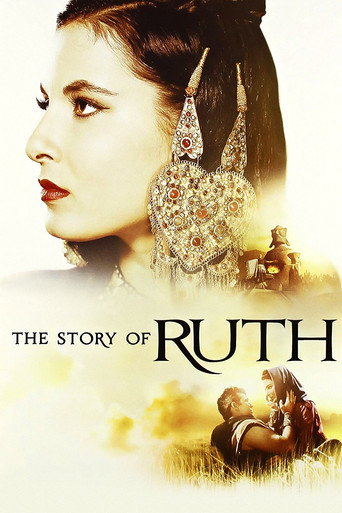
Films & series on Ruth
Each has a guide: scripture sources, where it departs from the Bible, discussion questions, and where to watch
Reflections on Ruth
People in this book
Questions for reflection
- ·God is never explicitly named in Ruth, yet His providence pervades every chapter. Have there been seasons in your life where you only recognized God's quiet guidance in hindsight?
- ·Ruth declares, 'Your God will be my God' (1:16). Is your commitment to God being tested and proven through specific relationships and hardships?
- ·Boaz extended kindness to an outsider (2:8-16). Are you willing to proactively care for those whom society has overlooked?
- ·Naomi called herself 'empty' (1:21), yet God filled her emptiness (4:13-17). How can you hold on to hope amid present grief?
- ·Ruth's quiet faithfulness enters the messianic genealogy (4:18-22). How might your ordinary acts of loyalty find meaning within God's larger redemptive story?
Want to read Ruth start to finish? Open the reader for parallel Chinese/English text and ask anything as you go.
Start reading RuthRuth
Chapter 3
1And Naomi her mother-in-law said unto her, My daughter, shall I not seek rest for thee, that it may be well with thee?
2And now is not Boaz our kinsman, with whose maidens thou wast? Behold, he winnoweth barley to-night in the threshing-floor.
3Wash thyself therefore, and anoint thee, and put thy raiment upon thee, and get thee down to the threshing-floor, but make not thyself known unto the man, until he shall have done eating and drinking.
4And it shall be, when he lieth down, that thou shalt mark the place where he shall lie, and thou shalt go in, and uncover his feet, and lay thee down; and he will tell thee what thou shalt do.
5And she said unto her, All that thou sayest I will do.
6And she went down unto the threshing-floor, and did according to all that her mother-in-law bade her.
7And when Boaz had eaten and drunk, and his heart was merry, he went to lie down at the end of the heap of grain: and she came softly, and uncovered his feet, and laid her down.
8And it came to pass at midnight, that the man was afraid, and turned himself; and, behold, a woman lay at his feet.
9And he said, Who art thou? And she answered, I am Ruth thy handmaid: spread therefore thy skirt over thy handmaid; for thou art a near kinsman.
10And he said, Blessed be thou of Jehovah, my daughter: thou hast showed more kindness in the latter end than at the beginning, inasmuch as thou followedst not young men, whether poor or rich.
11And now, my daughter, fear not; I will do to thee all that thou sayest; for all the city of my people doth know that thou art a worthy woman.
12And now it is true that I am a near kinsman; howbeit there is a kinsman nearer than I.
13Tarry this night, and it shall be in the morning, that if he will perform unto thee the part of a kinsman, well; let him do the kinsman's part: but if he will not do the part of a kinsman to thee, then will I do the part of a kinsman to thee, as Jehovah liveth: lie down until the morning.
14And she lay at his feet until the morning. And she rose up before one could discern another. For he said, Let it not be known that the woman came to the threshing-floor.
15And he said, Bring the mantle that is upon thee, and hold it; and she held it; and he measured six measures of barley, and laid it on her: and he went into the city.
16And when she came to her mother-in-law, she said, Who art thou, my daughter? And she told her all that the man had done to her.
17And she said, These six measures of barley gave he me; for he said, Go not empty unto thy mother-in-law.
18Then said she, Sit still, my daughter, until thou know how the matter will fall; for the man will not rest, until he have finished the thing this day.