ERA
Exodus and Law
1500 BC
Passover and the Ten Commandments: Exodus 20:1-17; holiness law: Leviticus 19:18
Key Passages
Filter by Place
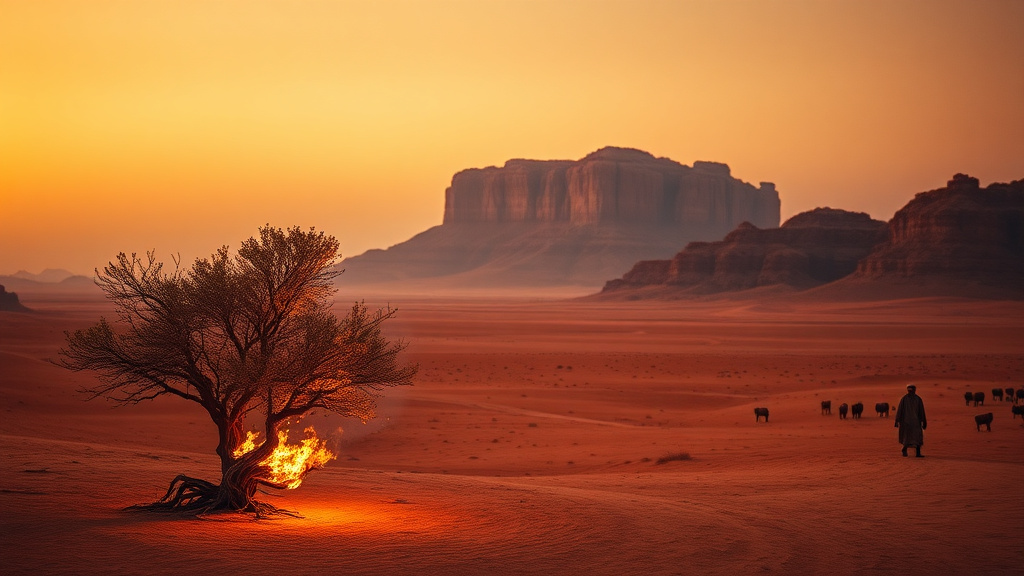
Exodus 3
Exodus · Ch.3
The Burning Bush and the Name
Numbers 26:5
protestant「Reuben, the first-born of Israel; the sons of Reuben: of Hanoch, the family of the Hanochites; of Pallu, the family of the Palluites;」
Deliverance
allGod's initiative to descend and rescue Israel from Egyptian bondage, establishing the OT theme of redemption that prefigures Christ's ultimate salvation.
Why does 'Shema Yisrael' hold the central place in Jewish prayer?
The Shema is not merely text but a covenantal declaration recited twice daily.

Exodus
Exodus
The Tabernacle — God's Dwelling Place
Exodus 20:17
protestant「Thou shalt not covet thy neighbor's house, thou shalt not covet thy neighbor's wife, nor his man-servant, nor his maid-servant, nor his ox, nor his ass, nor anything that is thy neighbor's.」
Signs and Wonders
allMiraculous acts God performed in Egypt, intended to make Israel and future generations know that the LORD is the one true God, displaying His glory and power.
How is 'love your neighbor as yourself' applied practically in Leviticus 19:18?
This commandment goes beyond emotion to include concrete acts of social justice.
Deuteronomy 21:12
judaism「and you bring her into your household, and she trims her hair, pares her nails,」
Glory of the Lord
allThe manifestation of God's majestic presence, appearing in the cloud to confirm He had heard Israel's complaints.
How has Catholic tradition connected the ten plagues of Egypt to the Passion of Christ?
Reading the plagues as typological foreshadowings of Christ's redemptive suffering.
Numbers 17:9
protestant「And Moses brought out all the rods from before Jehovah unto all the children of Israel: and they looked, and took every man his rod.」
Covenant
allThe solemn agreement God established with Israel at Sinai, conditioned upon hearing His voice and keeping His commandments, because all the earth belongs to Him.
Why does only the tenth plague require the special act of marking the doorposts with blood, and what makes this night different?
The blood-marked night stands apart as the night of redemption itself.
Exodus 13:15
protestant「and it came to pass, when Pharaoh would hardly let us go, that Jehovah slew all the first-born in the land of Egypt, both the first-born of man, and the first-born of beast: therefore I sacrifice to Jehovah all that openeth the womb, being males; but all the first-born of my sons I redeem.」
Compassionate and Gracious
allFoundational attributes of God's self-revealed nature: merciful, gracious, slow to anger, abounding in lovingkindness and faithfulness. Among the most quoted descriptions of God's character in the Old Testament.
Is the commandment 'You shall not murder' absolute in all circumstances?
Examining the application of 'You shall not murder' in contexts of war, capital punishment, and self-defense.
Exodus 32:10
protestant「now therefore let me alone, that my wrath may wax hot against them, and that I may consume them: and I will make of thee a great nation.」
Ark of the Covenant
allThe acacia wood chest overlaid with gold containing the tablets of the Law, representing God's covenant presence with Israel.
What aspects does the commandment 'You shall not murder' cover?
From literal killing to inner anger, expanded interpretations of not murdering.
Numbers 20:20
judaism「But they replied, “You shall not pass through!” And Edom went out against them in heavy force, strongly armed.」
Cherubim
allAngelic guardians woven into the tabernacle curtains, symbolizing divine presence and the guarding of the holy realm.
Why is 'I am the LORD' in Exodus 20:2 the foundation of the Ten Commandments?
The relationship between knowing God and the order of commandments
Exodus 17:14
judaism「Then GOD said to Moses, “Inscribe this in a document as a reminder, and read it aloud to Joshua: I will utterly blot out the memory of Amalek from under heaven!”」
Sanctify
allTo set apart persons or things from the common sphere and consecrate them to God, expressing holiness and divine ownership—a foundational concept of Israel's faith.
How does 'Hear, O Israel' in Deuteronomy 6:4 shape Jewish monotheism?
The centrality of the Shema and the daily declaration of God's oneness.
Numbers 3:8
judaism「They shall take charge of all the furnishings of the Tent of Meeting—a duty on behalf of the Israelites—doing the work of the Tabernacle.」
Stiffnecked People
allGod's description of Israel's stubbornness and rebellion; a metaphor of an unyielding neck that resists divine guidance and discipline.
How did Moses' encounter at the burning bush shape his understanding of God's presence?
The command to remove sandals—how did this moment redefine holy ground for Moses?
Leviticus 16:12
judaism「and he shall take a panful of glowing coals scooped from the altar before GOD, and two handfuls of finely ground aromatic incense, and bring this behind the curtain.」
Firstborn
allThe firstborn represents inheritance and primogeniture. God's killing of every Egyptian firstborn is the severest judgment, while also introducing the consecrating of Israel's firstborn to God.
What does it mean to love your neighbor as yourself, and where do we draw the line of who counts as a neighbor?
Leviticus 19:18 is short but its implications stretch across centuries and borders.
Numbers 10:10
protestant「Also in the day of your gladness, and in your set feasts, and in the beginnings of your months, ye shall blow the trumpets over your burnt-offerings, and over the sacrifices of your peace-offerings; and they shall be to you for a memorial before your God: I am Jehovah your God.」
Separation
allJehovah makes a distinction between Egyptians and Israelites, showing God's electing grace in salvation, protecting His people from the plagues.
Why did Moses turn aside to look at the burning bush rather than pass it by?
What compelled Moses to pause before a bush that blazed but was not consumed?
Numbers 21:16
protestant「And from thence they journeyed to Beer: that is the well whereof Jehovah said unto Moses, Gather the people together, and I will give them water.」
Moses
allThe deliverer and lawgiver of Israel, whose name means 'drawn out of water,' foreshadowing Christ as the ultimate Deliverer.
What is the meaning of "justice, justice you shall pursue" and why is the word repeated?
Deuteronomy 16:20 is a foundational verse for Jewish ethics and communal responsibility.
Exodus 23:14
protestant「Three times thou shalt keep a feast unto me in the year.」
Ark of the Covenant
allThe gold-covered chest containing the tablets of the Decalogue, representing God's covenantal presence and supreme symbol of the Most Holy Place.
Why is Deuteronomy 6:4 'Hear O Israel' the heart of daily prayer?
The Shema is more than a verse—it is the pulse of Jewish life.
Numbers 7:7
protestant「Two wagons and four oxen he gave unto the sons of Gershon, according to their service:」
Breastplate
allThe square breastplate set with twelve precious stones engraved with the names of Israel's tribes, worn over the heart.
What does it mean to "remember" and "keep" the Sabbath today?
Two seemingly opposed commandments unite in Jewish observance.
Exodus 31:12
protestant「And Jehovah spake unto Moses, saying,」
Pillar of Cloud
allThe visible manifestation of God's presence guiding Israel; when it descended at the Tent door, it signified divine encounter and speech with Moses.
What inner struggles do Moses' excuses before the burning bush reveal?
'I am slow of speech'—humility or fear before divine calling?
Numbers 6:3
judaism「they shall abstain from wine and any other intoxicant; they shall not drink vinegar of wine or of any other intoxicant, neither shall they drink anything in which grapes have been steeped, nor eat grapes fresh or dried.」
Eagles' Wings
allA vivid metaphor for God's redemptive act, depicting how He carried Israel to Himself with protective love and power. Later echoed in Deuteronomy 32:11 and Matthew 23:37.
Why were the Egyptian magicians able to replicate some of the early plagues, and what does this limitation signify?
The magicians' limited mimicry exposes the source and boundary of true authority.
Deuteronomy 14:10
judaism「But you may not eat anything that has no fins and scales: it is impure for you.」
Tavnit
allThe heavenly blueprint God revealed to Moses on the mountain, indicating the tabernacle must be built strictly according to divine design.
How does the Shema shape the daily rhythm and ethical vision of Jewish life?
Deuteronomy 6:4-5 is recited morning and evening. What does it ask of the whole person?
Leviticus 18:11
protestant「The nakedness of thy father's wife's daughter, begotten of thy father, she is thy sister, thou shalt not uncover her nakedness.」
Rod Becomes Serpent
allAaron's rod turning into a serpent serves as the opening sign against Pharaoh. It symbolizes God's supremacy over Egyptian deities (including the serpent-goddess Wadjet) and initiates the contest of divine power.
Why were the Egyptian magicians able to replicate some of the early plagues, and what does this limitation signify?
The magicians' limited mimicry exposes the source and boundary of true authority.
Leviticus 17:4
protestant「and hath not brought it unto the door of the tent of meeting, to offer it as an oblation unto Jehovah before the tabernacle of Jehovah: blood shall be imputed unto that man; he hath shed blood; and that man shall be cut off from among his people:」
Massah and Meribah
allPlace names memorializing Israel's striving and tempting of the Lord, becoming symbols of doubt about God's presence.
How does 'love your neighbor as yourself' shape Jewish ethics?
'Love your neighbor as yourself'—called the great principle of the Torah, why so central?
Deuteronomy 4:10
protestant「the day that thou stoodest before Jehovah thy God in Horeb, when Jehovah said unto me, Assemble me the people, and I will make them hear my words, that they may learn to fear me all the days that they live upon the earth, and that they may teach their children.」
Ephod
allThe central priestly garment woven with gold, blue, purple, and scarlet threads, symbolizing the priestly office and divine service.
How does Catholicism interpret the commandment to keep the Sabbath holy?
The Sabbath rest is transferred to Sunday worship in Catholic tradition.
Exodus 36:10
protestant「And he coupled five curtains one to another: and the other five curtains he coupled one to another.」
Outstretched Arm
allA symbol of God's mighty power, describing His extraordinary might in saving and judging, delivering Israel from Egypt with an actively intervening hand.
How does 'sola scriptura' address apparent contradictions within biblical law?
When Mosaic laws show internal tension, how does Protestant tradition discern a unified center?
Leviticus 24:5
protestant「And thou shalt take fine flour, and bake twelve cakes thereof: two tenth parts of an ephah shall be in one cake.」
Willing Offering
allFreewill offerings given by Israelites from willing hearts for the sanctuary, reflecting gratitude and devotion to God.
How does 'love your neighbor as yourself' shape tension and balance within Jewish ethics?
Rabbinic tradition reads this as 'communal ethics' while still affirming proper concern for oneself.
Exodus 8:12
protestant「And Moses and Aaron went out from Pharaoh: and Moses cried unto Jehovah concerning the frogs which he had brought upon Pharaoh.」
God Almighty
judaismThe divine name under which God appeared to Abraham, Isaac, and Jacob, emphasizing His almighty power, before the fuller revelation of the name YHWH.
Why is 'Hear, O Israel' so central?
The Shema in Deuteronomy and faith in the One God
Exodus 39:3
protestant「And they did beat the gold into thin plates, and cut it into wires, to work it in the blue, and in the purple, and in the scarlet, and in the fine linen, the work of the skilful workman.」
Remember
allA sacred act of mutual remembrance between God and His people, encompassing covenant fidelity and the generational duty to transmit the story of salvation.
Why did Pharaoh's heart repeatedly harden through the ten plagues, and what does this reveal about human resistance to divine authority?
Exploring the spiritual dynamics behind Pharaoh's hardened heart as plagues unfold.