BIBLE BOOK GUIDE
2 Maccabees
15 chapters
Under Gentile persecution, the Jews fight for the Temple and the Law, revealing God's faithfulness to His people and the hope of resurrection beyond death.
2 Maccabees
Choose a chapter
Pick a chapter and it opens in the Current chapter tab. Come back here whenever you want to choose another one.
Why this book was written
The author supplements 1 Maccabees by recounting Jeremiah's letter, the martyrs' stories, and Judas Maccabeus's victories, offering concrete examples to encourage persecuted readers and strengthen their faith in the Temple, the Law, and the resurrection.
Structure
- 1–2Preface and the Letter of Jeremiah
- 3–7Suffering and Devastation in Jerusalem
- 8–10Judas Maccabeus's Counterattack and Temple Purification
- 11–12Diplomatic Documents and Care for the Dead
- 13–15Final Campaigns and Apocalyptic Vision
Major themes
Suffering and Martyrdom for the Faith
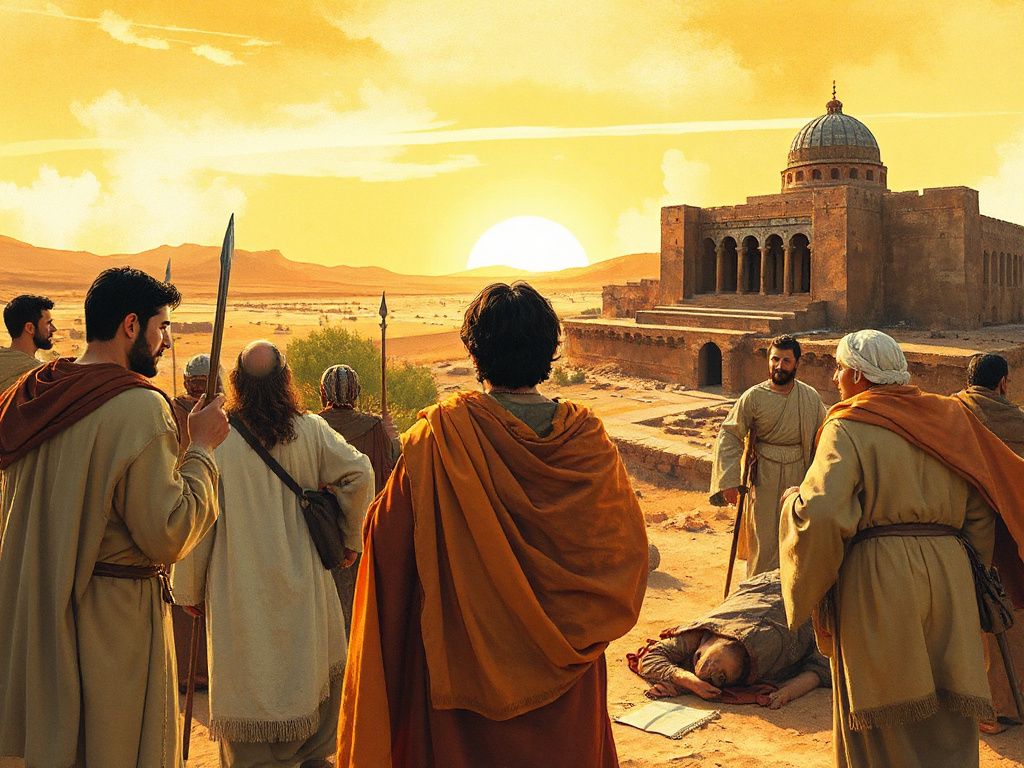
2 Maccabees recounts the desecration of the Jerusalem Temple and the martyrdom of an elderly scribe and a mother with her seven sons, who chose death over transgression of the Law (6:18–7:42), showing loyalty to the Torah above physical survival.
Purification and Rededication of the Temple
After Judas Maccabeus's victory over Nicanor, the Temple was purified, the altar renewed, and the feast of dedication celebrated (10:1–8), the event behind the Jewish festival of Hanukkah.
Hope of Resurrection
The martyrs affirm bodily resurrection: the third brother speaks of receiving his limbs again (7:11), the fourth cites the king's promise of resurrection (7:14), and the mother confesses the Lord of the world will raise them to eternal life (7:23, 29).
God's Faithfulness and Just Judgment
The author's two prefaces frame suffering as divine discipline (1:13–2:18), and the gruesome death of Antiochus IV (9:1–29) demonstrates God's righteous judgment upon the wicked.
Intercession and Prayers for the Dead
12:38–46 records Judas offering a sacrifice for fallen soldiers, praying for the dead 'that they might be delivered from their sin,' a key text for the Catholic doctrine of prayers for the dead.
God's Hand of Protection and Deliverance
The recurring phrase 'the hand of God' (3:34; 8:24; 15:15–21) shows that the Lord delivers through visions, guides, and protection.
How it points to Christ
Though deuterocanonical, 2 Maccabees is preserved in the Catholic canon. Its firm confession of bodily resurrection (7:9–23) aligns with Christian belief in resurrection; the sacrifice for the dead (12:38–46) founds the Christian practice of praying for souls in purgatory; the profanation and rededication of the Temple (10:1–8) foreshadows Christ who cleanses the inner temple of the believer (2 Cor 6:16); and the protective 'hand' of God (8:24) prefigures the all-powerful hand of the Lord Jesus.
Key verses
- 6:26Dying for the Law is presented as a noble exchange, foreshadowing the hope of resurrection.
- 7:9The mother of the seven sons affirms that the Creator will restore them to life beyond death.
- 7:28God created the world from nothing, grounding the doctrine of resurrection.
- 10:1–4The Maccabean purification of the Temple and restoration of the festival foreshadows purification and renewal through the cross.
- 12:38–46Prayers and sacrifices for the dead teach the faithful to offer charity for souls in purgatory.
- 15:9–14The vision of Jeremiah and Onias strengthens confidence in the Temple and the intercession of the saints.
- 15:36The institution of Hanukkah commemorates the miraculous deliverance and victory.
Questions for reflection
- ·When faith and life stand in tension, am I willing, like the seven brothers and their mother, to let eternal hope overcome present fear?
- ·Do I believe suffering can be purifying and lead to repentance, as the two preface letters explain (1:13–2:18)?
- ·Do I pray for the deceased, entrusting them to God's mercy (cf. 12:38–46)?
- ·Is there any 'temple' in my life that has been defiled and needs to be re-sanctified for true worship?
- ·How do I recognize and rely on the 'helping hand' of God at work in my life (cf. 8:24; 15:15)?
Want to read 2 Maccabees start to finish? Open the reader for parallel Chinese/English text and ask anything as you go.
Start reading 2 Maccabees2 Maccabees
Chapter 1
1A Letter to the Jews in Egypt The Jewish brethren in Jerusalem and those in the land of Judea, To their Jewish brethren in Egypt, Greeting, and good peace.
2May God do good to you, and may he remember his covenant with Abraham and Isaac and Jacob, his faithful servants.
3May he give you all a heart to worship him and to do his will with a strong heart and a willing spirit.
4May he open your heart to his law and his commandments, and may he bring peace.
5May he hear your prayers and be reconciled to you, and may he not forsake you in time of evil.
6We are now praying for you here.
7In the reign of Deme′trius, in the one hundred and sixty-ninth year, we Jews wrote to you, in the critical distress which came upon us in those years after Jason and his company revolted from the holy land and the kingdom
8and burned the gate and shed innocent blood. We besought the Lord and we were heard, and we offered sacrifice and cereal offering, and we lighted the lamps and we set out the loaves.
9And now see that you keep the feast of booths in the month of Chislev, in the one hundred and eighty-eighth year.
10A Letter to Aristobulus Those in Jerusalem and those in Judea and the senate and Judas, To Aristobu′lus, who is of the family of the anointed priests, teacher of Ptol′emy the king, and to the Jews in Egypt, Greeting, and good health.
11Having been saved by God out of grave dangers we thank him greatly for taking our side against the king.
12For he drove out those who fought against the holy city.
13For when the leader reached Persia with a force that seemed irresistible, they were cut to pieces in the temple of Nane′a by a deception employed by the priests of Nane′a.
14For under pretext of intending to marry her, Anti′ochus came to the place together with his friends, to secure most of its treasures as a dowry.
15When the priests of the temple of Nane′a had set out the treasures and Anti′ochus had come with a few men inside the wall of the sacred precinct, they closed the temple as soon as he entered it.
16Opening the secret door in the ceiling, they threw stones and struck down the leader and his men, and dismembered them and cut off their heads and threw them to the people outside.
17Blessed in every way be our God, who has brought judgment upon those who have behaved impiously.
18Fire Consumes Nehemiah’s Sacrifice Since on the twenty-fifth day of Chislev we shall celebrate the purification of the temple, we thought it necessary to notify you, in order that you also may celebrate the feast of booths and the feast of the fire given when Nehemi′ah, who built the temple and altar, offered sacrifices.
19For when our fathers were being led captive to Persia, the pious priests of that time took some of the fire of the altar and secretly hid it in the hollow of a dry cistern, where they took such precautions that the place was unknown to any one.
20But after many years had passed, when it pleased God, Nehemi′ah, having been commissioned by the king of Persia, sent the descendants of the priests who had hidden the fire to get it. And when they reported to us that they had not found fire but thick liquid, he ordered them to dip it out and bring it.
21And when the materials for the sacrifices were presented, Nehemi′ah ordered the priests to sprinkle the liquid on the wood and what was laid upon it.
22When this was done and some time had passed and the sun, which had been clouded over, shone out, a great fire blazed up, so that all marveled.
23And while the sacrifice was being consumed, the priests offered prayer—the priests and every one. Jonathan led, and the rest responded, as did Nehemi′ah.
24The prayer was to this effect: “O Lord, Lord God, Creator of all things, who art awe-inspiring and strong and just and merciful, who alone art King and art kind,
25who alone art bountiful, who alone art just and almighty and eternal, who dost rescue Israel from every evil, who didst choose the fathers and consecrate them,
26accept this sacrifice on behalf of all thy people Israel and preserve thy portion and make it holy.
27Gather together our scattered people, set free those who are slaves among the Gentiles, look upon those who are rejected and despised, and let the Gentiles know that thou art our God.
28Afflict those who oppress and are insolent with pride.
29Plant thy people in thy holy place, as Moses said.”
30Then the priests sang the hymns.
31And when the materials of the sacrifice were consumed, Nehemi′ah ordered that the liquid that was left should be poured upon large stones.
32When this was done, a flame blazed up; but when the light from the altar shone back, it went out.
33When this matter became known, and it was reported to the king of the Persians that, in the place where the exiled priests had hidden the fire, the liquid had appeared with which Nehemi′ah and his associates had burned the materials of the sacrifice,
34the king investigated the matter, and enclosed the place and made it sacred.
35And with those persons whom the king favored he exchanged many excellent gifts.
36Nehemi′ah and his associates called this “nephthar,” which means purification, but by most people it is called naphtha.