BIBLE BOOK GUIDE
2 Maccabees
15 chapters
Under Gentile persecution, the Jews fight for the Temple and the Law, revealing God's faithfulness to His people and the hope of resurrection beyond death.
2 Maccabees
Choose a chapter
Pick a chapter and it opens in the Current chapter tab. Come back here whenever you want to choose another one.
Why this book was written
The author supplements 1 Maccabees by recounting Jeremiah's letter, the martyrs' stories, and Judas Maccabeus's victories, offering concrete examples to encourage persecuted readers and strengthen their faith in the Temple, the Law, and the resurrection.
Structure
- 1–2Preface and the Letter of Jeremiah
- 3–7Suffering and Devastation in Jerusalem
- 8–10Judas Maccabeus's Counterattack and Temple Purification
- 11–12Diplomatic Documents and Care for the Dead
- 13–15Final Campaigns and Apocalyptic Vision
Major themes
Suffering and Martyrdom for the Faith
2 Maccabees recounts the desecration of the Jerusalem Temple and the martyrdom of an elderly scribe and a mother with her seven sons, who chose death over transgression of the Law (6:18–7:42), showing loyalty to the Torah above physical survival.
Purification and Rededication of the Temple
After Judas Maccabeus's victory over Nicanor, the Temple was purified, the altar renewed, and the feast of dedication celebrated (10:1–8), the event behind the Jewish festival of Hanukkah.
Hope of Resurrection
The martyrs affirm bodily resurrection: the third brother speaks of receiving his limbs again (7:11), the fourth cites the king's promise of resurrection (7:14), and the mother confesses the Lord of the world will raise them to eternal life (7:23, 29).
God's Faithfulness and Just Judgment
The author's two prefaces frame suffering as divine discipline (1:13–2:18), and the gruesome death of Antiochus IV (9:1–29) demonstrates God's righteous judgment upon the wicked.
Intercession and Prayers for the Dead
12:38–46 records Judas offering a sacrifice for fallen soldiers, praying for the dead 'that they might be delivered from their sin,' a key text for the Catholic doctrine of prayers for the dead.
God's Hand of Protection and Deliverance
The recurring phrase 'the hand of God' (3:34; 8:24; 15:15–21) shows that the Lord delivers through visions, guides, and protection.
How it points to Christ
Though deuterocanonical, 2 Maccabees is preserved in the Catholic canon. Its firm confession of bodily resurrection (7:9–23) aligns with Christian belief in resurrection; the sacrifice for the dead (12:38–46) founds the Christian practice of praying for souls in purgatory; the profanation and rededication of the Temple (10:1–8) foreshadows Christ who cleanses the inner temple of the believer (2 Cor 6:16); and the protective 'hand' of God (8:24) prefigures the all-powerful hand of the Lord Jesus.
Key verses
- 6:26Dying for the Law is presented as a noble exchange, foreshadowing the hope of resurrection.
- 7:9The mother of the seven sons affirms that the Creator will restore them to life beyond death.
- 7:28God created the world from nothing, grounding the doctrine of resurrection.
- 10:1–4The Maccabean purification of the Temple and restoration of the festival foreshadows purification and renewal through the cross.
- 12:38–46Prayers and sacrifices for the dead teach the faithful to offer charity for souls in purgatory.
- 15:9–14The vision of Jeremiah and Onias strengthens confidence in the Temple and the intercession of the saints.
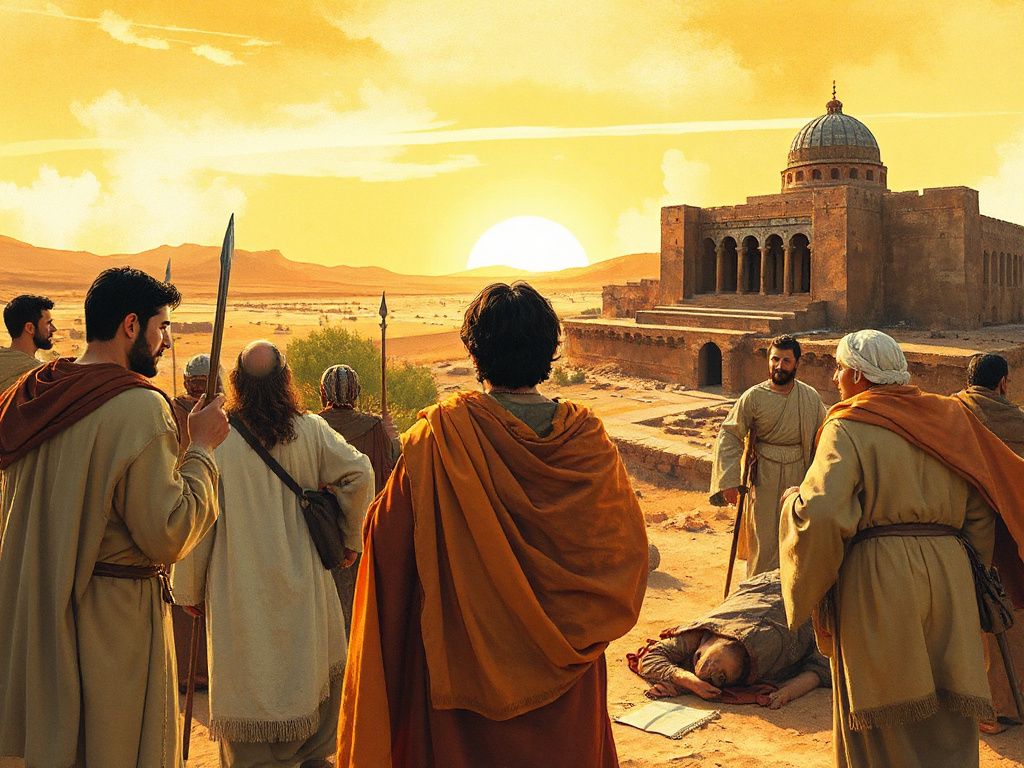
- 15:36The institution of Hanukkah commemorates the miraculous deliverance and victory.
Questions for reflection
- ·When faith and life stand in tension, am I willing, like the seven brothers and their mother, to let eternal hope overcome present fear?
- ·Do I believe suffering can be purifying and lead to repentance, as the two preface letters explain (1:13–2:18)?
- ·Do I pray for the deceased, entrusting them to God's mercy (cf. 12:38–46)?
- ·Is there any 'temple' in my life that has been defiled and needs to be re-sanctified for true worship?
- ·How do I recognize and rely on the 'helping hand' of God at work in my life (cf. 8:24; 15:15)?
Want to read 2 Maccabees start to finish? Open the reader for parallel Chinese/English text and ask anything as you go.
Start reading 2 Maccabees2 Maccabees
Chapter 14
1Al′cimus Speaks against Judas Three years later, word came to Judas and his men that Deme′trius, the son of Seleu′cus, had sailed into the harbor of Trip′olis with a strong army and a fleet,
2and had taken possession of the country, having made away with Anti′ochus and his guardian Lys′ias.
3Now a certain Al′cimus, who had formerly been high priest but had wilfully defiled himself in the times of separation, realized that there was no way for him to be safe or to have access again to the holy altar,
4and went to King Deme′trius in about the one hundred and fifty-first year, presenting to him a crown of gold and a palm, and besides these some of the customary olive branches from the temple. During that day he kept quiet.
5But he found an opportunity that furthered his mad purpose when he was invited by Deme′trius to a meeting of the council and was asked about the disposition and intentions of the Jews. He answered:
6“Those of the Jews who are called Haside′ans, whose leader is Judas Maccabe′us, are keeping up war and stirring up sedition, and will not let the kingdom attain tranquillity.
7Therefore I have laid aside my ancestral glory—I mean the high priesthood—and have now come here,
8first because I am genuinely concerned for the interests of the king, and second because I have regard also for my fellow citizens. For through the folly of those whom I have mentioned our whole nation is now in no small misfortune.
9Since you are acquainted, O king, with the details of this matter, deign to take thought for our country and our hard-pressed nation with the gracious kindness which you show to all.
10For as long as Judas lives, it is impossible for the government to find peace.”
11When he had said this, the rest of the king’s friends, who were hostile to Judas, quickly inflamed Deme′trius still more.
12And he immediately chose Nica′nor, who had been in command of the elephants, appointed him governor of Judea, and sent him off
13with orders to kill Judas and scatter his men, and to set up Al′cimus as high priest of the greatest temple.
14And the Gentiles throughout Judea, who had fled before Judas, flocked to join Nica′nor, thinking that the misfortunes and calamities of the Jews would mean prosperity for themselves.
15Nicanor Makes Friends with Judas When the Jews heard of Nica′nor’s coming and the gathering of the Gentiles, they sprinkled dust upon their heads and prayed to him who established his own people for ever and always upholds his own heritage by manifesting himself.
16At the command of the leader, they set out from there immediately and engaged them in battle at a village called Dessau.
17Simon, the brother of Judas, had encountered Nica′nor, but had been temporarily checked because of the sudden consternation created by the enemy.
18Nevertheless Nica′nor, hearing of the valor of Judas and his men and their courage in battle for their country, shrank from deciding the issue by bloodshed.
19Therefore he sent Posido′nius and Theod′otus and Mattathi′as to give and receive pledges of friendship.
20When the terms had been fully considered, and the leader had informed the people, and it had appeared that they were of one mind, they agreed to the covenant.
21And the leaders set a day on which to meet by themselves. A chariot came forward from each army; seats of honor were set in place;
22Judas posted armed men in readiness at key places to prevent sudden treachery on the part of the enemy; they held the proper conference.
23Nica′nor stayed on in Jerusalem and did nothing out of the way, but dismissed the flocks of people that had gathered.
24And he kept Judas always in his presence; he was warmly attached to the man.
25And he urged him to marry and have children; so he married, settled down, and shared the common life.
26Nicanor Turns against Judas But when Al′cimus noticed their good will for one another, he took the covenant that had been made and went to Deme′trius. He told him that Nica′nor was disloyal to the government, for he had appointed that conspirator against the kingdom, Judas, to be his successor.
27The king became excited and, provoked by the false accusations of that depraved man, wrote to Nica′nor, stating that he was displeased with the covenant and commanding him to send Maccabe′us to Antioch as a prisoner without delay.
28When this message came to Nica′nor, he was troubled and grieved that he had to annul their agreement when the man had done no wrong.
29Since it was not possible to oppose the king, he watched for an opportunity to accomplish this by a stratagem.
30But Maccabe′us, noticing that Nica′nor was more austere in his dealings with him and was meeting him more rudely than had been his custom, concluded that this austerity did not spring from the best motives. So he gathered not a few of his men, and went into hiding from Nica′nor.
31When the latter became aware that he had been cleverly outwitted by the man, he went to the great and holy temple while the priests were offering the customary sacrifices, and commanded them to hand the man over.
32And when they declared on oath that they did not know where the man was whom he sought,
33he stretched out his right hand toward the sanctuary, and swore this oath: “If you do not hand Judas over to me as a prisoner, I will level this precinct of God to the ground and tear down the altar, and I will build here a splendid temple to Diony′sus.”
34Having said this, he went away. Then the priests stretched forth their hands toward heaven and called upon the constant Defender of our nation, in these words:
35“O Lord of all, who hast need of nothing, thou wast pleased that there be a temple for thy habitation among us;
36so now, O holy One, Lord of all holiness, keep undefiled for ever this house that has been so recently purified.”
37Razis Dies for His Country A certain Razis, one of the elders of Jerusalem, was denounced to Nica′nor as a man who loved his fellow citizens and was very well thought of and for his good will was called father of the Jews.
38For in former times, when there was no mingling with the Gentiles, he had been accused of Judaism, and for Judaism he had with all zeal risked body and life.
39Nica′nor, wishing to exhibit the enmity which he had for the Jews, sent more than five hundred soldiers to arrest him;
40for he thought that by arresting him he would do them an injury.
41When the troops were about to capture the tower and were forcing the door of the courtyard, they ordered that fire be brought and the doors burned. Being surrounded, Razis fell upon his own sword,
42preferring to die nobly rather than to fall into the hands of sinners and suffer outrages unworthy of his noble birth.
43But in the heat of the struggle he did not hit exactly, and the crowd was now rushing in through the doors. He bravely ran up on the wall, and manfully threw himself down into the crowd.
44But as they quickly drew back, a space opened and he fell in the middle of the empty space.
45Still alive and aflame with anger, he rose, and though his blood gushed forth and his wounds were severe he ran through the crowd; and standing upon a steep rock,
46with his blood now completely drained from him, he tore out his entrails, took them with both hands and hurled them at the crowd, calling upon the Lord of life and spirit to give them back to him again. This was the manner of his death.