BIBLE BOOK GUIDE
2 Maccabees
15 chapters
Under Gentile persecution, the Jews fight for the Temple and the Law, revealing God's faithfulness to His people and the hope of resurrection beyond death.
2 Maccabees
Choose a chapter
Pick a chapter and it opens in the Current chapter tab. Come back here whenever you want to choose another one.
Why this book was written
The author supplements 1 Maccabees by recounting Jeremiah's letter, the martyrs' stories, and Judas Maccabeus's victories, offering concrete examples to encourage persecuted readers and strengthen their faith in the Temple, the Law, and the resurrection.
Structure
- 1–2Preface and the Letter of Jeremiah
- 3–7Suffering and Devastation in Jerusalem
- 8–10Judas Maccabeus's Counterattack and Temple Purification
- 11–12Diplomatic Documents and Care for the Dead
- 13–15Final Campaigns and Apocalyptic Vision
Major themes
Suffering and Martyrdom for the Faith
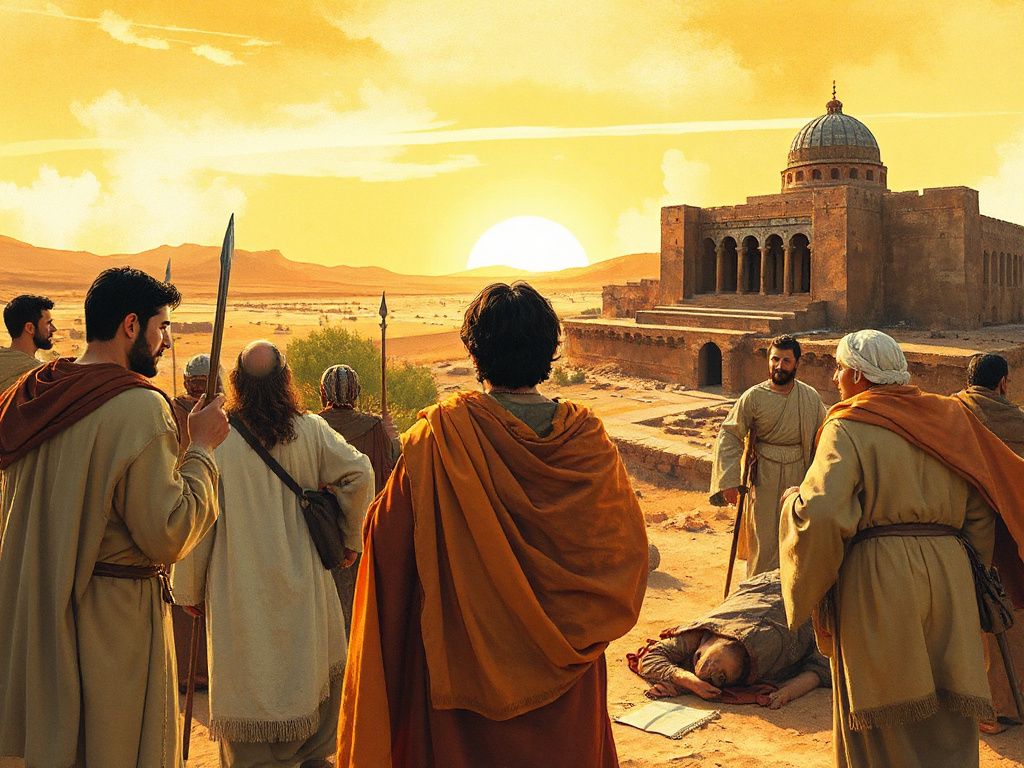
2 Maccabees recounts the desecration of the Jerusalem Temple and the martyrdom of an elderly scribe and a mother with her seven sons, who chose death over transgression of the Law (6:18–7:42), showing loyalty to the Torah above physical survival.
Purification and Rededication of the Temple
After Judas Maccabeus's victory over Nicanor, the Temple was purified, the altar renewed, and the feast of dedication celebrated (10:1–8), the event behind the Jewish festival of Hanukkah.
Hope of Resurrection
The martyrs affirm bodily resurrection: the third brother speaks of receiving his limbs again (7:11), the fourth cites the king's promise of resurrection (7:14), and the mother confesses the Lord of the world will raise them to eternal life (7:23, 29).
God's Faithfulness and Just Judgment
The author's two prefaces frame suffering as divine discipline (1:13–2:18), and the gruesome death of Antiochus IV (9:1–29) demonstrates God's righteous judgment upon the wicked.
Intercession and Prayers for the Dead
12:38–46 records Judas offering a sacrifice for fallen soldiers, praying for the dead 'that they might be delivered from their sin,' a key text for the Catholic doctrine of prayers for the dead.
God's Hand of Protection and Deliverance
The recurring phrase 'the hand of God' (3:34; 8:24; 15:15–21) shows that the Lord delivers through visions, guides, and protection.
How it points to Christ
Though deuterocanonical, 2 Maccabees is preserved in the Catholic canon. Its firm confession of bodily resurrection (7:9–23) aligns with Christian belief in resurrection; the sacrifice for the dead (12:38–46) founds the Christian practice of praying for souls in purgatory; the profanation and rededication of the Temple (10:1–8) foreshadows Christ who cleanses the inner temple of the believer (2 Cor 6:16); and the protective 'hand' of God (8:24) prefigures the all-powerful hand of the Lord Jesus.
Key verses
- 6:26Dying for the Law is presented as a noble exchange, foreshadowing the hope of resurrection.
- 7:9The mother of the seven sons affirms that the Creator will restore them to life beyond death.
- 7:28God created the world from nothing, grounding the doctrine of resurrection.
- 10:1–4The Maccabean purification of the Temple and restoration of the festival foreshadows purification and renewal through the cross.
- 12:38–46Prayers and sacrifices for the dead teach the faithful to offer charity for souls in purgatory.
- 15:9–14The vision of Jeremiah and Onias strengthens confidence in the Temple and the intercession of the saints.
- 15:36The institution of Hanukkah commemorates the miraculous deliverance and victory.
Questions for reflection
- ·When faith and life stand in tension, am I willing, like the seven brothers and their mother, to let eternal hope overcome present fear?
- ·Do I believe suffering can be purifying and lead to repentance, as the two preface letters explain (1:13–2:18)?
- ·Do I pray for the deceased, entrusting them to God's mercy (cf. 12:38–46)?
- ·Is there any 'temple' in my life that has been defiled and needs to be re-sanctified for true worship?
- ·How do I recognize and rely on the 'helping hand' of God at work in my life (cf. 8:24; 15:15)?
Want to read 2 Maccabees start to finish? Open the reader for parallel Chinese/English text and ask anything as you go.
Start reading 2 Maccabees2 Maccabees
Chapter 6
1The Suppression of Judaism Not long after this, the king sent an Athenian senator to compel the Jews to forsake the laws of their fathers and cease to live by the laws of God,
2and also to pollute the temple in Jerusalem and call it the temple of Olympian Zeus, and to call the one in Geri′zim the temple of Zeus the Friend of Strangers, as did the people who dwelt in that place.
3Harsh and utterly grievous was the onslaught of evil.
4For the temple was filled with debauchery and reveling by the Gentiles, who dallied with harlots and had intercourse with women within the sacred precincts, and besides brought in things for sacrifice that were unfit.
5The altar was covered with abominable offerings which were forbidden by the laws.
6A man could neither keep the sabbath, nor observe the feasts of his fathers, nor so much as confess himself to be a Jew.
7On the monthly celebration of the king’s birthday, the Jews were taken, under bitter constraint, to partake of the sacrifices; and when the feast of Diony′sus came, they were compelled to walk in the procession in honor of Diony′sus, wearing wreaths of ivy.
8At the suggestion of Ptol′emy a decree was issued to the neighboring Greek cities, that they should adopt the same policy toward the Jews and make them partake of the sacrifices,
9and should slay those who did not choose to change over to Greek customs. One could see, therefore, the misery that had come upon them.
10For example, two women were brought in for having circumcised their children. These women they publicly paraded about the city, with their babies hung at their breasts, then hurled them down headlong from the wall.
11Others who had assembled in the caves near by, to observe the seventh day secretly, were betrayed to Philip and were all burned together, because their piety kept them from defending themselves, in view of their regard for that most holy day.
12Providential Significance of the Persecution Now I urge those who read this book not to be depressed by such calamities, but to recognize that these punishments were designed not to destroy but to discipline our people.
13In fact, not to let the impious alone for long, but to punish them immediately, is a sign of great kindness.
14For in the case of the other nations the Lord waits patiently to punish them until they have reached the full measure of their sins; but he does not deal in this way with us,
15in order that he may not take vengeance on us afterward when our sins have reached their height.
16Therefore he never withdraws his mercy from us. Though he disciplines us with calamities, he does not forsake his own people.
17Let what we have said serve as a reminder; we must go on briefly with the story.
18The Martyrdom of Eleazar Elea′zar, one of the scribes in high position, a man now advanced in age and of noble presence, was being forced to open his mouth to eat swine’s flesh.
19But he, welcoming death with honor rather than life with pollution, went up to the the rack of his own accord, spitting out the flesh,
20as men ought to go who have the courage to refuse things that it is not right to taste, even for the natural love of life.
21Those who were in charge of that unlawful sacrifice took the man aside, because of their long acquaintance with him, and privately urged him to bring meat of his own providing, proper for him to use, and pretend that he was eating the flesh of the sacrificial meal which had been commanded by the king,
22so that by doing this he might be saved from death, and be treated kindly on account of his old friendship with them.
23But making a high resolve, worthy of his years and the dignity of his old age and the gray hairs which he had reached with distinction and his excellent life even from childhood, and moreover according to the holy God-given law, he declared himself quickly, telling them to send him to Hades.
24“Such pretense is not worthy of our time of life,” he said, “lest many of the young should suppose that Elea′zar in his ninetieth year has gone over to an alien religion,
25and through my pretense, for the sake of living a brief moment longer, they should be led astray because of me, while I defile and disgrace my old age.
26For even if for the present I should avoid the punishment of men, yet whether I live or die I shall not escape the hands of the Almighty.
27Therefore, by manfully giving up my life now, I will show myself worthy of my old age
28and leave to the young a noble example of how to die a good death willingly and nobly for the revered and holy laws.” When he had said this, he went at once to the rack.
29And those who a little before had acted toward him with good will now changed to ill will, because the words he had uttered were in their opinion sheer madness.
30When he was about to die under the blows, he groaned aloud and said: “It is clear to the Lord in his holy knowledge that, though I might have been saved from death, I am enduring terrible sufferings in my body under this beating, but in my soul I am glad to suffer these things because I fear him.”
31So in this way he died, leaving in his death an example of nobility and a memorial of courage, not only to the young but to the great body of his nation.