BIBLE BOOK GUIDE
2 Maccabees
15 chapters
Under Gentile persecution, the Jews fight for the Temple and the Law, revealing God's faithfulness to His people and the hope of resurrection beyond death.
2 Maccabees
Choose a chapter
Pick a chapter and it opens in the Current chapter tab. Come back here whenever you want to choose another one.
Why this book was written
The author supplements 1 Maccabees by recounting Jeremiah's letter, the martyrs' stories, and Judas Maccabeus's victories, offering concrete examples to encourage persecuted readers and strengthen their faith in the Temple, the Law, and the resurrection.
Structure
- 1–2Preface and the Letter of Jeremiah
- 3–7Suffering and Devastation in Jerusalem
- 8–10Judas Maccabeus's Counterattack and Temple Purification
- 11–12Diplomatic Documents and Care for the Dead
- 13–15Final Campaigns and Apocalyptic Vision
Major themes
Suffering and Martyrdom for the Faith
2 Maccabees recounts the desecration of the Jerusalem Temple and the martyrdom of an elderly scribe and a mother with her seven sons, who chose death over transgression of the Law (6:18–7:42), showing loyalty to the Torah above physical survival.
Purification and Rededication of the Temple
After Judas Maccabeus's victory over Nicanor, the Temple was purified, the altar renewed, and the feast of dedication celebrated (10:1–8), the event behind the Jewish festival of Hanukkah.
Hope of Resurrection
The martyrs affirm bodily resurrection: the third brother speaks of receiving his limbs again (7:11), the fourth cites the king's promise of resurrection (7:14), and the mother confesses the Lord of the world will raise them to eternal life (7:23, 29).
God's Faithfulness and Just Judgment
The author's two prefaces frame suffering as divine discipline (1:13–2:18), and the gruesome death of Antiochus IV (9:1–29) demonstrates God's righteous judgment upon the wicked.
Intercession and Prayers for the Dead
12:38–46 records Judas offering a sacrifice for fallen soldiers, praying for the dead 'that they might be delivered from their sin,' a key text for the Catholic doctrine of prayers for the dead.
God's Hand of Protection and Deliverance
The recurring phrase 'the hand of God' (3:34; 8:24; 15:15–21) shows that the Lord delivers through visions, guides, and protection.
How it points to Christ
Though deuterocanonical, 2 Maccabees is preserved in the Catholic canon. Its firm confession of bodily resurrection (7:9–23) aligns with Christian belief in resurrection; the sacrifice for the dead (12:38–46) founds the Christian practice of praying for souls in purgatory; the profanation and rededication of the Temple (10:1–8) foreshadows Christ who cleanses the inner temple of the believer (2 Cor 6:16); and the protective 'hand' of God (8:24) prefigures the all-powerful hand of the Lord Jesus.
Key verses
- 6:26Dying for the Law is presented as a noble exchange, foreshadowing the hope of resurrection.
- 7:9The mother of the seven sons affirms that the Creator will restore them to life beyond death.
- 7:28God created the world from nothing, grounding the doctrine of resurrection.
- 10:1–4The Maccabean purification of the Temple and restoration of the festival foreshadows purification and renewal through the cross.
- 12:38–46Prayers and sacrifices for the dead teach the faithful to offer charity for souls in purgatory.
- 15:9–14The vision of Jeremiah and Onias strengthens confidence in the Temple and the intercession of the saints.
- 15:36The institution of Hanukkah commemorates the miraculous deliverance and victory.
Questions for reflection
- ·When faith and life stand in tension, am I willing, like the seven brothers and their mother, to let eternal hope overcome present fear?
- ·Do I believe suffering can be purifying and lead to repentance, as the two preface letters explain (1:13–2:18)?
- ·Do I pray for the deceased, entrusting them to God's mercy (cf. 12:38–46)?
- ·Is there any 'temple' in my life that has been defiled and needs to be re-sanctified for true worship?
- ·How do I recognize and rely on the 'helping hand' of God at work in my life (cf. 8:24; 15:15)?
Want to read 2 Maccabees start to finish? Open the reader for parallel Chinese/English text and ask anything as you go.
Start reading 2 Maccabees2 Maccabees
Chapter 4
1Simon Accuses Onias The previously mentioned Simon, who had informed about the money against his own country, slandered Oni′as, saying that it was he who had incited Heliodor′us and had been the real cause of the misfortune.
2He dared to designate as a plotter against the government the man who was the benefactor of the city, the protector of his fellow countrymen, and a zealot for the laws.
3When his hatred progressed to such a degree that even murders were committed by one of Simon’s approved agents,
4Oni′as recognized that the rivalry was serious and that Apollo′nius, the son of Menes′theus and governor of Coelesyria and Phoenic′ia, was intensifying the malice of Simon.
5So he betook himself to the king, not accusing his fellow citizens but having in view the welfare, both public and private, of all the people.
6For he saw that without the king’s attention public affairs could not again reach a peaceful settlement, and that Simon would not stop his folly.
7Jason’s Reforms When Seleu′cus died and Anti′ochus who was called Epiph′anes succeeded to the kingdom, Jason the brother of Oni′as obtained the high priesthood by corruption,
8promising the king at an interview three hundred and sixty talents of silver and, from another source of revenue, eighty talents.
9In addition to this he promised to pay one hundred and fifty more if permission were given to establish by his authority a gymnasium and a body of youth for it, and to enrol the men of Jerusalem as citizens of Antioch.
10When the king assented and Jason came to office, he at once shifted his countrymen over to the Greek way of life.
11He set aside the existing royal concessions to the Jews, secured through John the father of Eupole′mus, who went on the mission to establish friendship and alliance with the Romans; and he destroyed the lawful ways of living and introduced new customs contrary to the law.
12For with alacrity he founded a gymnasium right under the citadel, and he induced the noblest of the young men to wear the Greek hat.
13There was such an extreme of Hellenization and increase in the adoption of foreign ways because of the surpassing wickedness of Jason, who was ungodly and no high priest,
14that the priests were no longer intent upon their service at the altar. Despising the sanctuary and neglecting the sacrifices, they hastened to take part in the unlawful proceedings in the wrestling arena after the call to the discus,
15disdaining the honors prized by their fathers and putting the highest value upon Greek forms of prestige.
16For this reason heavy disaster overtook them, and those whose ways of living they admired and wished to imitate completely became their enemies and punished them.
17For it is no light thing to show irreverence to the divine laws—a fact which later events will make clear.
18Jason Introduces Greek Customs When the quadrennial games were being held at Tyre and the king was present,
19the vile Jason sent envoys, chosen as being Antioch′ian citizens from Jerusalem, to carry three hundred silver drachmas for the sacrifice to Her′cules. Those who carried the money, however, thought best not to use it for sacrifice, because that was inappropriate, but to expend it for another purpose.
20So this money was intended by the sender for the sacrifice to Her′cules, but by the decision of its carriers it was applied to the construction of triremes.
21When Apollo′nius the son of Menes′theus was sent to Egypt for the coronation of Philome′tor as king, Anti′ochus learned that Philome′tor had become hostile to his government, and he took measures for his own security. Therefore upon arriving at Joppa he proceeded to Jerusalem.
22He was welcomed magnificently by Jason and the city, and ushered in with a blaze of torches and with shouts. Then he marched into Phoenic′ia.
23Menelaus Becomes High Priest After a period of three years Jason sent Menela′us, the brother of the previously mentioned Simon, to carry the money to the king and to complete the records of essential business.
24But he, when presented to the king, extolled him with an air of authority, and secured the high priesthood for himself, outbidding Jason by three hundred talents of silver.
25After receiving the king’s orders he returned, possessing no qualification for the high priesthood, but having the hot temper of a cruel tyrant and the rage of a savage wild beast.
26So Jason, who after supplanting his own brother was supplanted by another man, was driven as a fugitive into the land of Ammon.
27And Menela′us held the office, but he did not pay regularly any of the money promised to the king.
28When So′stratus the captain of the citadel kept requesting payment, for the collection of the revenue was his responsibility, the two of them were summoned by the king on account of this issue.
29Menela′us left his own brother Lysim′achus as deputy in the high priesthood, while So′stratus left Crates, the commander of the Cyprian troops.
30The Murder of Onias While such was the state of affairs, it happened that the people of Tarsus and of Mallus revolted because their cities had been given as a present to Anti′ochis, the king’s concubine.
31So the king went hastily to settle the trouble, leaving Androni′cus, a man of high rank, to act as his deputy.
32But Menela′us, thinking he had obtained a suitable opportunity, stole some of the gold vessels of the temple and gave them to Androni′cus; other vessels, as it happened, he had sold to Tyre and the neighboring cities.
33When Oni′as became fully aware of these acts he publicly exposed them, having first withdrawn to a place of sanctuary at Daphne near Antioch.
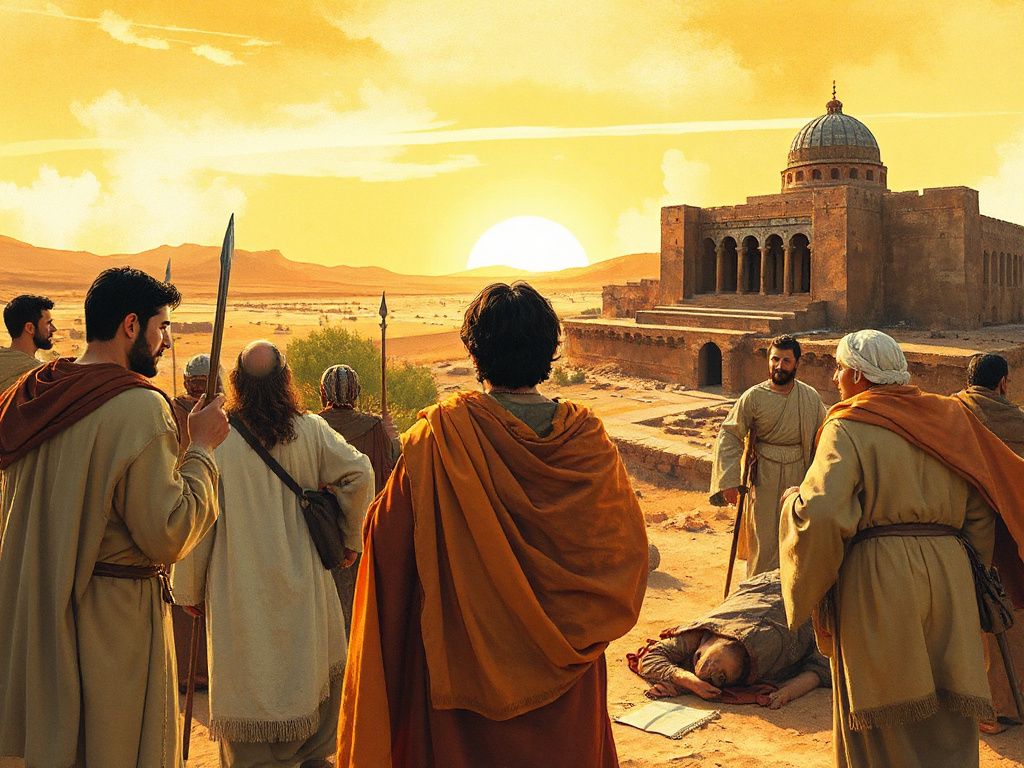
34Therefore Menela′us, taking Androni′cus aside, urged him to kill Oni′as. Androni′cus came to Oni′as, and resorting to treachery offered him sworn pledges and gave him his right hand, and in spite of his suspicion persuaded Oni′as to come out from the place of sanctuary; then, with no regard for justice, he immediately put him out of the way.
35For this reason not only Jews, but many also of other nations, were grieved and displeased at the unjust murder of the man.
36When the king returned from the region of Cilic′ia, the Jews in the city appealed to him with regard to the unreasonable murder of Oni′as, and the Greeks shared their hatred of the crime.
37Therefore Anti′ochus was grieved at heart and filled with pity, and wept because of the moderation and good conduct of the deceased;
38and inflamed with anger, he immediately stripped off the purple robe from Androni′cus, tore off his garments, and led him about the whole city to that very place where he had committed the outrage against Oni′as, and there he dispatched the bloodthirsty fellow. The Lord thus repaid him with the punishment he deserved.
39Unpopularity of Lysimachus and Menelaus When many acts of sacrilege had been committed in the city by Lysim′achus with the connivance of Menela′us, and when report of them had spread abroad, the populace gathered against Lysim′achus, because many of the gold vessels had already been stolen.
40And since the crowds were becoming aroused and filled with anger, Lysim′achus armed about three thousand men and launched an unjust attack, under the leadership of a certain Aura′nus, a man advanced in years and no less advanced in folly.
41But when the Jews became aware of Lysim′achus’ attack, some picked up stones, some blocks of wood, and others took handfuls of the ashes that were lying about, and threw them in wild confusion at Lysim′achus and his men.
42As a result, they wounded many of them, and killed some, and put them all to flight; and the temple robber himself they killed close by the treasury.
43Charges were brought against Menela′us about this incident.
44When the king came to Tyre, three men sent by the senate presented the case before him.
45But Menela′us, already as good as beaten, promised a substantial bribe to Ptol′emy son of Dorym′enes to win over the king.
46Therefore Ptol′emy, taking the king aside into a colonnade as if for refreshment, induced the king to change his mind.
47Menela′us, the cause of all the evil, he acquitted of the charges against him, while he sentenced to death those unfortunate men, who would have been freed uncondemned if they had pleaded even before Scyth′ians.
48And so those who had spoken for the city and the villages and the holy vessels quickly suffered the unjust penalty.
49Therefore even the Tyr′ians, showing their hatred of the crime, provided magnificently for their funeral.
50But Menela′us, because of the cupidity of those in power, remained in office, growing in wickedness, having become the chief plotter against his fellow citizens.