BIBLE BOOK GUIDE
2 Maccabees
15 chapters
Under Gentile persecution, the Jews fight for the Temple and the Law, revealing God's faithfulness to His people and the hope of resurrection beyond death.
2 Maccabees
Choose a chapter
Pick a chapter and it opens in the Current chapter tab. Come back here whenever you want to choose another one.
Why this book was written
The author supplements 1 Maccabees by recounting Jeremiah's letter, the martyrs' stories, and Judas Maccabeus's victories, offering concrete examples to encourage persecuted readers and strengthen their faith in the Temple, the Law, and the resurrection.
Structure
- 1–2Preface and the Letter of Jeremiah
- 3–7Suffering and Devastation in Jerusalem
- 8–10Judas Maccabeus's Counterattack and Temple Purification
- 11–12Diplomatic Documents and Care for the Dead
- 13–15Final Campaigns and Apocalyptic Vision
Major themes
Suffering and Martyrdom for the Faith
2 Maccabees recounts the desecration of the Jerusalem Temple and the martyrdom of an elderly scribe and a mother with her seven sons, who chose death over transgression of the Law (6:18–7:42), showing loyalty to the Torah above physical survival.
Purification and Rededication of the Temple
After Judas Maccabeus's victory over Nicanor, the Temple was purified, the altar renewed, and the feast of dedication celebrated (10:1–8), the event behind the Jewish festival of Hanukkah.
Hope of Resurrection
The martyrs affirm bodily resurrection: the third brother speaks of receiving his limbs again (7:11), the fourth cites the king's promise of resurrection (7:14), and the mother confesses the Lord of the world will raise them to eternal life (7:23, 29).
God's Faithfulness and Just Judgment
The author's two prefaces frame suffering as divine discipline (1:13–2:18), and the gruesome death of Antiochus IV (9:1–29) demonstrates God's righteous judgment upon the wicked.
Intercession and Prayers for the Dead
12:38–46 records Judas offering a sacrifice for fallen soldiers, praying for the dead 'that they might be delivered from their sin,' a key text for the Catholic doctrine of prayers for the dead.
God's Hand of Protection and Deliverance
The recurring phrase 'the hand of God' (3:34; 8:24; 15:15–21) shows that the Lord delivers through visions, guides, and protection.
How it points to Christ
Though deuterocanonical, 2 Maccabees is preserved in the Catholic canon. Its firm confession of bodily resurrection (7:9–23) aligns with Christian belief in resurrection; the sacrifice for the dead (12:38–46) founds the Christian practice of praying for souls in purgatory; the profanation and rededication of the Temple (10:1–8) foreshadows Christ who cleanses the inner temple of the believer (2 Cor 6:16); and the protective 'hand' of God (8:24) prefigures the all-powerful hand of the Lord Jesus.
Key verses
- 6:26Dying for the Law is presented as a noble exchange, foreshadowing the hope of resurrection.
- 7:9The mother of the seven sons affirms that the Creator will restore them to life beyond death.
- 7:28God created the world from nothing, grounding the doctrine of resurrection.
- 10:1–4The Maccabean purification of the Temple and restoration of the festival foreshadows purification and renewal through the cross.
- 12:38–46Prayers and sacrifices for the dead teach the faithful to offer charity for souls in purgatory.
- 15:9–14The vision of Jeremiah and Onias strengthens confidence in the Temple and the intercession of the saints.
- 15:36The institution of Hanukkah commemorates the miraculous deliverance and victory.
Questions for reflection
- ·When faith and life stand in tension, am I willing, like the seven brothers and their mother, to let eternal hope overcome present fear?
- ·Do I believe suffering can be purifying and lead to repentance, as the two preface letters explain (1:13–2:18)?
- ·Do I pray for the deceased, entrusting them to God's mercy (cf. 12:38–46)?
- ·Is there any 'temple' in my life that has been defiled and needs to be re-sanctified for true worship?
- ·How do I recognize and rely on the 'helping hand' of God at work in my life (cf. 8:24; 15:15)?
Want to read 2 Maccabees start to finish? Open the reader for parallel Chinese/English text and ask anything as you go.
Start reading 2 Maccabees2 Maccabees
Chapter 7
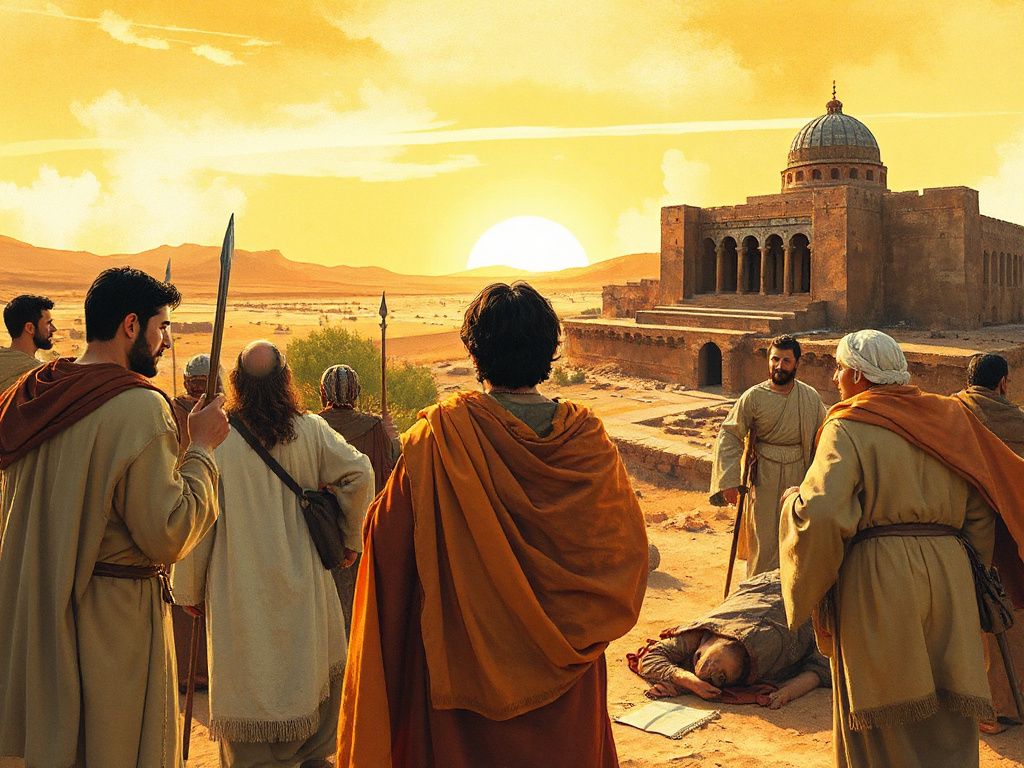
1The Martyrdom of Seven Brothers It happened also that seven brothers and their mother were arrested and were being compelled by the king, under torture with whips and cords, to partake of unlawful swine’s flesh.
2One of them, acting as their spokesman, said, “What do you intend to ask and learn from us? For we are ready to die rather than transgress the laws of our fathers.”
3The king fell into a rage, and gave orders that pans and caldrons be heated.
4These were heated immediately, and he commanded that the tongue of their spokesman be cut out and that they scalp him and cut off his hands and feet, while the rest of the brothers and the mother looked on.
5When he was utterly helpless, the king ordered them to take him to the fire, still breathing, and to fry him in a pan. The smoke from the pan spread widely, but the brothers and their mother encouraged one another to die nobly, saying,
6“The Lord God is watching over us and in truth has compassion on us, as Moses declared in his song which bore witness against the people to their faces, when he said, ‘And he will have compassion on his servants.’”
7After the first brother had died in this way, they brought forward the second for their sport. They tore off the skin of his head with the hair, and asked him, “Will you eat rather than have your body punished limb by limb?”
8He replied in the language of his fathers, and said to them, “No.” Therefore he in turn underwent tortures as the first brother had done.
9And when he was at his last breath, he said, “You accursed wretch, you dismiss us from this present life, but the King of the universe will raise us up to an everlasting renewal of life, because we have died for his laws.”
10After him, the third was the victim of their sport. When it was demanded, he quickly put out his tongue and courageously stretched forth his hands,
11and said nobly, “I got these from Heaven, and because of his laws I disdain them, and from him I hope to get them back again.”
12As a result the king himself and those with him were astonished at the young man’s spirit, for he regarded his sufferings as nothing.
13When he too had died, they maltreated and tortured the fourth in the same way.
14And when he was near death, he said, “One cannot but choose to die at the hands of men and to cherish the hope that God gives of being raised again by him. But for you there will be no resurrection to life!”
15Next they brought forward the fifth and maltreated him.
16But he looked at the king, and said, “Because you have authority among men, mortal though you are, you do what you please. But do not think that God has forsaken our people.
17Keep on, and see how his mighty power will torture you and your descendants!”
18After him they brought forward the sixth. And when he was about to die, he said, “Do not deceive yourself in vain. For we are suffering these things on our own account, because of our sins against our own God. Therefore astounding things have happened.
19But do not think that you will go unpunished for having tried to fight against God!”
20The mother was especially admirable and worthy of honorable memory. Though she saw her seven sons perish within a single day, she bore it with good courage because of her hope in the Lord.
21She encouraged each of them in the language of their fathers. Filled with a noble spirit, she fired her woman’s reasoning with a man’s courage, and said to them,
22“I do not know how you came into being in my womb. It was not I who gave you life and breath, nor I who set in order the elements within each of you.
23Therefore the Creator of the world, who shaped the beginning of man and devised the origin of all things, will in his mercy give life and breath back to you again, since you now forget yourselves for the sake of his laws.”
24Anti′ochus felt that he was being treated with contempt, and he was suspicious of her reproachful tone. The youngest brother being still alive, Anti′ochus not only appealed to him in words, but promised with oaths that he would make him rich and enviable if he would turn from the ways of his fathers, and that he would take him for his friend and entrust him with public affairs.
25Since the young man would not listen to him at all, the king called the mother to him and urged her to advise the youth to save himself.
26After much urging on his part, she undertook to persuade her son.
27But, leaning close to him, she spoke in their native tongue as follows, deriding the cruel tyrant: “My son, have pity on me. I carried you nine months in my womb, and nursed you for three years, and have reared you and brought you up to this point in your life, and have taken care of you.
28I beseech you, my child, to look at the heaven and the earth and see everything that is in them, and recognize that God did not make them out of things that existed. Thus also mankind comes into being.
29Do not fear this butcher, but prove worthy of your brothers. Accept death, so that in God’s mercy I may get you back again with your brothers.”
30While she was still speaking, the young man said, “What are you waiting for? I will not obey the king’s command, but I obey the command of the law that was given to our fathers through Moses.
31But you, who have contrived all sorts of evil against the Hebrews, will certainly not escape the hands of God.
32For we are suffering because of our own sins.
33And if our living Lord is angry for a little while, to rebuke and discipline us, he will again be reconciled with his own servants.
34But you, unholy wretch, you most defiled of all men, do not be elated in vain and puffed up by uncertain hopes, when you raise your hand against the children of heaven.
35You have not yet escaped the judgment of the almighty, all-seeing God.
36For our brothers after enduring a brief suffering have drunk of everflowing life under God’s covenant; but you, by the judgment of God, will receive just punishment for your arrogance.
37I, like my brothers, give up body and life for the laws of our fathers, appealing to God to show mercy soon to our nation and by afflictions and plagues to make you confess that he alone is God,
38and through me and my brothers to bring to an end the wrath of the Almighty which has justly fallen on our whole nation.”
39The king fell into a rage, and handled him worse than the others, being exasperated at his scorn.
40So he died in his integrity, putting his whole trust in the Lord.
41Last of all, the mother died, after her sons.
42Let this be enough, then, about the eating of sacrifices and the extreme tortures.