BIBLE BOOK GUIDE
2 Maccabees
15 chapters
Under Gentile persecution, the Jews fight for the Temple and the Law, revealing God's faithfulness to His people and the hope of resurrection beyond death.
2 Maccabees
Choose a chapter
Pick a chapter and it opens in the Current chapter tab. Come back here whenever you want to choose another one.
Why this book was written
The author supplements 1 Maccabees by recounting Jeremiah's letter, the martyrs' stories, and Judas Maccabeus's victories, offering concrete examples to encourage persecuted readers and strengthen their faith in the Temple, the Law, and the resurrection.
Structure
- 1–2Preface and the Letter of Jeremiah
- 3–7Suffering and Devastation in Jerusalem
- 8–10Judas Maccabeus's Counterattack and Temple Purification
- 11–12Diplomatic Documents and Care for the Dead
- 13–15Final Campaigns and Apocalyptic Vision
Major themes
Suffering and Martyrdom for the Faith
2 Maccabees recounts the desecration of the Jerusalem Temple and the martyrdom of an elderly scribe and a mother with her seven sons, who chose death over transgression of the Law (6:18–7:42), showing loyalty to the Torah above physical survival.
Purification and Rededication of the Temple
After Judas Maccabeus's victory over Nicanor, the Temple was purified, the altar renewed, and the feast of dedication celebrated (10:1–8), the event behind the Jewish festival of Hanukkah.
Hope of Resurrection
The martyrs affirm bodily resurrection: the third brother speaks of receiving his limbs again (7:11), the fourth cites the king's promise of resurrection (7:14), and the mother confesses the Lord of the world will raise them to eternal life (7:23, 29).
God's Faithfulness and Just Judgment
The author's two prefaces frame suffering as divine discipline (1:13–2:18), and the gruesome death of Antiochus IV (9:1–29) demonstrates God's righteous judgment upon the wicked.
Intercession and Prayers for the Dead
12:38–46 records Judas offering a sacrifice for fallen soldiers, praying for the dead 'that they might be delivered from their sin,' a key text for the Catholic doctrine of prayers for the dead.
God's Hand of Protection and Deliverance
The recurring phrase 'the hand of God' (3:34; 8:24; 15:15–21) shows that the Lord delivers through visions, guides, and protection.
How it points to Christ
Though deuterocanonical, 2 Maccabees is preserved in the Catholic canon. Its firm confession of bodily resurrection (7:9–23) aligns with Christian belief in resurrection; the sacrifice for the dead (12:38–46) founds the Christian practice of praying for souls in purgatory; the profanation and rededication of the Temple (10:1–8) foreshadows Christ who cleanses the inner temple of the believer (2 Cor 6:16); and the protective 'hand' of God (8:24) prefigures the all-powerful hand of the Lord Jesus.
Key verses
- 6:26Dying for the Law is presented as a noble exchange, foreshadowing the hope of resurrection.
- 7:9The mother of the seven sons affirms that the Creator will restore them to life beyond death.
- 7:28God created the world from nothing, grounding the doctrine of resurrection.
- 10:1–4The Maccabean purification of the Temple and restoration of the festival foreshadows purification and renewal through the cross.
- 12:38–46Prayers and sacrifices for the dead teach the faithful to offer charity for souls in purgatory.
- 15:9–14The vision of Jeremiah and Onias strengthens confidence in the Temple and the intercession of the saints.
- 15:36The institution of Hanukkah commemorates the miraculous deliverance and victory.
Questions for reflection
- ·When faith and life stand in tension, am I willing, like the seven brothers and their mother, to let eternal hope overcome present fear?
- ·Do I believe suffering can be purifying and lead to repentance, as the two preface letters explain (1:13–2:18)?
- ·Do I pray for the deceased, entrusting them to God's mercy (cf. 12:38–46)?
- ·Is there any 'temple' in my life that has been defiled and needs to be re-sanctified for true worship?
- ·How do I recognize and rely on the 'helping hand' of God at work in my life (cf. 8:24; 15:15)?
Want to read 2 Maccabees start to finish? Open the reader for parallel Chinese/English text and ask anything as you go.
Start reading 2 Maccabees2 Maccabees
Chapter 13
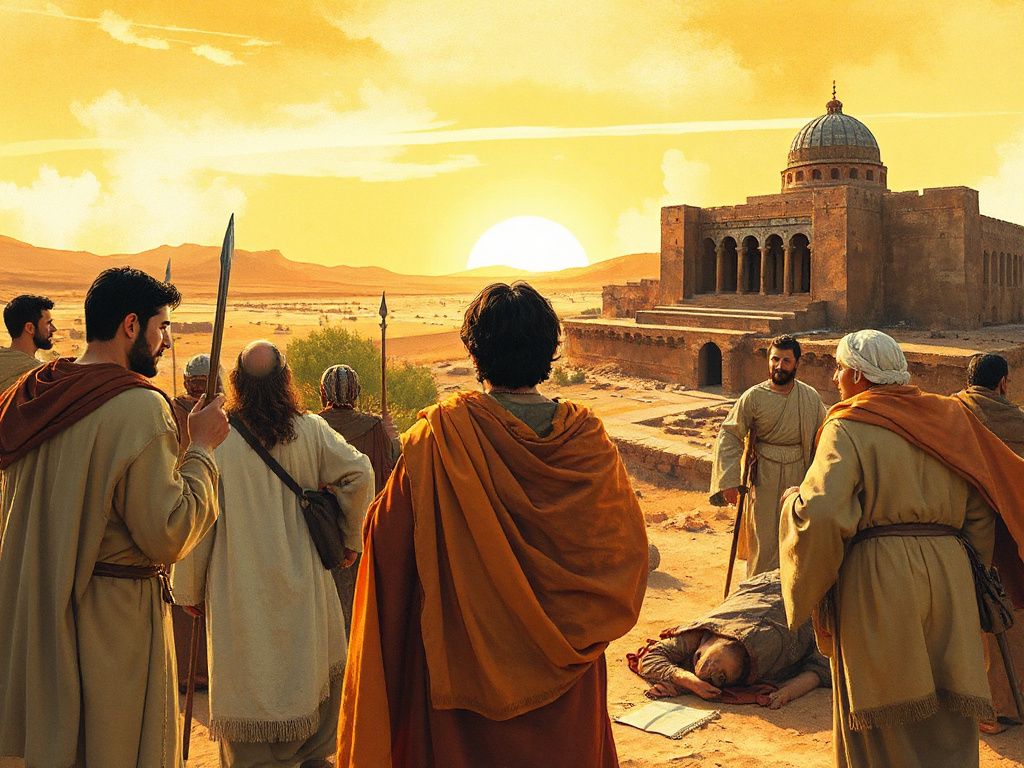
1Menelaus Is Put to Death In the one hundred and forty-ninth year word came to Judas and his men that Anti′ochus Eu′pator was coming with a great army against Judea,
2and with him Lys′ias, his guardian, who had charge of the government. Each of them had a Greek force of one hundred and ten thousand infantry, five thousand three hundred cavalry, twenty-two elephants, and three hundred chariots armed with scythes.
3Menela′us also joined them and with utter hypocrisy urged Anti′ochus on, not for the sake of his country’s welfare, but because he thought that he would be established in office.
4But the King of kings aroused the anger of Anti′ochus against the scoundrel; and when Lys′ias informed him that this man was to blame for all the trouble, he ordered them to take him to Beroe′a and to put him to death by the method which is the custom in that place.
5For there is a tower in that place, fifty cubits high, full of ashes, and it has a rim running around it which on all sides inclines precipitously into the ashes.
6There they all push to destruction any man guilty of sacrilege or notorious for other crimes.
7By such a fate it came about that Menela′us the lawbreaker died, without even burial in the earth.
8And this was eminently just; because he had committed many sins against the altar whose fire and ashes were holy, he met his death in ashes.
9A Battle Near the City of Modein The king with barbarous arrogance was coming to show to the Jews things far worse than those that had been done in his father’s time.
10But when Judas heard of this, he ordered the people to call upon the Lord day and night, now if ever to help those who were on the point of being deprived of the law and their country and the holy temple,
11and not to let the people who had just begun to revive fall into the hands of the blasphemous Gentiles.
12When they had all joined in the same petition and had besought the merciful Lord with weeping and fasting and lying prostrate for three days without ceasing, Judas exhorted them and ordered them to stand ready.
13After consulting privately with the elders, he determined to march out and decide the matter by the help of God before the king’s army could enter Judea and get possession of the city.
14So, committing the decision to the Creator of the world and exhorting his men to fight nobly to the death for the laws, temple, city, country, and commonwealth, he pitched his camp near Mo′de-in.
15He gave his men the watchword, “God’s victory,” and with a picked force of the bravest young men, he attacked the king’s pavilion at night and slew as many as two thousand men in the camp. He stabbed the leading elephant and its rider.
16In the end they filled the camp with terror and confusion and withdrew in triumph.
17This happened, just as day was dawning, because the Lord’s help protected him.
18Antiochus Makes a Treaty with the Jews The king, having had a taste of the daring of the Jews, tried strategy in attacking their positions.
19He advanced against Beth-zur, a strong fortress of the Jews, was turned back, attacked again, and was defeated.
20Judas sent in to the garrison whatever was necessary.
21But Rhod′ocus, a man from the ranks of the Jews, gave secret information to the enemy; he was sought for, caught, and put in prison.
22The king negotiated a second time with the people in Beth-zur, gave pledges, received theirs, withdrew, attacked Judas and his men, was defeated;
23he got word that Philip, who had been left in charge of the government, had revolted in Antioch; he was dismayed, called in the Jews, yielded and swore to observe all their rights, settled with them and offered sacrifice, honored the sanctuary and showed generosity to the holy place.
24He received Maccabe′us, left Hegemon′ides as governor from Ptolema′is to Gerar,
25and went to Ptolema′is. The people of Ptolema′is were indignant over the treaty; in fact they were so angry that they wanted to annul its terms.
26Lys′ias took the public platform, made the best possible defense, convinced them, appeased them, gained their good will, and set out for Antioch. This is how the king’s attack and withdrawal turned out.