BIBLE BOOK GUIDE
2 Maccabees
15 chapters
Under Gentile persecution, the Jews fight for the Temple and the Law, revealing God's faithfulness to His people and the hope of resurrection beyond death.
2 Maccabees
Choose a chapter
Pick a chapter and it opens in the Current chapter tab. Come back here whenever you want to choose another one.
Why this book was written
The author supplements 1 Maccabees by recounting Jeremiah's letter, the martyrs' stories, and Judas Maccabeus's victories, offering concrete examples to encourage persecuted readers and strengthen their faith in the Temple, the Law, and the resurrection.
Structure
- 1–2Preface and the Letter of Jeremiah
- 3–7Suffering and Devastation in Jerusalem
- 8–10Judas Maccabeus's Counterattack and Temple Purification
- 11–12Diplomatic Documents and Care for the Dead
- 13–15Final Campaigns and Apocalyptic Vision
Major themes
Suffering and Martyrdom for the Faith
2 Maccabees recounts the desecration of the Jerusalem Temple and the martyrdom of an elderly scribe and a mother with her seven sons, who chose death over transgression of the Law (6:18–7:42), showing loyalty to the Torah above physical survival.
Purification and Rededication of the Temple
After Judas Maccabeus's victory over Nicanor, the Temple was purified, the altar renewed, and the feast of dedication celebrated (10:1–8), the event behind the Jewish festival of Hanukkah.
Hope of Resurrection
The martyrs affirm bodily resurrection: the third brother speaks of receiving his limbs again (7:11), the fourth cites the king's promise of resurrection (7:14), and the mother confesses the Lord of the world will raise them to eternal life (7:23, 29).
God's Faithfulness and Just Judgment
The author's two prefaces frame suffering as divine discipline (1:13–2:18), and the gruesome death of Antiochus IV (9:1–29) demonstrates God's righteous judgment upon the wicked.
Intercession and Prayers for the Dead
12:38–46 records Judas offering a sacrifice for fallen soldiers, praying for the dead 'that they might be delivered from their sin,' a key text for the Catholic doctrine of prayers for the dead.
God's Hand of Protection and Deliverance
The recurring phrase 'the hand of God' (3:34; 8:24; 15:15–21) shows that the Lord delivers through visions, guides, and protection.
How it points to Christ
Though deuterocanonical, 2 Maccabees is preserved in the Catholic canon. Its firm confession of bodily resurrection (7:9–23) aligns with Christian belief in resurrection; the sacrifice for the dead (12:38–46) founds the Christian practice of praying for souls in purgatory; the profanation and rededication of the Temple (10:1–8) foreshadows Christ who cleanses the inner temple of the believer (2 Cor 6:16); and the protective 'hand' of God (8:24) prefigures the all-powerful hand of the Lord Jesus.
Key verses
- 6:26Dying for the Law is presented as a noble exchange, foreshadowing the hope of resurrection.
- 7:9The mother of the seven sons affirms that the Creator will restore them to life beyond death.
- 7:28God created the world from nothing, grounding the doctrine of resurrection.
- 10:1–4The Maccabean purification of the Temple and restoration of the festival foreshadows purification and renewal through the cross.
- 12:38–46Prayers and sacrifices for the dead teach the faithful to offer charity for souls in purgatory.
- 15:9–14The vision of Jeremiah and Onias strengthens confidence in the Temple and the intercession of the saints.
- 15:36The institution of Hanukkah commemorates the miraculous deliverance and victory.
Questions for reflection
- ·When faith and life stand in tension, am I willing, like the seven brothers and their mother, to let eternal hope overcome present fear?
- ·Do I believe suffering can be purifying and lead to repentance, as the two preface letters explain (1:13–2:18)?
- ·Do I pray for the deceased, entrusting them to God's mercy (cf. 12:38–46)?
- ·Is there any 'temple' in my life that has been defiled and needs to be re-sanctified for true worship?
- ·How do I recognize and rely on the 'helping hand' of God at work in my life (cf. 8:24; 15:15)?
Want to read 2 Maccabees start to finish? Open the reader for parallel Chinese/English text and ask anything as you go.
Start reading 2 Maccabees2 Maccabees
Chapter 9
1The Last Campaign of Antiochus Epiphanes About that time, as it happened, Anti′ochus had retreated in disorder from the region of Persia.
2For he had entered the city called Persep′olis, and attempted to rob the temples and control the city. Therefore the people rushed to the rescue with arms, and Anti′ochus and his men were defeated, with the result that Anti′ochus was put to flight by the inhabitants and beat a shameful retreat.
3While he was in Ecbat′ana, news came to him of what had happened to Nica′nor and the forces of Timothy.
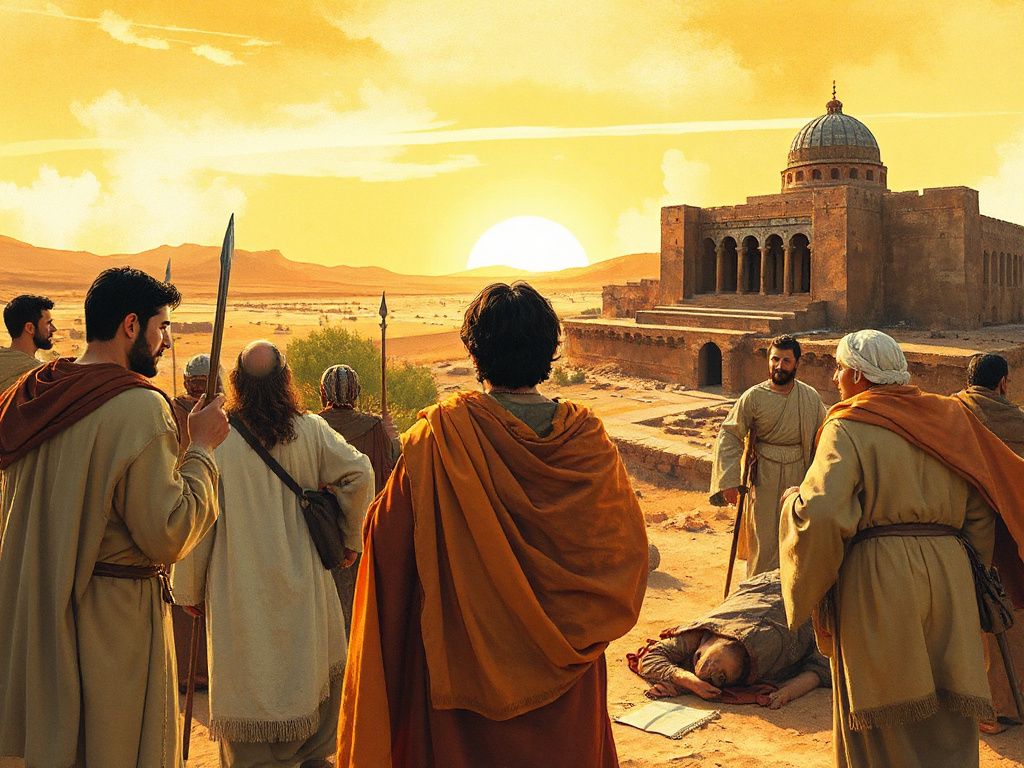
4Transported with rage, he conceived the idea of turning upon the Jews the injury done by those who had put him to flight; so he ordered his charioteer to drive without stopping until he completed the journey. But the judgment of heaven rode with him! For in his arrogance he said, “When I get there I will make Jerusalem a cemetery of Jews.”
5But the all-seeing Lord, the God of Israel, struck him an incurable and unseen blow. As soon as he ceased speaking he was seized with a pain in his bowels for which there was no relief and with sharp internal tortures—
6and that very justly, for he had tortured the bowels of others with many and strange inflictions.
7Yet he did not in any way stop his insolence, but was even more filled with arrogance, breathing fire in his rage against the Jews, and giving orders to hasten the journey. And so it came about that he fell out of his chariot as it was rushing along, and the fall was so hard as to torture every limb of his body.
8Thus he who had just been thinking that he could command the waves of the sea, in his superhuman arrogance, and imagining that he could weigh the high mountains in a balance, was brought down to earth and carried in a litter, making the power of God manifest to all.
9And so the ungodly man’s body swarmed with worms, and while he was still living in anguish and pain, his flesh rotted away, and because of his stench the whole army felt revulsion at his decay.
10Because of his intolerable stench no one was able to carry the man who a little while before had thought that he could touch the stars of heaven.
11Then it was that, broken in spirit, he began to lose much of his arrogance and to come to his senses under the scourge of God, for he was tortured with pain every moment.
12And when he could not endure his own stench, he uttered these words: “It is right to be subject to God, and no mortal should think that he is equal to God.”
13Antiochus Makes a Promise to God Then the abominable fellow made a vow to the Lord, who would no longer have mercy on him, stating
14that the holy city, which he was hastening to level to the ground and to make a cemetery, he was now declaring to be free;
15and the Jews, whom he had not considered worth burying but had planned to throw out with their children to the beasts, for the birds to pick, he would make, all of them, equal to citizens of Athens;
16and the holy sanctuary, which he had formerly plundered, he would adorn with the finest offerings; and the holy vessels he would give back, all of them, many times over; and the expenses incurred for the sacrifices he would provide from his own revenues;
17and in addition to all this he also would become a Jew and would visit every inhabited place to proclaim the power of God.
18But when his sufferings did not in any way abate, for the judgment of God had justly come upon him, he gave up all hope for himself and wrote to the Jews the following letter, in the form of a supplication. This was its content:
19Antiochus’s Letter and Death “To his worthy Jewish citizens, Anti′ochus their king and general sends hearty greetings and good wishes for their health and prosperity.
20If you and your children are well and your affairs are as you wish, I am glad. As my hope is in heaven,
21I remember with affection your esteem and good will. On my way back from the region of Persia I suffered an annoying illness, and I have deemed it necessary to take thought for the general security of all.
22I do not despair of my condition, for I have good hope of recovering from my illness,
23but I observed that my father, on the occasions when he made expeditions into the upper country, appointed his successor,
24so that, if anything unexpected happened or any unwelcome news came, the people throughout the realm would not be troubled, for they would know to whom the government was left.
25Moreover, I understand how the princes along the borders and the neighbors to my kingdom keep watching for opportunities and waiting to see what will happen. So I have appointed my son Anti′ochus to be king, whom I have often entrusted and commended to most of you when I hastened off to the upper provinces; and I have written to him what is written here.
26I therefore urge and beseech you to remember the public and private services rendered to you and to maintain your present good will, each of you, toward me and my son.
27For I am sure that he will follow my policy and will treat you with moderation and kindness.”
28So the murderer and blasphemer, having endured the most intense suffering, such as he had inflicted on others, came to the end of his life by a most pitiable fate, among the mountains in a strange land.
29And Philip, one of his courtiers, took his body home; then, fearing the son of Anti′ochus, he betook himself to Ptol′emy Philome′tor in Egypt.