BIBLE BOOK GUIDE
Nehemiah
13 chapters
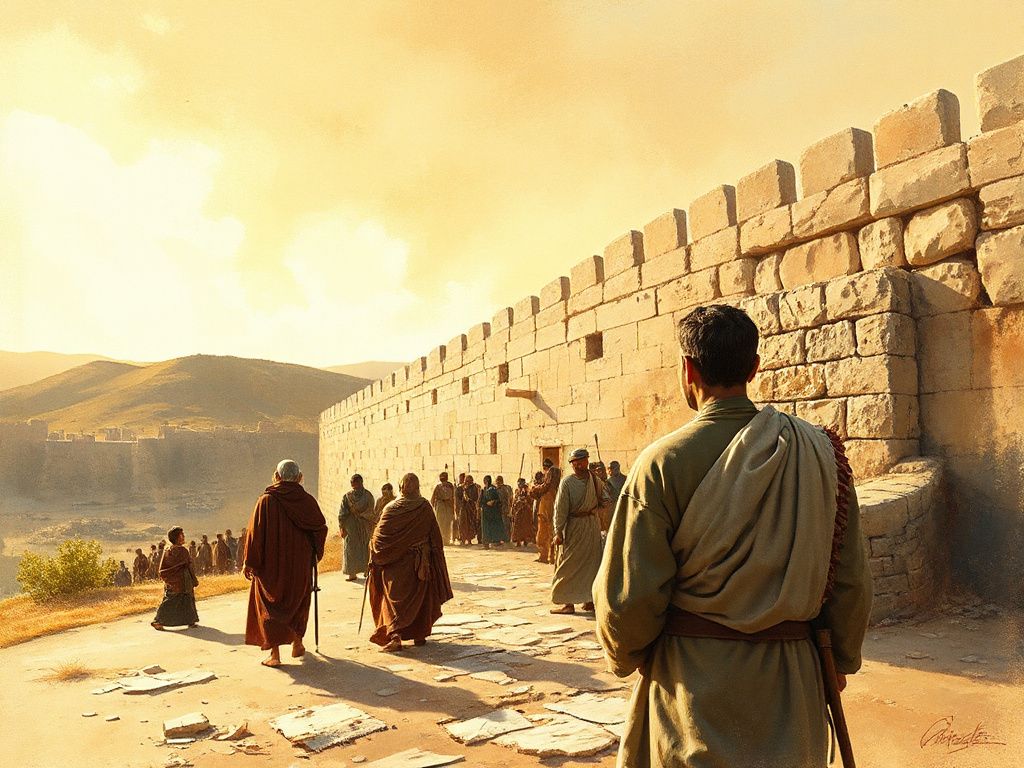
In the context of post-exilic ruin, God uses Nehemiah's leadership, prayer, and action to rally the remnant to rebuild Jerusalem's walls so that worship and God's presence are restored.
Nehemiah
Choose a chapter
Pick a chapter and it opens in the Current chapter tab. Come back here whenever you want to choose another one.
Why this book was written
Written in the post-exilic period, the book records how Nehemiah led the returnees to rebuild Jerusalem's walls, addressing the remnant and future readers. The author shows that God remains faithful amid hardship, calling His people to face opposition and division through prayer, repentance, and unified service, thereby safeguarding the holy city and temple worship.
Structure
- 1–2Nehemiah's Burden and Return
- 3–7Rebuilding the Walls of Jerusalem
- 8–10Hearing the Law, Confession, and Covenant Renewal
- 11–12Settling the People and Dedication of the Walls
- 13Nehemiah's Reforms and Vigilance
Major themes
Rebuilding and Renewal
Nehemiah records how the returned exiles rebuilt Jerusalem's walls (Neh 2:17-18; 6:15), symbolizing spiritual renewal and God's restoring work.
Prayer and Dependence on God
Nehemiah punctuates the book with short prayers (Neh 2:4; 4:4-5; 5:19; 6:9; 13:14, 22, 29, 31), showing reliance on God for guidance and protection in every matter.
Self-Sacrificing and Faithful Leadership
Nehemiah served as governor for twelve years without exploiting his position or demanding provision (Neh 5:14-18), modeling humble service and righteous governance.
Resisting Opposition
Facing ridicule, threats, and plots from Sanballat, Tobiah, the Ammonites, and others (Neh 2:10, 19; 4:1-3; 6:1-14), the people built with tools in one hand and weapons in the other, combining faith with action.
Return and Reform of the Covenant Community
Chapters 8-13 record Ezra's reading of the Law, the people's confession and covenant renewal (Neh 8-10), and reforms removing impurity from the temple and stopping intermarriage (Neh 13), emphasizing renewed covenant commitment.
How it points to Christ
Though Nehemiah does not directly predict the Messiah, its themes are fully realized in Christ: Nehemiah acts as mediator for the exiles, seeking favor from King Artaxerxes (Neh 2:1-8), prefiguring Christ as our great High Priest interceding before the Father (Heb 7:25). The rebuilt walls point to Christ breaking down the dividing wall (Eph 2:14) so that God and people, and people with one another, may be reconciled. The covenant renewal (Neh 9-10) anticipates the superior new covenant established by Christ (Heb 8:6-13). Nehemiah's anguish over his people and zeal for the temple (Neh 13:8-9) mirrors Christ's jealous zeal for God's house (John 2:17).
Key verses
- 1:5–11Nehemiah's confessional prayer sets the book's spiritual tone: the work of rebuilding begins with humble repentance and trust in the covenant-keeping God.
- 2:17–18Nehemiah rallies the people to build, and God's hand is confirmed upon him, marking the official launch of the rebuilding project.
- 4:9Faced with mockery and threats, the people built with one hand, held weapons with the other, and prayed to God.
- 6:15–16The wall was completed in fifty-two days, striking fear into the enemies and showing the work was from God.
- 8:8–10Ezra expounds the Law; the people weep with joy and are told that the joy of the Lord is their strength.
- 9:6The Levites' prayer exalts God as Creator and covenant-keeper, forming the heart of the community's spiritual renewal.
- 10:29–39The people enter a binding oath to walk in God's Law, support the temple, and bring tithes, showing genuine covenant commitment.
- 13:31Nehemiah closes with a plea to be remembered after ordering purifications and arrangements, echoing the book's call to holiness and vigilance.
People in this book
Questions for reflection
- ·When facing daunting tasks or opposition, do I first pray and seek God like Nehemiah before taking action (Neh 2:4-8)?
- ·In leadership or service, do I guard my heart from self-interest as Nehemiah did, refusing to exploit the people (Neh 5:14-18)?
- ·In the covenant renewal (Neh 8-10), the people wept, confessed, and recommitted themselves. Do I likewise continually return to God's Word to examine my heart and renew my commitments?
- ·When enemies use ridicule, threats, and deception (Neh 6) to cause me to abandon God's calling, how can I persevere as Nehemiah did?
- ·Does Nehemiah remind me that spiritual renewal is not only about external building but also about inner holiness and obedience (Neh 13)?
Where Nehemiah fits in the Bible's storyline
This book appears in the 12-stop storyline at:
Where to start reading the Bible? See the full 12-stop storyline
Want to read Nehemiah start to finish? Open the reader for parallel Chinese/English text and ask anything as you go.
Start reading NehemiahNehemiah
Chapter 10
1Now those that sealed were: Nehemiah the governor, the son of Hacaliah, and Zedekiah,
2Seraiah, Azariah, Jeremiah,
3Pashhur, Amariah, Malchijah,
4Hattush, Shebaniah, Malluch,
5Harim, Meremoth, Obadiah,
6340, Ginnethon, Baruch,
7Meshullam, Abijah, Mijamin,
8Maaziah, Bilgai, Shemaiah; these were the priests.
9And the Levites: namely, Jeshua the son of Azaniah, Binnui of the sons of Henadad, Kadmiel;
10and their brethren, Shebaniah, Hodiah, Kelita, Pelaiah, Hanan,
11Mica, Rehob, Hashabiah,
12Zaccur, Sherebiah, Shebaniah,
13Hodiah, Bani, Beninu.
14The chiefs of the people: Parosh, Pahath-moab, Elam, Zattu, Bani,
15Bunni, Azgad, Bebai,
16Adonijah, Bigvai, Adin,
17Ater, Hezekiah, Azzur,
18Hodiah, Hashum, Bezai,
19Hariph, Anathoth, Nobai,
20Magpiash, Meshullam, Hezir,
21Meshezabel, Zadok, Jaddua,
22Pelatiah, Hanan, Anaiah,
23Hoshea, Hananiah, Hasshub,
24Hallohesh, Pilha, Shobek,
25Rehum, Hashabnah, Maaseiah,
26and Ahiah, Hanan, Anan,
27Malluch, Harim, Baanah.
28And the rest of the people, the priests, the Levites, the porters, the singers, the Nethinim, and all they that had separated themselves from the peoples of the lands unto the law of God, their wives, their sons, and their daughters, every one that had knowledge, and understanding;
29They clave to their brethren, their nobles, and entered into a curse, and into an oath, to walk in God's law, which was given by Moses the servant of God, and to observe and do all the commandments of Jehovah our Lord, and his ordinances and his statutes;
30and that we would not give our daughters unto the peoples of the land, nor take their daughters for our sons;
31and if the peoples of the land bring wares or any grain on the sabbath day to sell, that we would not buy of them on the sabbath, or on a holy day; and that we would forego the seventh year, and the exaction of every debt.
32Also we made ordinances for us, to charge ourselves yearly with the third part of a shekel for the service of the house of our God;
33for the showbread, and for the continual meal - offering, and for the continual burnt-offering, for the sabbaths, for the new moons, for the set feasts, and for the holy things, and for the sin-offerings to make atonement for Israel, and for all the work of the house of our God.
34And we cast lots, the priests, the Levites, and the people, for the wood - offering, to bring it into the house of our God, according to our fathers' houses, at times appointed, year by year, to burn upon the altar of Jehovah our God, as it is written in the law;
35and to bring the first-fruits of our ground, and the first-fruits of all fruit of all manner of trees, year by year, unto the house of Jehovah;
36also the first-born of our sons, and of our cattle, as it is written in the law, and the firstlings of our herds and of our flocks, to bring to the house of our God, unto the priests that minister in the house of our God;
37and that we should bring the first-fruits of our dough, and our heave-offerings, and the fruit of all manner of trees, the new wine and the oil, unto the priests, to the chambers of the house of our God; and the tithes of our ground unto the Levites; for they, the Levites, take the tithes in all the cities of our tillage.
38And the priest the son of Aaron shall be with the Levites, when the Levites take tithes: and the Levites shall bring up the tithe of the tithes unto the house of our God, to the chambers, into the treasure - house.
39For the children of Israel and the children of Levi shall bring the heave-offering of the grain, of the new wine, and of the oil, unto the chambers, where are the vessels of the sanctuary, and the priests that minister, and the porters, and the singers: and we will not forsake the house of our God.