BIBLE BOOK GUIDE
Nehemiah
13 chapters
In the context of post-exilic ruin, God uses Nehemiah's leadership, prayer, and action to rally the remnant to rebuild Jerusalem's walls so that worship and God's presence are restored.
Nehemiah
Choose a chapter
Pick a chapter and it opens in the Current chapter tab. Come back here whenever you want to choose another one.
Why this book was written
Written in the post-exilic period, the book records how Nehemiah led the returnees to rebuild Jerusalem's walls, addressing the remnant and future readers. The author shows that God remains faithful amid hardship, calling His people to face opposition and division through prayer, repentance, and unified service, thereby safeguarding the holy city and temple worship.
Structure
- 1–2Nehemiah's Burden and Return
- 3–7Rebuilding the Walls of Jerusalem
- 8–10Hearing the Law, Confession, and Covenant Renewal
- 11–12Settling the People and Dedication of the Walls
- 13Nehemiah's Reforms and Vigilance
Major themes
Rebuilding and Renewal
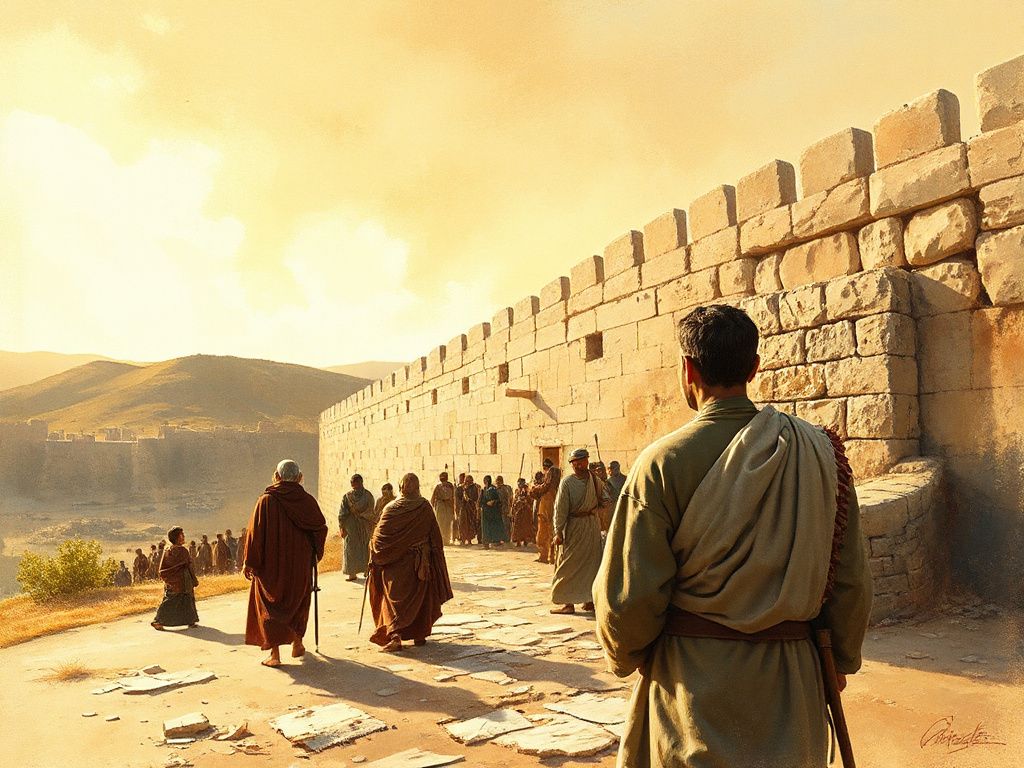
Nehemiah records how the returned exiles rebuilt Jerusalem's walls (Neh 2:17-18; 6:15), symbolizing spiritual renewal and God's restoring work.
Prayer and Dependence on God
Nehemiah punctuates the book with short prayers (Neh 2:4; 4:4-5; 5:19; 6:9; 13:14, 22, 29, 31), showing reliance on God for guidance and protection in every matter.
Self-Sacrificing and Faithful Leadership
Nehemiah served as governor for twelve years without exploiting his position or demanding provision (Neh 5:14-18), modeling humble service and righteous governance.
Resisting Opposition
Facing ridicule, threats, and plots from Sanballat, Tobiah, the Ammonites, and others (Neh 2:10, 19; 4:1-3; 6:1-14), the people built with tools in one hand and weapons in the other, combining faith with action.
Return and Reform of the Covenant Community
Chapters 8-13 record Ezra's reading of the Law, the people's confession and covenant renewal (Neh 8-10), and reforms removing impurity from the temple and stopping intermarriage (Neh 13), emphasizing renewed covenant commitment.
How it points to Christ
Though Nehemiah does not directly predict the Messiah, its themes are fully realized in Christ: Nehemiah acts as mediator for the exiles, seeking favor from King Artaxerxes (Neh 2:1-8), prefiguring Christ as our great High Priest interceding before the Father (Heb 7:25). The rebuilt walls point to Christ breaking down the dividing wall (Eph 2:14) so that God and people, and people with one another, may be reconciled. The covenant renewal (Neh 9-10) anticipates the superior new covenant established by Christ (Heb 8:6-13). Nehemiah's anguish over his people and zeal for the temple (Neh 13:8-9) mirrors Christ's jealous zeal for God's house (John 2:17).
Key verses
- 1:5–11Nehemiah's confessional prayer sets the book's spiritual tone: the work of rebuilding begins with humble repentance and trust in the covenant-keeping God.
- 2:17–18Nehemiah rallies the people to build, and God's hand is confirmed upon him, marking the official launch of the rebuilding project.
- 4:9Faced with mockery and threats, the people built with one hand, held weapons with the other, and prayed to God.
- 6:15–16The wall was completed in fifty-two days, striking fear into the enemies and showing the work was from God.
- 8:8–10Ezra expounds the Law; the people weep with joy and are told that the joy of the Lord is their strength.
- 9:6The Levites' prayer exalts God as Creator and covenant-keeper, forming the heart of the community's spiritual renewal.
- 10:29–39The people enter a binding oath to walk in God's Law, support the temple, and bring tithes, showing genuine covenant commitment.
- 13:31Nehemiah closes with a plea to be remembered after ordering purifications and arrangements, echoing the book's call to holiness and vigilance.
People in this book
Questions for reflection
- ·When facing daunting tasks or opposition, do I first pray and seek God like Nehemiah before taking action (Neh 2:4-8)?
- ·In leadership or service, do I guard my heart from self-interest as Nehemiah did, refusing to exploit the people (Neh 5:14-18)?
- ·In the covenant renewal (Neh 8-10), the people wept, confessed, and recommitted themselves. Do I likewise continually return to God's Word to examine my heart and renew my commitments?
- ·When enemies use ridicule, threats, and deception (Neh 6) to cause me to abandon God's calling, how can I persevere as Nehemiah did?
- ·Does Nehemiah remind me that spiritual renewal is not only about external building but also about inner holiness and obedience (Neh 13)?
Where Nehemiah fits in the Bible's storyline
This book appears in the 12-stop storyline at:
Where to start reading the Bible? See the full 12-stop storyline
Want to read Nehemiah start to finish? Open the reader for parallel Chinese/English text and ask anything as you go.
Start reading NehemiahNehemiah
Chapter 4
1But it came to pass that, when Sanballat heard that we were building the wall, he was wroth, and took great indignation, and mocked the Jews.
2And he spake before his brethren and the army of Samaria, and said, What are these feeble Jews doing? will they fortify themselves? will they sacrifice? will they make an end in a day? will they revive the stones out of the heaps of rubbish, seeing they are burned?
3Now Tobiah the Ammonite was by him, and he said, Even that which they are building, if a fox go up, he shall break down their stone wall.
4Hear, O our God; for we are despised: and turn back their reproach upon their own head, and give them up for a spoil in a land of captivity;
5and cover not their iniquity, and let not their sin be blotted out from before thee; for they have provoked thee to anger before the builders.
6So we built the wall; and all the wall was joined together unto half the height thereof: for the people had a mind to work.
7But it came to pass that, when Sanballat, and Tobiah, and the Arabians, and the Ammonites, and the Ashdodites, heard that the repairing of the walls of Jerusalem went forward, and that the breaches began to be stopped, then they were very wroth;
8and they conspired all of them together to come and fight against Jerusalem, and to cause confusion therein.
9But we made our prayer unto our God, and set a watch against them day and night, because of them.
10And Judah said, The strength of the bearers of burdens is decayed, and there is much rubbish; so that we are not able to build the wall.
11And our adversaries said, They shall not know, neither see, till we come into the midst of them, and slay them, and cause the work to cease.
12And it came to pass that, when the Jews that dwelt by them came, they said unto us ten times from all places, Ye must return unto us.
13Therefore set I in the lowest parts of the space behind the wall, in the open places, I set there the people after their families with their swords, their spears, and their bows.
14And I looked, and rose up, and said unto the nobles, and to the rulers, and to the rest of the people, Be not ye afraid of them: remember the Lord, who is great and terrible, and fight for your brethren, your sons, and your daughters, your wives, and your houses.
15And it came to pass, when our enemies heard that it was known unto us, and God had brought their counsel to nought, that we returned all of us to the wall, every one unto his work.
16And it came to pass from that time forth, that half of my servants wrought in the work, and half of them held the spears, the shields, and the bows, and the coats of mail; and the rulers were behind all the house of Judah.
17They all builded the wall and they that bare burdens laded themselves; every one with one of his hands wrought in the work, and with the other held his weapon;
18and the builders, every one had his sword girded by his side, and so builded. And he that sounded the trumpet was by me.
19And I said unto the nobles, and to the rulers and to the rest of the people, The work is great and large, and we are separated upon the wall, one far from another:
20in what place soever ye hear the sound of the trumpet, resort ye thither unto us; our God will fight for us.
21So we wrought in the work: and half of them held the spears from the rising of the morning till the stars appeared.
22Likewise at the same time said I unto the people, Let every one with his servant lodge within Jerusalem, that in the night they may be a guard to us, and may labor in the day.
23So neither I, nor my brethren, nor my servants, nor the men of the guard that followed me, none of us put off our clothes, every one went with his weapon to the water.