BIBLE BOOK GUIDE
Nehemiah
13 chapters
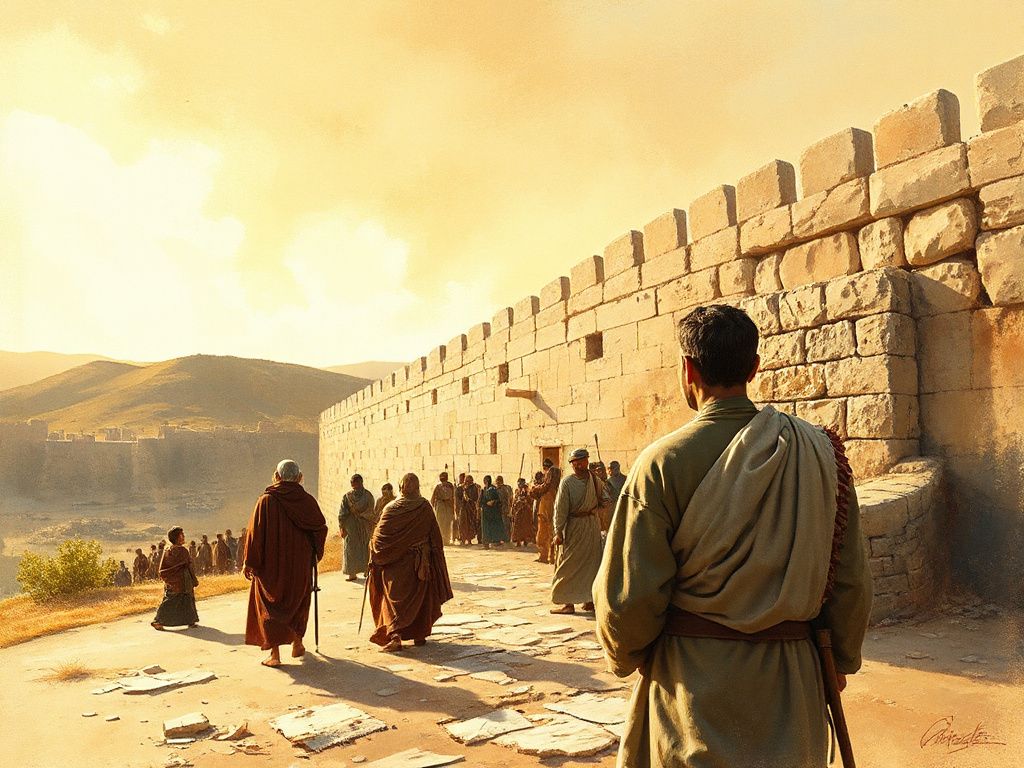
In the context of post-exilic ruin, God uses Nehemiah's leadership, prayer, and action to rally the remnant to rebuild Jerusalem's walls so that worship and God's presence are restored.
Nehemiah
Choose a chapter
Pick a chapter and it opens in the Current chapter tab. Come back here whenever you want to choose another one.
Why this book was written
Written in the post-exilic period, the book records how Nehemiah led the returnees to rebuild Jerusalem's walls, addressing the remnant and future readers. The author shows that God remains faithful amid hardship, calling His people to face opposition and division through prayer, repentance, and unified service, thereby safeguarding the holy city and temple worship.
Structure
- 1–2Nehemiah's Burden and Return
- 3–7Rebuilding the Walls of Jerusalem
- 8–10Hearing the Law, Confession, and Covenant Renewal
- 11–12Settling the People and Dedication of the Walls
- 13Nehemiah's Reforms and Vigilance
Major themes
Rebuilding and Renewal
Nehemiah records how the returned exiles rebuilt Jerusalem's walls (Neh 2:17-18; 6:15), symbolizing spiritual renewal and God's restoring work.
Prayer and Dependence on God
Nehemiah punctuates the book with short prayers (Neh 2:4; 4:4-5; 5:19; 6:9; 13:14, 22, 29, 31), showing reliance on God for guidance and protection in every matter.
Self-Sacrificing and Faithful Leadership
Nehemiah served as governor for twelve years without exploiting his position or demanding provision (Neh 5:14-18), modeling humble service and righteous governance.
Resisting Opposition
Facing ridicule, threats, and plots from Sanballat, Tobiah, the Ammonites, and others (Neh 2:10, 19; 4:1-3; 6:1-14), the people built with tools in one hand and weapons in the other, combining faith with action.
Return and Reform of the Covenant Community
Chapters 8-13 record Ezra's reading of the Law, the people's confession and covenant renewal (Neh 8-10), and reforms removing impurity from the temple and stopping intermarriage (Neh 13), emphasizing renewed covenant commitment.
How it points to Christ
Though Nehemiah does not directly predict the Messiah, its themes are fully realized in Christ: Nehemiah acts as mediator for the exiles, seeking favor from King Artaxerxes (Neh 2:1-8), prefiguring Christ as our great High Priest interceding before the Father (Heb 7:25). The rebuilt walls point to Christ breaking down the dividing wall (Eph 2:14) so that God and people, and people with one another, may be reconciled. The covenant renewal (Neh 9-10) anticipates the superior new covenant established by Christ (Heb 8:6-13). Nehemiah's anguish over his people and zeal for the temple (Neh 13:8-9) mirrors Christ's jealous zeal for God's house (John 2:17).
Key verses
- 1:5–11Nehemiah's confessional prayer sets the book's spiritual tone: the work of rebuilding begins with humble repentance and trust in the covenant-keeping God.
- 2:17–18Nehemiah rallies the people to build, and God's hand is confirmed upon him, marking the official launch of the rebuilding project.
- 4:9Faced with mockery and threats, the people built with one hand, held weapons with the other, and prayed to God.
- 6:15–16The wall was completed in fifty-two days, striking fear into the enemies and showing the work was from God.
- 8:8–10Ezra expounds the Law; the people weep with joy and are told that the joy of the Lord is their strength.
- 9:6The Levites' prayer exalts God as Creator and covenant-keeper, forming the heart of the community's spiritual renewal.
- 10:29–39The people enter a binding oath to walk in God's Law, support the temple, and bring tithes, showing genuine covenant commitment.
- 13:31Nehemiah closes with a plea to be remembered after ordering purifications and arrangements, echoing the book's call to holiness and vigilance.
People in this book
Questions for reflection
- ·When facing daunting tasks or opposition, do I first pray and seek God like Nehemiah before taking action (Neh 2:4-8)?
- ·In leadership or service, do I guard my heart from self-interest as Nehemiah did, refusing to exploit the people (Neh 5:14-18)?
- ·In the covenant renewal (Neh 8-10), the people wept, confessed, and recommitted themselves. Do I likewise continually return to God's Word to examine my heart and renew my commitments?
- ·When enemies use ridicule, threats, and deception (Neh 6) to cause me to abandon God's calling, how can I persevere as Nehemiah did?
- ·Does Nehemiah remind me that spiritual renewal is not only about external building but also about inner holiness and obedience (Neh 13)?
Where Nehemiah fits in the Bible's storyline
This book appears in the 12-stop storyline at:
Where to start reading the Bible? See the full 12-stop storyline
Want to read Nehemiah start to finish? Open the reader for parallel Chinese/English text and ask anything as you go.
Start reading NehemiahNehemiah
Chapter 11
1And the princes of the people dwelt in Jerusalem: the rest of the people also cast lots, to bring one of ten to dwell in Jerusalem the holy city, and nine parts in the other cities.
2And the people blessed all the men that willingly offered themselves to dwell in Jerusalem.
3Now these are the chiefs of the province that dwelt in Jerusalem: but in the cities of Judah dwelt every one in his possession in their cities, to wit, Israel, the priests, and the Levites, and the Nethinim, and the children of Solomon's servants.
4And in Jerusalem dwelt certain of the children of Judah, and of the children of Benjamin. Of the children of Judah: Athaiah the son of Uzziah, the son of Zechariah, the son of Amariah, the son of Shephatiah, the son of Mahalalel, of the children of Perez;
5and Maaseiah the son of Baruch, the son of Col-hozeh, the son of Hazaiah, the son of Adaiah, the son of Joiarib, the son of Zechariah, the son of the Shilonite.
6All the sons of Perez that dwelt in Jerusalem were four hundred threescore and eight valiant men.
7And these are the sons of Benjamin: Sallu the son of Meshullam, the son of Joed, the son of Pedaiah, the son of Kolaiah, the son of Maaseiah, the son of Ithiel, the son of Jeshaiah.
8And after him Gabbai, Sallai, nine hundred twenty and eight.
9And Joel the son of Zichri was their overseer; and Judah the son of Hassenuah was second over the city.
10Of the priests: Jedaiah the son of Joiarib, Jachin,
11Seraiah the son of Hilkiah, the son of Meshullam, the son of Zadok, the son of Meraioth, the son of Ahitub, the ruler of the house of God,
12and their brethren that did the work of the house, eight hundred twenty and two; and Adaiah the son of Jeroham, the son of Pelaliah, the son of Amzi, the son of Zechariah, the son of Pashhur, the son of Malchijah,
13and his brethren, chiefs of fathers' houses, two hundred forty and two; and Amashsai the son of Azarel, the son of Ahzai, the son of Meshillemoth, the son of Immer,
14and their brethren, mighty men of valor, a hundred twenty and eight; and their overseer was Zabdiel, the son of Haggedolim.
15And of the Levites: Shemaiah the son of Hasshub, the son of Azrikam, the son of Hashabiah, the son of Bunni;
16and Shabbethai and Jozabad, of the chiefs of the Levites, who had the oversight of the outward business of the house of God;
17and Mattaniah the son of Mica, the son of Zabdi, the son of Asaph, who was the chief to begin the thanksgiving in prayer, and Bakbukiah, the second among his brethren; and Abda the son of Shammua, the son of Galal, the son of Jeduthun.
18All the Levites in the holy city were two hundred fourscore and four.
19Moreover the porters, Akkub, Talmon, and their brethren, that kept watch at the gates, were a hundred seventy and two.
20And the residue of Israel, of the priests, the Levites, were in all the cities of Judah, every one in his inheritance.
21But the Nethinim dwelt in Ophel: and Ziha and Gishpa were over the Nethinim.
22The overseer also of the Levites at Jerusalem was Uzzi the son of Bani, the son of Hashabiah, the son of Mattaniah, the son of Mica, of the sons of Asaph, the singers, over the business of the house of God.
23For there was a commandment from the king concerning them, and a settled provision for the singers, as every day required.
24And Pethahiah the son of Meshezabel, of the children of Zerah the son of Judah, was at the king's hand in all matters concerning the people.
25And as for the villages, with their fields, some of the children of Judah dwelt in Kiriath-arba and the towns thereof, and in Dibon and the towns thereof, and in Jekabzeel and the villages thereof,
26and in Jeshua, and in Moladah, and Beth-pelet,
27and in Hazar-shual, and in Beer-sheba and the towns thereof,
28and in Ziklag, and in Meconah and in the towns thereof,
29and in En-rimmon, and in Zorah, and in Jarmuth,
30Zanoah, Adullam, and their villages, Lachish and the fields thereof, Azekah and the towns thereof. So they encamped from Beer-sheba unto the valley of Hinnom.
31The children of Benjamin also dwelt from Geba onward, at Michmash and Aija, and at Beth-el and the towns thereof,
32at Anathoth, Nob, Ananiah,
33Hazor, Ramah, Gittaim,
34Hadid, Zeboim, Neballat,
35Lod, and Ono, the valley of craftsmen.
36And of the Levites, certain courses in Judah were joined to Benjamin.