BIBLE BOOK GUIDE
Nehemiah
13 chapters
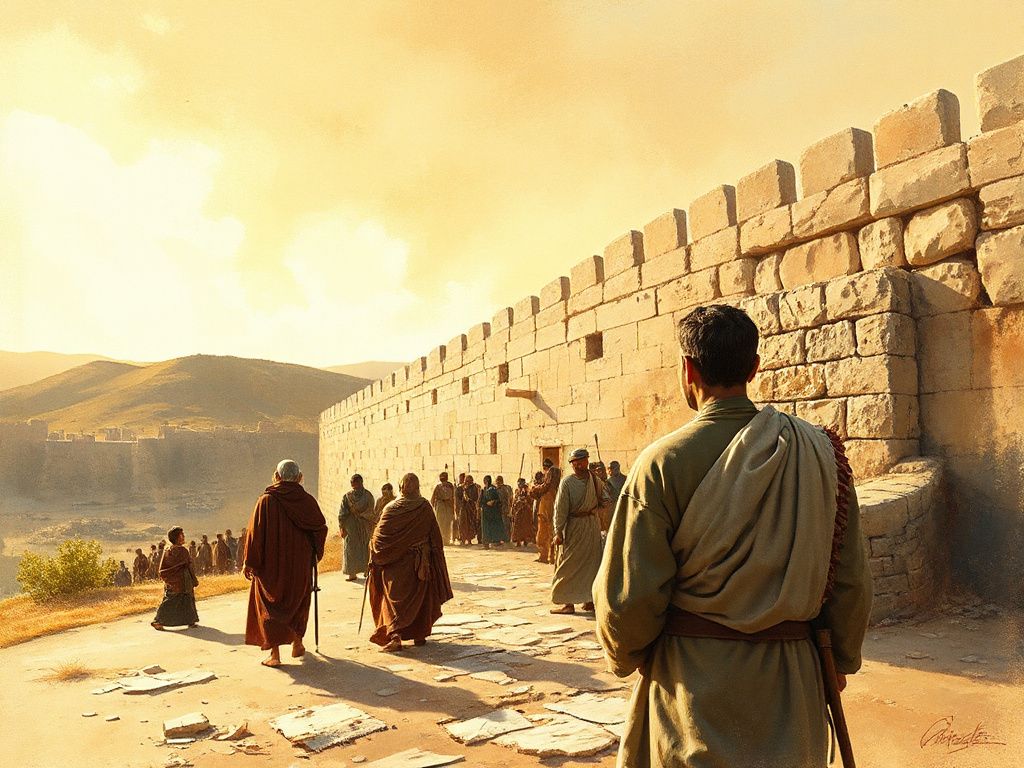
In the context of post-exilic ruin, God uses Nehemiah's leadership, prayer, and action to rally the remnant to rebuild Jerusalem's walls so that worship and God's presence are restored.
Nehemiah
Choose a chapter
Pick a chapter and it opens in the Current chapter tab. Come back here whenever you want to choose another one.
Why this book was written
Written in the post-exilic period, the book records how Nehemiah led the returnees to rebuild Jerusalem's walls, addressing the remnant and future readers. The author shows that God remains faithful amid hardship, calling His people to face opposition and division through prayer, repentance, and unified service, thereby safeguarding the holy city and temple worship.
Structure
- 1–2Nehemiah's Burden and Return
- 3–7Rebuilding the Walls of Jerusalem
- 8–10Hearing the Law, Confession, and Covenant Renewal
- 11–12Settling the People and Dedication of the Walls
- 13Nehemiah's Reforms and Vigilance
Major themes
Rebuilding and Renewal
Nehemiah records how the returned exiles rebuilt Jerusalem's walls (Neh 2:17-18; 6:15), symbolizing spiritual renewal and God's restoring work.
Prayer and Dependence on God
Nehemiah punctuates the book with short prayers (Neh 2:4; 4:4-5; 5:19; 6:9; 13:14, 22, 29, 31), showing reliance on God for guidance and protection in every matter.
Self-Sacrificing and Faithful Leadership
Nehemiah served as governor for twelve years without exploiting his position or demanding provision (Neh 5:14-18), modeling humble service and righteous governance.
Resisting Opposition
Facing ridicule, threats, and plots from Sanballat, Tobiah, the Ammonites, and others (Neh 2:10, 19; 4:1-3; 6:1-14), the people built with tools in one hand and weapons in the other, combining faith with action.
Return and Reform of the Covenant Community
Chapters 8-13 record Ezra's reading of the Law, the people's confession and covenant renewal (Neh 8-10), and reforms removing impurity from the temple and stopping intermarriage (Neh 13), emphasizing renewed covenant commitment.
How it points to Christ
Though Nehemiah does not directly predict the Messiah, its themes are fully realized in Christ: Nehemiah acts as mediator for the exiles, seeking favor from King Artaxerxes (Neh 2:1-8), prefiguring Christ as our great High Priest interceding before the Father (Heb 7:25). The rebuilt walls point to Christ breaking down the dividing wall (Eph 2:14) so that God and people, and people with one another, may be reconciled. The covenant renewal (Neh 9-10) anticipates the superior new covenant established by Christ (Heb 8:6-13). Nehemiah's anguish over his people and zeal for the temple (Neh 13:8-9) mirrors Christ's jealous zeal for God's house (John 2:17).
Key verses
- 1:5–11Nehemiah's confessional prayer sets the book's spiritual tone: the work of rebuilding begins with humble repentance and trust in the covenant-keeping God.
- 2:17–18Nehemiah rallies the people to build, and God's hand is confirmed upon him, marking the official launch of the rebuilding project.
- 4:9Faced with mockery and threats, the people built with one hand, held weapons with the other, and prayed to God.
- 6:15–16The wall was completed in fifty-two days, striking fear into the enemies and showing the work was from God.
- 8:8–10Ezra expounds the Law; the people weep with joy and are told that the joy of the Lord is their strength.
- 9:6The Levites' prayer exalts God as Creator and covenant-keeper, forming the heart of the community's spiritual renewal.
- 10:29–39The people enter a binding oath to walk in God's Law, support the temple, and bring tithes, showing genuine covenant commitment.
- 13:31Nehemiah closes with a plea to be remembered after ordering purifications and arrangements, echoing the book's call to holiness and vigilance.
People in this book
Questions for reflection
- ·When facing daunting tasks or opposition, do I first pray and seek God like Nehemiah before taking action (Neh 2:4-8)?
- ·In leadership or service, do I guard my heart from self-interest as Nehemiah did, refusing to exploit the people (Neh 5:14-18)?
- ·In the covenant renewal (Neh 8-10), the people wept, confessed, and recommitted themselves. Do I likewise continually return to God's Word to examine my heart and renew my commitments?
- ·When enemies use ridicule, threats, and deception (Neh 6) to cause me to abandon God's calling, how can I persevere as Nehemiah did?
- ·Does Nehemiah remind me that spiritual renewal is not only about external building but also about inner holiness and obedience (Neh 13)?
Want to read Nehemiah start to finish? Open the reader for parallel Chinese/English text and ask anything as you go.
Start reading NehemiahNehemiah
Chapter 7
1Now it came to pass, when the wall was built, and I had set up the doors, and the porters and the singers and the Levites were appointed,
2that I gave my brother Hanani, and Hananiah the governor of the castle, charge over Jerusalem; for he was a faithful man, and feared God above many.
3And I said unto them, Let not the gates of Jerusalem be opened until the sun be hot; and while they stand on guard, let them shut the doors, and bar ye them: and appoint watches of the inhabitants of Jerusalem, every one in his watch, and every one to be over against his house.
4Now the city was wide and large; but the people were few therein, and the houses were not builded.
5And my God put into my heart to gather together the nobles, and the rulers, and the people, that they might be reckoned by genealogy. And I found the book of the genealogy of them that came up at the first, and I found written therein:
6These are the children of the province, that went up out of the captivity of those that had been carried away, whom Nebuchadnezzar the king of Babylon had carried away, and that returned unto Jerusalem and to Judah, every one unto his city;
7who came with Zerubbabel, Jeshua, Nehemiah, Azariah, Raamiah, Nahamani, Mordecai, Bilshan, Mispereth, Bigvai, Nehum, Baanah. The number of the men of the people of Israel:
8The children of Parosh, two thousand a hundred and seventy and two.
9The children of Shephatiah, three hundred seventy and two.
10The children of Arah, six hundred fifty and two.
11The children of Pahath-moab, of the children of Jeshua and Joab, two thousand and eight hundred and eighteen.
12The children of Elam, a thousand two hundred fifty and four.
13The children of Zattu, eight hundred forty and five.
14The children of Zaccai, seven hundred and threescore.
15The children of Binnui, six hundred forty and eight.
16The children of Bebai, six hundred twenty and eight.
17The children of Azgad, two thousand three hundred twenty and two.
18The children of Adonikam, six hundred threescore and seven.
19The children of Bigvai, two thousand threescore and seven.
20The children of Adin, six hundred fifty and five.
21The children of Ater, of Hezekiah, ninety and eight.
22The children of Hashum, three hundred twenty and eight.
23The children of Bezai, three hundred twenty and four.
24The children of Hariph, a hundred and twelve.
25The children of Gibeon, ninety and five.
26The men of Beth-lehem and Netophah, a hundred fourscore and eight.
27The men of Anathoth, a hundred twenty and eight.
28The men of Beth-azmaveth, forty and two.
29The men of Kiriath-jearim, Chephirah, and Beeroth, seven hundred forty and three.
30The men of Ramah and Geba, six hundred twenty and one.
31The men of Michmas, a hundred and twenty and two.
32The men of Beth-el and Ai, a hundred twenty and three.
33The men of the other Nebo, fifty and two.
34The children of the other Elam, a thousand two hundred fifty and four.
35The children of Harim, three hundred and twenty.
36The children of Jericho, three hundred forty and five.
37The children of Lod, Hadid, and Ono, seven hundred twenty and one.
38The children of Senaah, three thousand nine hundred and thirty.
39The priests: The children of Jedaiah, of the house of Jeshua, nine hundred seventy and three.
40The children of Immer, a thousand fifty and two.
41The children of Pashhur, a thousand two hundred forty and seven.
42The children of Harim, a thousand and seventeen.
43The Levites: the children of Jeshua, of Kadmiel, of the children of Hodevah, seventy and four.
44The singers: the children of Asaph, a hundred forty and eight.
45The porters: the children of Shallum, the children of Ater, the children of Talmon, the children of Akkub, the children of Hatita, the children of Shobai, a hundred thirty and eight.
46The Nethinim: the children of Ziha, the children of Hasupha, the children of Tabbaoth,
47the children of Keros, the children of Sia, the children of Padon,
48the children of Lebana, the children of Hagaba, the children of Salmai,
49the children of Hanan, the children of Giddel, the children of Gahar,
50the children of Reaiah, the children of Rezin, the children of Nekoda,
51the children of Gazzam, the children of Uzza, the children of Paseah.
52The children of Besai, the children of Meunim, the children of Nephushesim,
53the children of Bakbuk, the children of Hakupha, the children of Harhur,
54the children of Bazlith, the children of Mehida, the children of Harsha,
55the children of Barkos, the children of Sisera, the children of Temah,
56the children of Neziah, the children of Hatipha.
57The children of Solomon's servants: the children of Sotai, the children of Sophereth, the children of Perida,
58the children of Jaala, the children of Darkon, the children of Giddel,
59the children of Shephatiah, the children of Hattil, the children of Pochereth-hazzebaim, the children of Amon.
60All the Nethinim, and the children of Solomon's servants, were three hundred ninety and two.
61And these were they that went up from Tel-melah, Tel-harsha, Cherub, Addon, and Immer; but they could not show their fathers' houses, nor their seed, whether they were of Israel:
62The children of Delaiah, the children of Tobiah, the children of Nekoda, six hundred forty and two.
63And of the priests: the children of Hobaiah, the children of Hakkoz, the children of Barzillai, who took a wife of the daughters of Barzillai the Gileadite, and was called after their name.
64These sought their register among those that were reckoned by genealogy, but it was not found: therefore were they deemed polluted and put from the priesthood.
65And the governor said unto them, that they should not eat of the most holy things, till there stood up a priest with Urim and Thummim.
66The whole assembly together was forty and two thousand three hundred and threescore,
67besides their men-servants and their maid-servants, of whom there were seven thousand three hundred thirty and seven: and they had two hundred forty and five singing men and singing women.
68Their horses were seven hundred thirty and six; their mules, two hundred forty and five;
69their camels, four hundred thirty and five; their asses, six thousand seven hundred and twenty.
70And some from among the heads of fathers' houses gave unto the work. The governor gave to the treasury a thousand darics of gold, fifty basins, five hundred and thirty priests' garments.
71And some of the heads of fathers' houses gave into the treasury of the work twenty thousand darics of gold, and two thousand and two hundred pounds of silver.
72And that which the rest of the people gave was twenty thousand darics of gold, and two thousand pounds of silver, and threescore and seven priests' garments.
73So the priests, and the Levites, and the porters, and the singers, and some of the people, and the Nethinim, and all Israel, dwelt in their cities. And when the seventh month was come, the children of Israel were in their cities.