BIBLE BOOK GUIDE
Nehemiah
13 chapters
In the context of post-exilic ruin, God uses Nehemiah's leadership, prayer, and action to rally the remnant to rebuild Jerusalem's walls so that worship and God's presence are restored.
Nehemiah
Choose a chapter
Pick a chapter and it opens in the Current chapter tab. Come back here whenever you want to choose another one.
Why this book was written
Written in the post-exilic period, the book records how Nehemiah led the returnees to rebuild Jerusalem's walls, addressing the remnant and future readers. The author shows that God remains faithful amid hardship, calling His people to face opposition and division through prayer, repentance, and unified service, thereby safeguarding the holy city and temple worship.
Structure
- 1–2Nehemiah's Burden and Return
- 3–7Rebuilding the Walls of Jerusalem
- 8–10Hearing the Law, Confession, and Covenant Renewal
- 11–12Settling the People and Dedication of the Walls
- 13Nehemiah's Reforms and Vigilance
Major themes
Rebuilding and Renewal
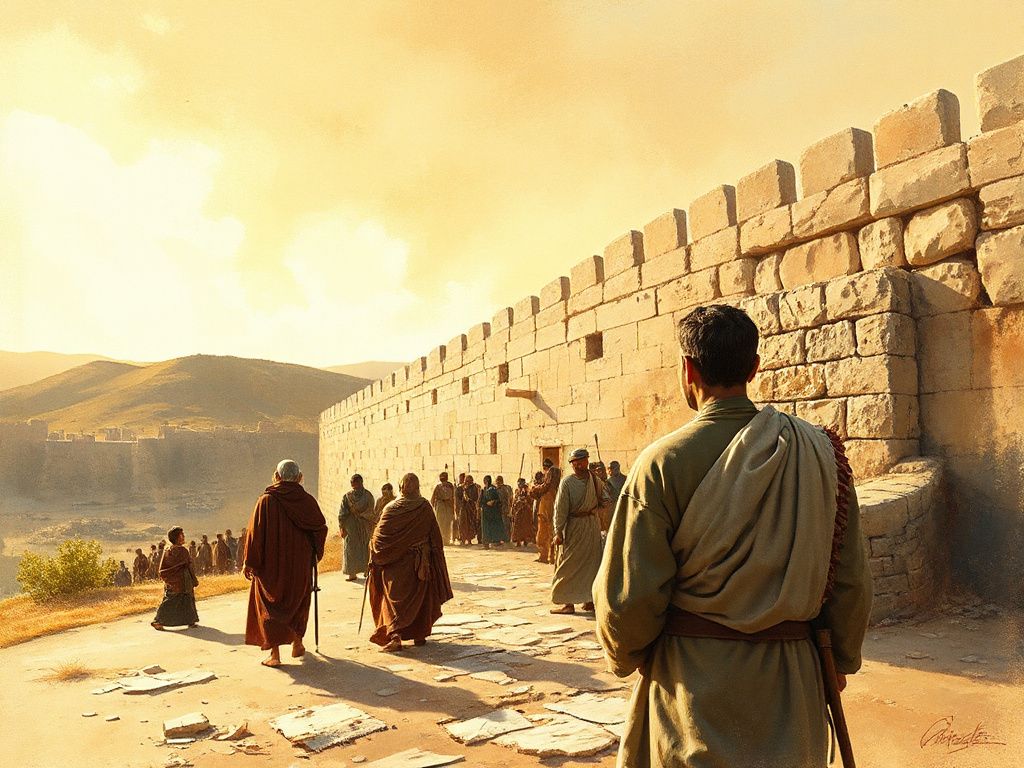
Nehemiah records how the returned exiles rebuilt Jerusalem's walls (Neh 2:17-18; 6:15), symbolizing spiritual renewal and God's restoring work.
Prayer and Dependence on God
Nehemiah punctuates the book with short prayers (Neh 2:4; 4:4-5; 5:19; 6:9; 13:14, 22, 29, 31), showing reliance on God for guidance and protection in every matter.
Self-Sacrificing and Faithful Leadership
Nehemiah served as governor for twelve years without exploiting his position or demanding provision (Neh 5:14-18), modeling humble service and righteous governance.
Resisting Opposition
Facing ridicule, threats, and plots from Sanballat, Tobiah, the Ammonites, and others (Neh 2:10, 19; 4:1-3; 6:1-14), the people built with tools in one hand and weapons in the other, combining faith with action.
Return and Reform of the Covenant Community
Chapters 8-13 record Ezra's reading of the Law, the people's confession and covenant renewal (Neh 8-10), and reforms removing impurity from the temple and stopping intermarriage (Neh 13), emphasizing renewed covenant commitment.
How it points to Christ
Though Nehemiah does not directly predict the Messiah, its themes are fully realized in Christ: Nehemiah acts as mediator for the exiles, seeking favor from King Artaxerxes (Neh 2:1-8), prefiguring Christ as our great High Priest interceding before the Father (Heb 7:25). The rebuilt walls point to Christ breaking down the dividing wall (Eph 2:14) so that God and people, and people with one another, may be reconciled. The covenant renewal (Neh 9-10) anticipates the superior new covenant established by Christ (Heb 8:6-13). Nehemiah's anguish over his people and zeal for the temple (Neh 13:8-9) mirrors Christ's jealous zeal for God's house (John 2:17).
Key verses
- 1:5–11Nehemiah's confessional prayer sets the book's spiritual tone: the work of rebuilding begins with humble repentance and trust in the covenant-keeping God.
- 2:17–18Nehemiah rallies the people to build, and God's hand is confirmed upon him, marking the official launch of the rebuilding project.
- 4:9Faced with mockery and threats, the people built with one hand, held weapons with the other, and prayed to God.
- 6:15–16The wall was completed in fifty-two days, striking fear into the enemies and showing the work was from God.
- 8:8–10Ezra expounds the Law; the people weep with joy and are told that the joy of the Lord is their strength.
- 9:6The Levites' prayer exalts God as Creator and covenant-keeper, forming the heart of the community's spiritual renewal.
- 10:29–39The people enter a binding oath to walk in God's Law, support the temple, and bring tithes, showing genuine covenant commitment.
- 13:31Nehemiah closes with a plea to be remembered after ordering purifications and arrangements, echoing the book's call to holiness and vigilance.
People in this book
Questions for reflection
- ·When facing daunting tasks or opposition, do I first pray and seek God like Nehemiah before taking action (Neh 2:4-8)?
- ·In leadership or service, do I guard my heart from self-interest as Nehemiah did, refusing to exploit the people (Neh 5:14-18)?
- ·In the covenant renewal (Neh 8-10), the people wept, confessed, and recommitted themselves. Do I likewise continually return to God's Word to examine my heart and renew my commitments?
- ·When enemies use ridicule, threats, and deception (Neh 6) to cause me to abandon God's calling, how can I persevere as Nehemiah did?
- ·Does Nehemiah remind me that spiritual renewal is not only about external building but also about inner holiness and obedience (Neh 13)?
Where Nehemiah fits in the Bible's storyline
This book appears in the 12-stop storyline at:
Where to start reading the Bible? See the full 12-stop storyline
Want to read Nehemiah start to finish? Open the reader for parallel Chinese/English text and ask anything as you go.
Start reading NehemiahNehemiah
Chapter 5
1Then there arose a great cry of the people and of their wives against their brethren the Jews.
2For there were that said, We, our sons and our daughters, are many: let us get grain, that we may eat and live.
3Some also there were that said, We are mortgaging our fields, and our vineyards, and our houses: let us get grain, because of the dearth.
4There were also that said, We have borrowed money for the king's tribute upon our fields and our vineyards.
5Yet now our flesh is as the flesh of our brethren, our children as their children: and, lo, we bring into bondage our sons and our daughters to be servants, and some of our daughters are brought into bondage already: neither is it in our power to help it; for other men have our fields and our vineyards.
6And I was very angry when I heard their cry and these words.
7Then I consulted with myself, and contended with the nobles and the rulers, and said unto them, Ye exact usury, every one of his brother. And I held a great assembly against them.
8And I said unto them, We after our ability have redeemed our brethren the Jews, that were sold unto the nations; and would ye even sell your brethren, and should they be sold unto us? Then held they their peace, and found never a word.
9Also I said, The thing that ye do is not good: ought ye not to walk in the fear of our God, because of the reproach of the nations our enemies?
10And I likewise, my brethren and my servants, do lend them money and grain. I pray you, let us leave off this usury.
11Restore, I pray you, to them, even this day, their fields, their vineyards, their oliveyards, and their houses, also the hundredth part of the money, and of the grain, the new wine, and the oil, that ye exact of them.
12Then said they, We will restore them, and will require nothing of them; so will we do, even as thou sayest. Then I called the priests, and took an oath of them, that they would do according to this promise.
13Also I shook out my lap, and said, So God shake out every man from his house, and from his labor, that performeth not this promise; even thus be he shaken out, and emptied. And all the assembly said, Amen, and praised Jehovah. And the people did according to this promise.
14Moreover from the time that I was appointed to be their governor in the land of Judah, from the twentieth year even unto the two and thirtieth year of Artaxerxes the king, that is, twelve years, I and my brethren have not eaten the bread of the governor.
15But the former governors that were before me were chargeable unto the people, and took of them bread and wine, besides forty shekels of silver; yea, even their servants bare rule over the people: but so did not I, because of the fear of God.
16Yea, also I continued in the work of this wall, neither bought we any land: and all my servants were gathered thither unto the work.
17Moreover there were at my table, of the Jews and the rulers, a hundred and fifty men, besides those that came unto us from among the nations that were round about us.
18Now that which was prepared for one day was one ox and six choice sheep; also fowls were prepared for me, and once in ten days store of all sorts of wine: yet for all this I demanded not the bread of the governor, because the bondage was heavy upon this people.
19Remember unto me, O my God, for good, all that I have done for this people.