Exodus 1:10
「come, let us deal wisely with them, lest they multiply, and it come to pass, that, when there falleth out any war, they also join themselves unto our enemies, and fight against us, and get them up out of the land.」
Exodus 23:19
「The first of the first-fruits of thy ground thou shalt bring into the house of Jehovah thy God. Thou shalt not boil a kid in it mother's milk.」
Exodus 6:25
「And Eleazar Aaron's son took him one of the daughters of Putiel to wife; and she bare him Phinehas. These are the heads of the fathers' houses of the Levites according to their families.」
Exodus 20:1-17
Exodus · Ch.20
Exodus 20:1-17 The Ten Commandments
Exodus 30:5
「And thou shalt make the staves of acacia wood, and overlay them with gold.」
Exodus 22:19
「Whosoever lieth with a beast shall surely be put to death.」
Exodus 25:1
「And Jehovah spake unto Moses, saying,」
The Rock
The rock at Horeb struck by Moses to bring forth water, typologically prefiguring Christ the spiritual Rock smitten to give life.
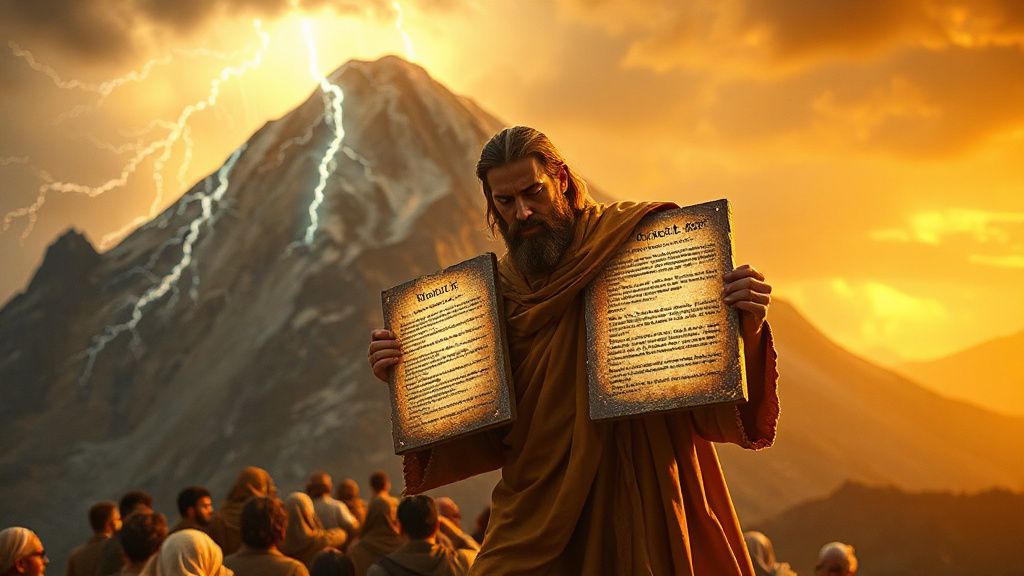
Ten Commandments
The ten commandments spoken directly by God at Mount Sinai, forming the core terms of the Mosaic covenant and the foundation of Israel's faith and moral life.
Unleavened Bread
Bread eaten with the Passover lamb symbolizing purity and the haste of Israel's deliverance; later became central to the Feast of Unleavened Bread.
Rock
The rock at Horeb struck to bring forth water, a type of Christ the spiritual Rock smitten to pour out life (1 Cor 10:4).
Pillar of Cloud
The visible manifestation of God's presence guiding Israel; when it descended at the Tent door, it signified divine encounter and speech with Moses.
Why is 'I am the LORD' in Exodus 20:2 the foundation of the Ten Commandments?
The relationship between knowing God and the order of commandments
What is the contemporary meaning of the Sabbath?
The Sabbath teaching in the Ten Commandments
What inner struggles do Moses' excuses before the burning bush reveal?
'I am slow of speech'—humility or fear before divine calling?
Why were the Egyptian magicians able to replicate some of the early plagues, and what does this limitation signify?
The magicians' limited mimicry exposes the source and boundary of true authority.
Is the commandment 'You shall not murder' absolute in all circumstances?
Examining the application of 'You shall not murder' in contexts of war, capital punishment, and self-defense.
How does rabbinic tradition interpret the theological symbolism of the burning bush?
What spiritual meanings do the rabbis attribute to the bush that burned yet was not consumed?