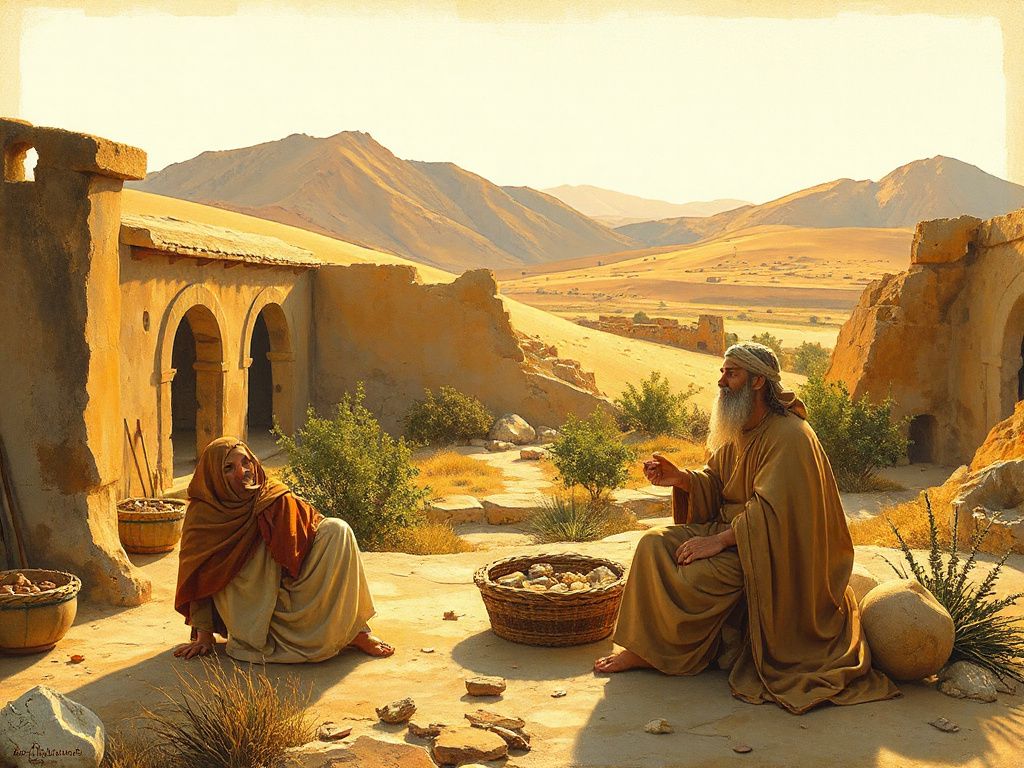
Tobit 1 — Genealogía, piedad y cautiverio
Tobit se presenta como un fiel neftalita que guardaba las ordenanzas del templo, fue deportado a Nínive, se negó a comer alimentos de los gentiles, sirvió como agente de compras del rey y arriesgó su vida enterrando a los muertos bajo Senaquerib.
Tobías
Elige un capítulo
Elige un capítulo y se abrirá en la pestaña Capítulo actual. Vuelve aquí para elegir otro.
Tobías
Capítulo 1
- 1.The book of the acts of Tobit the son of To′biel, son of Anan′iel, son of Ad′uel, son of Gab′ael, of the descendants of As′iel and the tribe of Naph′tali,
- 2.who in the days of Shalmane′ser, king of the Assyrians, was taken into captivity from Thisbe, which is to the south of Kedesh Naph′tali in Galilee above Asher.
- 3.Tobit’s Youth and Virtuous Life I, Tobit, walked in the ways of truth and righteousness all the days of my life, and I performed many acts of charity to my brethren and countrymen who went with me into the land of the Assyrians, to Nin′eveh.
- 4.Now when I was in my own country, in the land of Israel, while I was still a young man, the whole tribe of Naph′tali my forefather deserted the house of Jerusalem. This was the place which had been chosen from among all the tribes of Israel, where all the tribes should sacrifice and where the temple of the dwelling of the Most High was consecrated and established for all generations for ever.
- 5.All the tribes that joined in apostasy used to sacrifice to the calf Ba′al, and so did the house of Naph′tali my forefather.
- 6.But I alone went often to Jerusalem for the feasts, as it is ordained for all Israel by an everlasting decree. Taking the first fruits and the tithes of my produce and the first shearings, I would give these to the priests, the sons of Aaron, at the altar.
- 7.Of all my produce I would give a tenth to the sons of Levi who ministered at Jerusalem; a second tenth I would sell, and I would go and spend the proceeds each year at Jerusalem;
- 8.the third tenth I would give to those to whom it was my duty, as Deb′orah my father’s mother had commanded me, for I was left an orphan by my father.
- 9.When I became a man I married Anna, a member of our family, and by her I became the father of Tobi′as.
- 10.Taken Captive to Nineveh Now when I was carried away captive to Nin′eveh, all my brethren and my relatives ate the food of the Gentiles;
- 11.but I kept myself from eating it,
- 12.because I remembered God with all my heart.
- 13.Then the Most High gave me favor and good appearance in the sight of Shalmane′ser, and I was his buyer of provisions.
- 14.So I used to go into Media, and once at Rages in Media I left ten talents of silver in trust with Gab′ael, the brother of Gabri′as.
- 15.But when Shalmane′ser died, Sennach′erib his son reigned in his place; and under him the highways were unsafe, so that I could no longer go into Media.
- 16.Courage in Burying the Dead In the days of Shalmane′ser I performed many acts of charity to my brethren.
- 17.I would give my bread to the hungry and my clothing to the naked; and if I saw any one of my people dead and thrown out behind the wall of Nin′eveh, I would bury him.
- 18.And if Sennach′erib the king put to death any who came fleeing from Judea, I buried them secretly. For in his anger he put many to death. When the bodies were sought by the king, they were not found.
- 19.Then one of the men of Nin′eveh went and informed the king about me, that I was burying them; so I hid myself. When I learned that I was being searched for, to be put to death, I left home in fear.
- 20.Then all my property was confiscated and nothing was left to me except my wife Anna and my son Tobi′as.
- 21.But not fifty days passed before two of Sennach′erib’s sons killed him, and they fled to the mountains of Ar′arat. Then Esarhad′don, his son, reigned in his place; and he appointed Ahi′kar, the son of my brother An′ael, over all the accounts of his kingdom and over the entire administration.
- 22.Ahi′kar interceded for me, and I returned to Nin′eveh. Now Ahi′kar was cupbearer, keeper of the signet, and in charge of administration of the accounts, for Esarhad′don had appointed him second to himself. He was my nephew.
Qué significa este pasaje
Tobit 1 está enmarcado como una memoria en primera persona. Se abre con una genealogía de cuatro generaciones que remonta la línea de Tobit hasta un antepasado llamado Asiel, de la tribu de Neftalí. La tribu se sitúa geográficamente: en Galilea, por encima de Aser, cerca de Tisbé, al sur de Cedes de Neftalí. Esta combinación de fundamento genealógico y geográfico es típica de la autodefinición israelita en el exilio; el texto suministra identidad por linaje y lugar antes de suministrarla por acción.
El capítulo contrasta luego la fidelidad de Tobit con la apostasía de su tribu. Recuerda haber ido solo a Jerusalén para las fiestas, dar las primicias y los diezmos a los sacerdotes aaronitas en el altar, y un segundo diezmo que vendía y gastaba cada año en Jerusalén. Un tercer diezmo lo daba según el mandato de su abuela Débora, que lo crió siendo huérfano. Este patrón de triple diezmo —una parte dada a los levitas, una parte consumida en el santuario y una parte distribuida según la indicación de su abuela— hace que su obediencia al culto del templo sea inusualmente explícita y personal.
La segunda mitad narra el cautiverio y la persecución. Tobit se niega a comer alimentos de los gentiles porque recordaba a Dios con todo su corazón, es favorecido por Salmanasar y confía diez talentos de plata a Gabael en Rages de Media. Después de que Salmanasar muere, el reinado de Senaquerib hace que viajar a Media sea peligroso, y Tobit comienza su peligroso ministerio de enterrar a los judíos asesinados. Cuando se denuncia su actividad al rey, confiscan sus bienes y él huye, dejando solo a su esposa Ana y a su hijo Tobías. Senaquerib pronto es asesinado por dos de sus hijos, que huyen a Ararat; Esarhaddón nombra a Ajicar, sobrino de Tobit, quien logra el regreso de Tobit. El capítulo concluye con los títulos de Ajicar: copero, guardián del sello y segundo a cargo de las cuentas.
Contexto
El capítulo funciona como el movimiento inicial de una narración que abarcará el cautiverio en Nínive, un viaje a Media y la curación de la ceguera de Tobit. Establece tres cosas de las que depende el resto del libro: la piedad de Tobit (su observancia del templo y su rechazo de los alimentos de los gentiles), su posesión de diez talentos de plata depositados con Gabael en Rages, y su parentesco con Ajicar, el poderoso funcionario de la corte. La plata depositada es el recurso argumental que enviará a Tobías a su viaje, y la posición de Ajicar enmarca la corte de Nínive como un lugar donde la vida de Tobit está a la vez en riesgo y, en momentos clave, protegida.
El enterramiento de los muertos por parte de Tobit y su pérdida de bienes bajo Senaquerib forman el antecedente inmediato de sus desgracias posteriores descritas en el capítulo 2. La transición abrupta de Salmanasar a Senaquerib, la huida de los hijos a Ararat y la sucesión de Esarhaddón se presentan de forma comprimida, en consonancia con un narrador que resume acontecimientos que no presenció directamente.
Preguntas frecuentes
¿Por qué va Tobit solo a Jerusalén cuando su tribu ha apostatado?
El capítulo presenta las peregrinaciones en solitario de Tobit como un contraste deliberado con la apostasía del resto de la tribu de Neftalí, que sacrificaba al becerro de Baal. Su narración en primera persona subraya repetidamente que su observancia del templo era obediencia personal, no costumbre tribal.
¿Cuál es el significado de los diez talentos de plata dejados con Gabael?
La plata depositada es la razón material por la que Tobías será enviado más tarde a Gabael en Rages de Media para recuperarla, lo que inicia el viaje en el que se desarrollan los acontecimientos centrales del libro. Mientras el reinado de Senaquerib haga inseguros los caminos, el depósito permanece inaccesible.
¿Cómo aparece Ajicar en el capítulo inicial?
Tobit identifica a Ajicar como hijo de su hermano Anael, nombrado por Esarhaddón como su segundo, con los títulos de copero, guardián del sello y administrador jefe. Ajicar intercede de inmediato y logra el regreso de Tobit a Nínive después de su huida bajo Senaquerib, estableciéndolo como protector de Tobit dentro de la corte imperial.