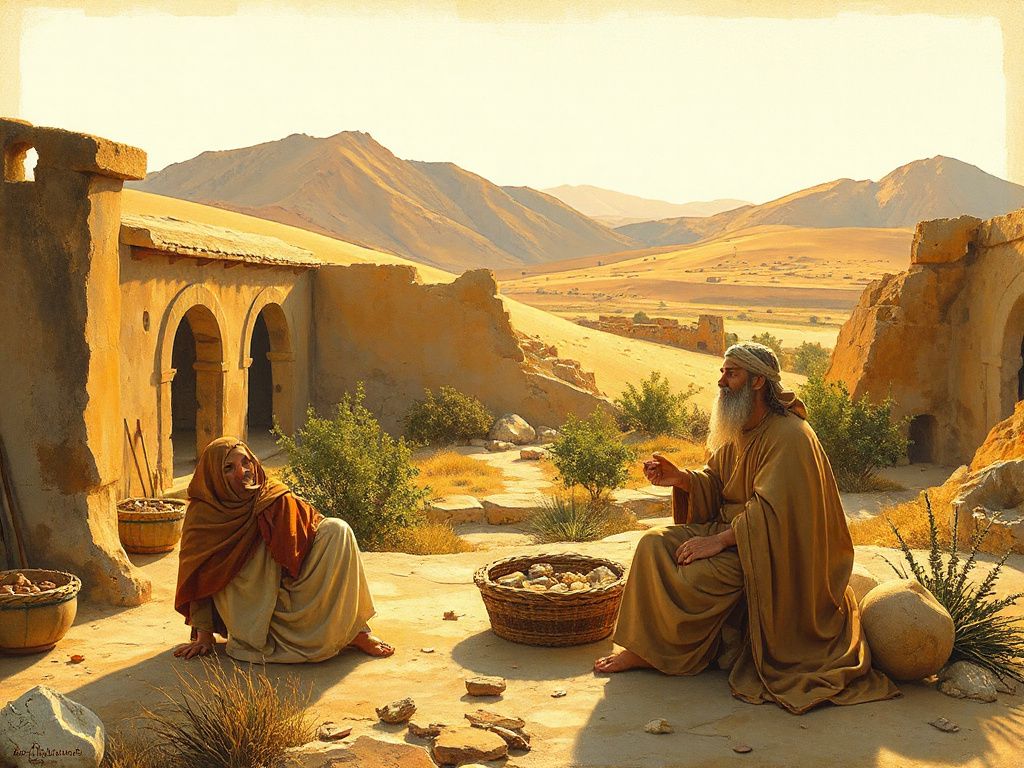
Tobías 6 — El pez, el demonio y el viaje a Ecbatana
En el viaje hacia Rages, un pez ataca a Tobías en el Tigris; Rafael le ordena guardar el corazón, el hígado y la hiel. Cerca de Ecbatana, Rafael concierta el matrimonio de Tobías con su parienta Sara, y prescribe un ritual de humo con los órganos del pez para ahuyentar al demonio que ha matado a sus siete maridos.
Tobías
Elige un capítulo
Elige un capítulo y se abrirá en la pestaña Capítulo actual. Vuelve aquí para elegir otro.
Tobías
Capítulo 6
- 1.Journey to Rages Now as they proceeded on their way they came at evening to the Tigris river and camped there.
- 2.Then the young man went down to wash himself. A fish leaped up from the river and would have swallowed the young man;
- 3.and the angel said to him, “Catch the fish.” So the young man seized the fish and threw it up on the land.
- 4.Then the angel said to him, “Cut open the fish and take the heart and liver and gall and put them away safely.”
- 5.So the young man did as the angel told him; and they roasted and ate the fish. And they both continued on their way until they came near to Ecbat′ana.
- 6.Then the young man said to the angel, “Brother Azari′as, of what use is the liver and heart and gall of the fish?”
- 7.He replied, “As for the heart and the liver, if a demon or evil spirit gives trouble to any one, you make a smoke from these before the man or woman, and that person will never be troubled again.
- 8.And as for the gall, anoint with it a man who has white films in his eyes, and he will be cured.”
- 9.Raph′ael’s Instructions When they approached Ecbat′ana,
- 10.the angel said to the young man, “Brother, today we shall stay with Rag′uel. He is your relative, and he has an only daughter named Sarah. I will suggest that she be given to you in marriage,
- 11.because you are entitled to her and to her inheritance, for you are her only eligible kinsman.
- 12.The girl is also beautiful and sensible. Now listen to my plan. I will speak to her father, and as soon as we return from Rages we will celebrate the marriage. For I know that Rag′uel, according to the law of Moses, cannot give her to another man without incurring the penalty of death, because you rather than any other man are entitled to the inheritance.”
- 13.Then the young man said to the angel, “Brother Azari′as, I have heard that the girl has been given to seven husbands and that each died in the bridal chamber.
- 14.Now I am the only son my father has, and I am afraid that if I go in I will die as those before me did, for a demon is in love with her, and he harms no one except those who approach her. So now I fear that I may die and bring the lives of my father and mother to the grave in sorrow on my account. And they have no other son to bury them.”
- 15.But the angel said to him, “Do you not remember the words with which your father commanded you to take a wife from among your own people? Now listen to me, brother, for she will become your wife; and do not worry about the demon, for this very night she will be given to you in marriage.
- 16.When you enter the bridal chamber, you shall take live ashes of incense and lay upon them some of the heart and liver of the fish so as to make a smoke.
- 17.Then the demon will smell it and flee away, and will never again return. And when you approach her, rise up, both of you, and cry out to the merciful God, and he will save you and have mercy on you. Do not be afraid, for she was destined for you from eternity. You will save her, and she will go with you, and I suppose that you will have children by her.” When Tobi′as heard these things, he fell in love with her and yearned deeply for her.
Qué significa este pasaje
La primera mitad del capítulo (versículos 1–8) se centra en un encuentro inesperado con un pez en el Tigris. Rafael instruye a Tobías a conservar el corazón, el hígado y la hiel, y luego explica que el corazón y el hígado ahuyentan a los demonios cuando se queman como incienso, mientras que la hiel sana las opacidades blancas de los ojos. El episodio establece que la protección de Rafael sobre Tobías es concreta y práctica, no meramente verbal.
La segunda mitad (versículos 9–17) se desplaza hacia la familia y el matrimonio. Rafael identifica a Raguel como un pariente con una hija casadera, Sara, y recuerda a Tobías el mandato de su padre de casarse dentro de su propio pueblo (versículos 10–12, 15). El obstáculo es un demonio que ha matado a los siete maridos sucesivos de Sara. La solución de Rafael combina la acción ritual (cenizas vivas de incienso con el corazón y el hígado del pez) con la oración al Dios misericordioso, y asegura a Tobías que Sara estaba «destinada para ti desde la eternidad». El capítulo vincula así la obediencia física, la instrucción angélica y la providencia divina en torno a la formación de una familia.
A lo largo del capítulo, el papel de Tobías es escuchar y obedecer: atrapa y abre el pez, acepta el plan de matrimonio a pesar del miedo y se enamora al escuchar las palabras de Rafael. La narrativa presenta los órganos de un pez ordinario como instrumentos de liberación tanto de la aflicción demoníaca como de la ceguera física, un tema que el libro completará cuando la misma hiel restaure la vista de Tobit en el capítulo 11.
Contexto
El capítulo tiene lugar enteramente en el camino: Tobías y su compañero disfrazado (al que aún se llama «hermano Azarías») viajan de Nínive hacia Rages en Media para cobrar un depósito. El capítulo 5 preparó el viaje al presentar a Rafael como un pariente contratado como guía, y el capítulo 6 se desarrolla en dos escenas: el campamento junto al río Tigris y la aproximación a Ecbatana, donde vive Raguel.
El capítulo 6 funciona como eje entre la misión viajera de Tobías y la trama del matrimonio. Los órganos del pez entregados en los versículos 2–5 no se usan de inmediato; se convierten en los recursos tanto para la liberación de Sara del demonio (capítulo 8) como para la curación de la ceguera de Tobit (capítulo 11). La nota del capítulo simplemente registra que los capítulos restantes de Tobit fuera de su selección principal fueron completados a modo de referencia; no se añade ningún comentario interpretativo adicional.
Preguntas frecuentes
¿Por qué Rafael hace que Tobías guarde el corazón, el hígado y la hiel del pez?
Según la propia explicación de Rafael en los versículos 7–8, el corazón y el hígado deben quemarse como incienso para ahuyentar a un demonio o espíritu maligno que aflige a alguien, mientras que la hiel sirve para ungir a un hombre con opacidades blancas en los ojos y sanarlo. Los órganos se convierten así en el medio tanto para la liberación de Sara como para la curación posterior de Tobit.
¿Quién es Sara y por qué Tobías tiene derecho a casarse con ella?
Sara es la hija única de Raguel en Ecbatana (versículos 10–12). Rafael explica que Tobías es su pariente elegible más cercano y tiene derecho tanto a ella como a su herencia, y que según «la ley de Moisés» Raguel no puede darla a otro hombre sin incurrir en la pena de muerte. Rafael recuerda también el mandato anterior de Tobit de tomar esposa de entre los suyos (versículo 15).
¿Qué prescribe Rafael contra el demonio y cuál es el papel de la oración?
Rafael instruye a Tobías a colocar el corazón y el hígado del pez sobre cenizas vivas de incienso en la cámara nupcial para que el demonio huela el humo y huya (versículos 16–17). Junto con este ritual, se les dice a Tobías y a Sara que se levanten y clamen al Dios misericordioso, que los salvará y tendrá misericordia de ellos. Rafael presenta la liberación como un acto físico de obediencia y a la vez como una oración a Dios, asegurando a Tobías que Sara «estaba destinada para ti desde la eternidad».