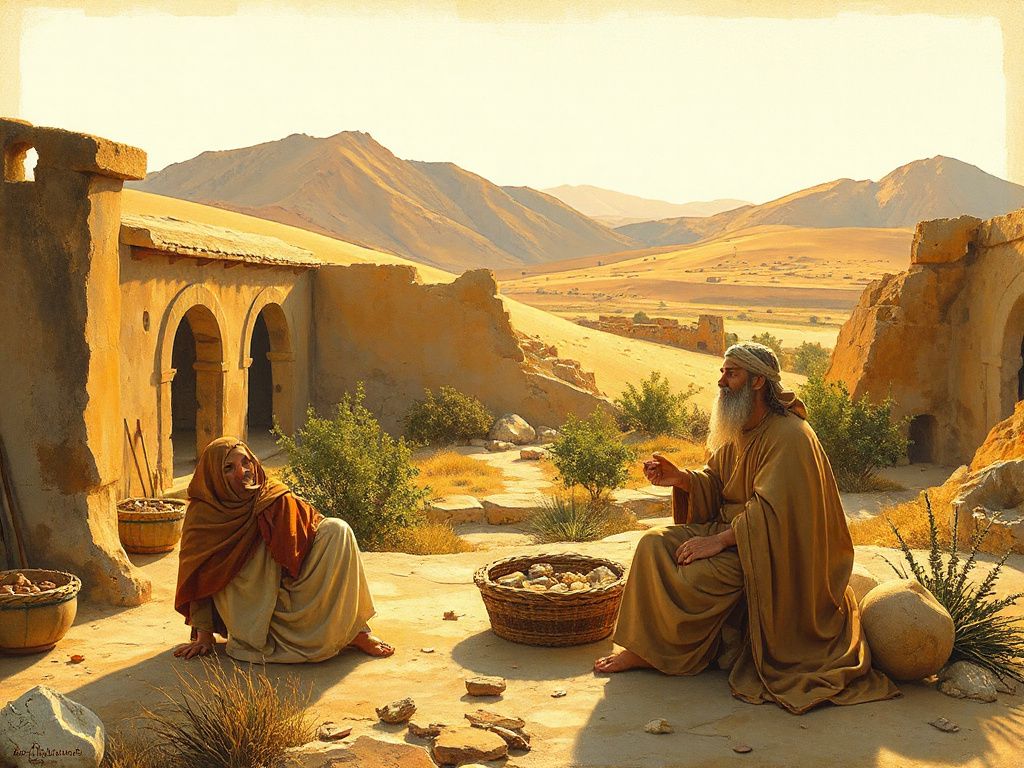
Tobías 4 — Los consejos de despedida de un padre
En su lecho de enfermo, Tobit llama a Tobías para transmitirle una serie de instrucciones morales e informarle sobre los diez talentos de plata depositados con Gabael en Ragés de Media.
Tobías
Elige un capítulo
Elige un capítulo y se abrirá en la pestaña Capítulo actual. Vuelve aquí para elegir otro.
Tobías
Capítulo 4
- 1.Tobit Gives Instructions to His Son On that day Tobit remembered the money which he had left in trust with Gab′ael at Rages in Media, and he said to himself:
- 2.“I have asked for death. Why do I not call my son Tobi′as so that I may explain to him about the money before I die?”
- 3.So he called him and said, “My son, when I die, bury me, and do not neglect your mother. Honor her all the days of your life; do what is pleasing to her, and do not grieve her.
- 4.Remember, my son, that she faced many dangers for you while you were yet unborn. When she dies, bury her beside me in the same grave.
- 5.“Remember the Lord our God all your days, my son, and refuse to sin or to transgress his commandments. Live uprightly all the days of your life, and do not walk in the ways of wrongdoing.
- 6.For if you do what is true, your ways will prosper through your deeds.
- 7.Give alms from your possessions to all who live uprightly, and do not let your eye begrudge the gift when you make it. Do not turn your face away from any poor man, and the face of God will not be turned away from you.
- 8.If you have many possessions, make your gift from them in proportion; if few, do not be afraid to give according to the little you have.
- 9.So you will be laying up a good treasure for yourself against the day of necessity.
- 10.For charity delivers from death and keeps you from entering the darkness;
- 11.and for all who practice it charity is an excellent offering in the presence of the Most High.
- 12.“Beware, my son, of all immorality. First of all take a wife from among the descendants of your fathers and do not marry a foreign woman, who is not of your father’s tribe; for we are the sons of the prophets. Remember, my son, that Noah, Abraham, Isaac, and Jacob, our fathers of old, all took wives from among their brethren. They were blessed in their children, and their posterity will inherit the land.
- 13.So now, my son, love your brethren, and in your heart do not disdain your brethren and the sons and daughters of your people by refusing to take a wife for yourself from among them. For in pride there is ruin and great confusion; and in shiftlessness there is loss and great want, because shiftlessness is the mother of famine.
- 14.Do not hold over till the next day the wages of any man who works for you, but pay him at once; and if you serve God you will receive payment. “Watch yourself, my son, in everything you do, and be disciplined in all your conduct.
- 15.And what you hate, do not do to any one. Do not drink wine to excess or let drunkenness go with you on your way.
- 16.Give of your bread to the hungry, and of your clothing to the naked. Give all your surplus to charity, and do not let your eye begrudge the gift when you made it.
- 17.Place your bread on the grave of the righteous, but give none to sinners.
- 18.Seek advice from every wise man, and do not despise any useful counsel.
- 19.Bless the Lord God on every occasion; ask him that your ways may be made straight and that all your paths and plans may prosper. For none of the nations has understanding; but the Lord himself gives all good things, and according to his will he humbles whomever he wishes. Money Left in Trust with Gabael “So, my son, remember my commands, and do not let them be blotted out of your mind.
- 20.And now let me explain to you about the ten talents of silver which I left in trust with Gab′ael the son of Gabri′as at Rages in Media.
- 21.Do not be afraid, my son, because we have become poor. You have great wealth if you fear God and refrain from every sin and do what is pleasing in his sight.”
Qué significa este pasaje
Tobías 4 está estructurado como un testamento en el lecho de muerte. Tobit recuerda la plata que dejó con Gabael (versículo 1) e inmediatamente llama a su hijo para que la instrucción pueda ser dada antes de morir (versículo 2). El capítulo tiene, por tanto, dos propósitos: una exhortación moral a Tobías y una transferencia práctica de responsabilidad por el depósito en Media.
El núcleo de la instrucción moral es una serie de mandatos breves. Tobit dice a Tobías que honre a su madre (versículo 3), que recuerde los peligros que ella afrontó al darle a luz (versículo 4), y que tenga al Señor presente y se abstenga del pecado (versículo 5). Se otorga un peso singular a la limosna: los versículos 7–11 prometen que la caridad libra de la muerte, preserva de las tinieblas y es una ofrenda excelente ante el Altísimo. El matrimonio se aborda en los versículos 12–13, con la instrucción de tomar esposa entre los parientes y no una mujer extranjera, siguiendo el ejemplo de Noé, Abraham, Isaac y Jacob. Otros mandatos cubren el pago puntual de los salarios (versículo 14), el principio de la regla de oro de no hacer a otros lo que uno aborrece (versículo 15), pan y vestido para los hambrientos y desnudos (versículo 16), pan colocado sobre la tumba de los justos (versículo 17), y el buscar consejo sabio (versículo 18).
El capítulo cierra con una oración por caminos rectos (versículo 19) y la revelación del depósito: diez talentos de plata dejados con Gabael, hijo de Gabrias, en Ragés de Media (versículo 20). Tobit replantea su pobreza señalando a Tobías la riqueza mayor de temer a Dios y evitar el pecado (versículo 21). La nota en el material designa el capítulo simplemente como la instrucción de despedida de Tobit.
Contexto
El texto del capítulo proporcionado contiene únicamente Tobías 4, sin los capítulos circundantes. Dentro del capítulo, el escenario se establece explícitamente: es el día en que Tobit recuerda el depósito con Gabael en Ragés de Media y decide convocar a Tobías antes de morir. La nota del capítulo en el material presentado identifica esta unidad como la instrucción de despedida de Tobit, lo que enmarca todo el capítulo como una escena de lecho de muerte. Aparte de la nota y el texto de los versículos mismos, no se ofrece más contexto.
Los dos versículos iniciales establecen el asunto práctico que cerrará el capítulo: los diez talentos de plata en Ragés (versículo 20), enmarcados por los versículos 1 y 21 tanto como la razón para llamar a Tobías como la respuesta al temor de Tobías ante la pobreza. Los versículos intermedios 3–19 forman un flujo continuo de proverbios y mandatos, que tratan la piedad, el deber familiar, la limosna, el matrimonio, el trato justo y la oración como una herencia única que el hijo ha de llevar adelante.
Preguntas frecuentes
¿Por qué Tobit llama a Tobías al comienzo del capítulo?
El versículo 2 indica que Tobit pidió la muerte y quiso explicar el asunto del dinero antes de morir, por lo que convocó a Tobías para darle sus instrucciones.
¿Qué enseña Tobit acerca de la limosna en este capítulo?
Tobit dice a Tobías que dé limosna de lo que tenga (versículos 7–8), afirma que la caridad libra de la muerte e impide entrar en las tinieblas (versículo 10), y la llama una ofrenda excelente ante el Altísimo (versículo 11). Repite el deber en el versículo 16 con pan para los hambrientos y vestido para los desnudos.
¿Qué asunto práctico revela Tobit al final del capítulo?
Los versículos 20–21 revelan los diez talentos de plata dejados en fideicomiso con Gabael, hijo de Gabrias, en Ragés de Media, y Tobit replantea su pobreza señalando a Tobías la riqueza de temer a Dios y evitar el pecado.