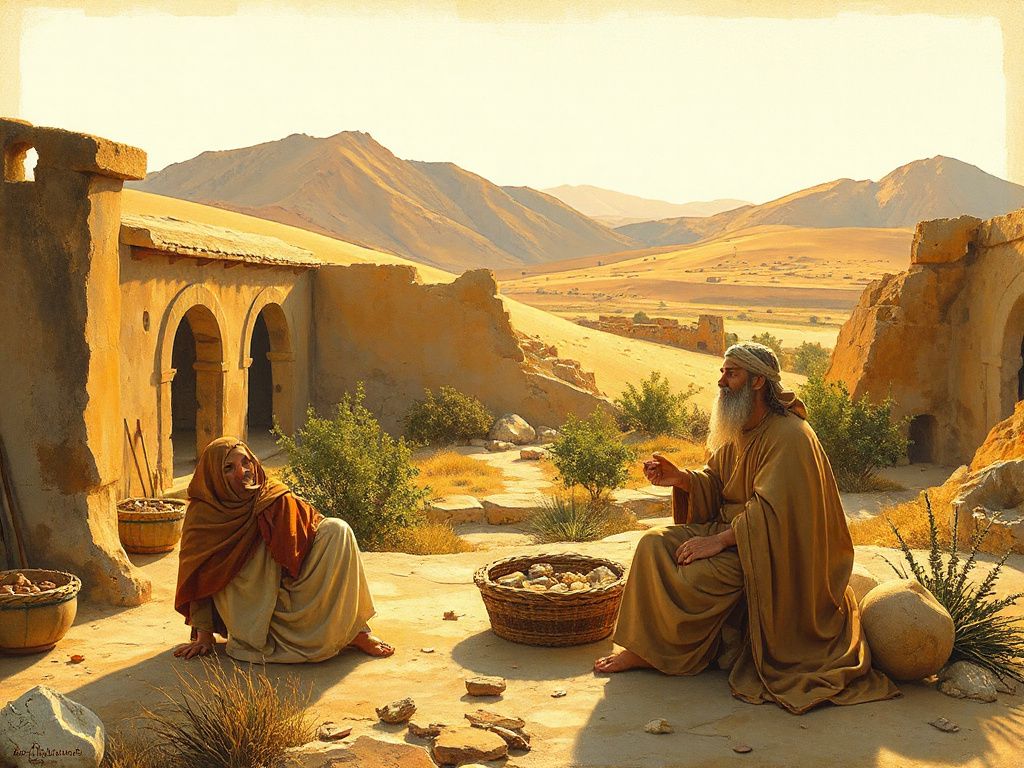
Tobías 7 — Matrimonio acordado y consumado
Tobías 7 narra la llegada de la familia a la casa de Ragüel, el reconocimiento por parte de Ragüel de que Tobías es hijo de su pariente Tobías, y los esponsales formales y la boda de Tobías con Sara.
Tobías
Elige un capítulo
Elige un capítulo y se abrirá en la pestaña Capítulo actual. Vuelve aquí para elegir otro.
Tobías
Capítulo 7
- 1.Arrival at Home of Raguel When they reached Ecbat′ana and arrived at the house of Rag′uel, Sarah met them and greeted them. They returned her greeting, and she brought them into the house.
- 2.Then Rag′uel said to his wife Edna, “How much the young man resembles my cousin Tobit!”
- 3.And Rag′uel asked them, “Where are you from, brethren?” They answered him, “We belong to the sons of Naph′tali, who are captives in Nin′eveh.”
- 4.So he said to them, “Do you know our brother Tobit?” And they said, “Yes, we do.” And he asked them, “Is he in good health?”
- 5.They replied, “He is alive and in good health.” And Tobi′as said, “He is my father.”
- 6.Then Rag′uel sprang up and kissed him and wept.
- 7.And he blessed him and exclaimed, “Son of that good and noble man!” When he heard that Tobit had lost his sight, he was stricken with grief and wept.
- 8.And his wife Edna and his daughter Sarah wept. They received them very warmly; and they killed a ram from the flock and set large servings of food before them. Marriage of Tobias and Sarah Then Tobi′as said to Raph′ael, “Brother Azari′as, speak of those things which you talked about on the journey, and let the matter be settled.”
- 9.So he communicated the proposal to Rag′uel. And Rag′uel said to Tobi′as, “Eat, drink, and be merry;
- 10.for it is your right to take my child. But let me explain the true situation to you.
- 11.I have given my daughter to seven husbands, and when each came to her he died in the night. But for the present be merry.” And Tobi′as said, “I will eat nothing here until you make a binding agreement with me.”
- 12.So Rag′uel said, “Take her right now, in accordance with the law. You are her relative, and she is yours. The merciful God will guide you both for the best.”
- 13.Then he called his daughter Sarah, and taking her by the hand he gave her to Tobi′as to be his wife, saying, “Here she is; take her according to the law of Moses, and take her with you to your father.” And he blessed them.
- 14.Next he called his wife Edna, and took a scroll and wrote out the contract; and they set their seals to it.
- 15.Then they began to eat.
- 16.And Rag′uel called his wife Edna and said to her, “Sister, make up the other room, and take her into it.”
- 17.So she did as he said, and took her there; and the girl began to weep. But the mother comforted her daughter in her tears, and said to her,
- 18.“Be brave, my child; the Lord of heaven and earth grant you joy in place of this sorrow of yours. Be brave, my daughter.”
Qué significa este pasaje
Tobías 7 se construye en torno al reconocimiento y al acuerdo formal. Ragüel identifica a Tobías como hijo de su primo Tobías por el parecido familiar, y el household llora junto cuando escucha que Tobías ha perdido la vista. El versículo que califica a Tobías como «hijo de aquel hombre bueno y noble» (v. 7) vincula la reputación del padre al hijo antes de que comience cualquier negociación, de modo que la solicitud de matrimonio se inscribe dentro de un marco de parentesco y confianza conocidos.
El capítulo trata también sobre la divulgación. Antes de entregar a su hija, Ragüel declara con claridad que ha dado a Sara a siete maridos y que cada uno murió durante la noche. Tobías responde insistiendo en un contrato escrito antes de comer, haciendo que la conversación pase de la hospitalidad a la obligación legal. Ragüel entonces confirma el matrimonio en términos de parentesco y ley mosaica, redactando el contrato y poniendo los sellos antes de que continúe la comida (vv. 9–15).
Los versículos finales pasan del procedimiento público al aposento privado. Edna prepara una habitación aparte para Sara, que llora, y su madre le dice que sea valiente y que mire al «Señor del cielo y de la tierra» para obtener gozo en lugar de tristeza (vv. 16–18). El capítulo avanza, por tanto, desde la identificación, hasta la divulgación honesta, hasta el pacto vinculante, hasta una oración familiar que confía el resultado a Dios.
Contexto
El capítulo se sitúa en la mitad del arco narrativo de Tobías. Se abre con los viajeros llegando a Ecbatana a la casa de Ragüel y se cierra con Sara siendo conducida a una cámara nupcial separada, dejando la noche de bodas en sí sin resolver en el límite del capítulo. Los dos encabezados de sección en el texto proporcionado — «Llegada a la casa de Ragüel» y «Matrimonio de Tobías y Sara» — marcan el quiebre estructural entre la hospitalidad (vv. 1–8) y los esponsales (vv. 9–18).
El contexto nupcial prepara también la siguiente etapa de la historia: la divulgación legal por parte de Ragüel de las siete muertes previas crea la crisis que el lector ya sabe que Tobías está preparado para enfrentar, y las palabras de despedida de Edna ponen la resolución en manos de Dios y no en la ansiedad humana.
Preguntas frecuentes
¿Por qué Ragüel llora antes de que se trate el matrimonio?
El capítulo señala que, cuando Ragüel oyó que Tobías había perdido la vista, quedó herido de dolor y lloró (v. 7). Sus lágrimas nacen de la preocupación por su pariente, no de la cuestión del matrimonio, que solo entra en la conversación en el v. 8.
¿Por qué Tobías se niega a comer antes de que se redacte el contrato?
Después de que Ragüel revela que ya han muerto siete maridos, Tobías insiste en que se haga un acuerdo vinculante antes de que él coma (v. 11). La exigencia convierte el arreglo de una hospitalidad informal en un pacto legal, que Ragüel concede en los vv. 12–14 citando el parentesco y la ley de Moisés y sellando un contrato escrito.
¿Cuál es la importancia de que Edna le diga a Sara que sea valiente en el v. 18?
Acabando de saber que va a ser entregada a un octavo marido tras siete muertes, Sara llora, y su madre la consuela señalando al «Señor del cielo y de la tierra» como aquel que puede cambiar su tristeza por gozo (v. 18). Las palabras enmarcan el resultado desconocido como asunto de acción divina y no del propio temor de Sara.