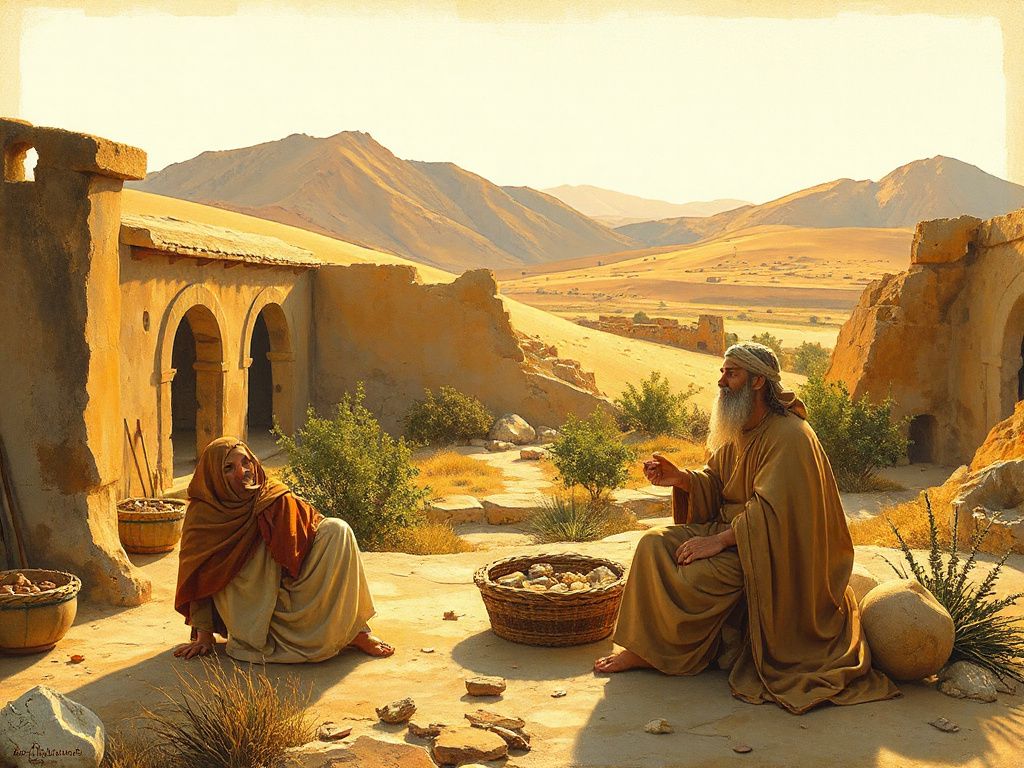
Tobías 3: Dos oraciones escuchadas y el envío de Rafael
Dos sufrientes oran pidiendo la muerte el mismo día, y Dios envía a Rafael para librarlos a ambos.
Tobías
Elige un capítulo
Elige un capítulo y se abrirá en la pestaña Capítulo actual. Vuelve aquí para elegir otro.
Tobías
Capítulo 3
- 1.Tobit’s Prayer Then in my grief I wept, and I prayed in anguish, saying,
- 2.“Righteous art thou, O Lord; all thy deeds and all thy ways are mercy and truth, and thou dost render true and righteous judgment for ever.
- 3.Remember me and look favorably upon me; do not punish me for my sins and for my unwitting offenses and those which my fathers committed before thee.
- 4.For they disobeyed thy commandments, and thou gavest us over to plunder, captivity, and death; thou madest us a byword of reproach in all the nations among which we have been dispersed.
- 5.And now thy many judgments are true in exacting penalty from me for my sins and those of my fathers, because we did not keep thy commandments. For we did not walk in truth before thee.
- 6.And now deal with me according to thy pleasure; command my spirit to be taken up, that I may depart and become dust. For it is better for me to die than to live, because I have heard false reproaches, and great is the sorrow within me. Command that I now be released from my distress to go to the eternal abode; do not turn thy face away from me.”
- 7.Sarah Falsely Accused On the same day, at Ecbat′ana in Media, it also happened that Sarah, the daughter of Rag′uel, was reproached by her father’s maids,
- 8.because she had been given to seven husbands, and the evil demon Asmode′us had slain each of them before he had been with her as his wife. So the maids said to her, “Do you not know that you strangle your husbands? You already have had seven and have had no benefit from any of them.
- 9.Why do you beat us? If they are dead, go with them! May we never see a son or daughter of yours!”
- 10.Sarah’s Prayer for Death When she heard these things she was deeply grieved, even to the thought of hanging herself. But she said, “I am the only child of my father; if I do this, it will be a disgrace to him, and I shall bring his old age down in sorrow to the grave.”
- 11.So she prayed by her window and said, “Blessed art thou, O Lord my God, and blessed is thy holy and honored name for ever. May all thy works praise thee for ever.
- 12.And now, O Lord, I have turned my eyes and my face toward thee.
- 13.Command that I be released from the earth and that I hear reproach no more.
- 14.Thou knowest, O Lord, that I am innocent of any sin with man,
- 15.and that I did not stain my name or the name of my father in the land of my captivity. I am my father’s only child, and he has no child to be his heir, no near kinsman or kinsman’s son for whom I should keep myself as wife. Already seven husbands of mine are dead. Why should I live? But if it be not pleasing to thee to take my life, command that respect be shown to me and pity be taken upon me, and that I hear reproach no more.”
- 16.An Answer to Prayer The prayer of both was heard in the presence of the glory of the great God.
- 17.And Raph′ael was sent to heal the two of them: to scale away the white films of Tobit’s eyes; to give Sarah the daughter of Rag′uel in marriage to Tobi′as the son of Tobit, and to bind Asmode′us the evil demon, because Tobi′as was entitled to possess her. At that very moment Tobit returned and entered his house and Sarah the daughter of Rag′uel came down from her upper room.
Qué significa este pasaje
El capítulo establece un paralelismo estructural: Tobías, recién cegado y burlado, ora angustiado desde Nínive (3,1–6), mientras que Sara, hija de Ragüel en Ecbatana, lo hace junto a la suya (3,7–15). Ambas oraciones comienzan con una confesión de la justicia de Dios y desembocan en una súplica de liberación de la aflicción. Tobías confiesa los pecados de sus padres y los suyos propios; Sara declara su inocencia pero soporta la vergüenza de siete esposos muertos. El recurso literario empareja a dos desconocidos en extremos opuestos del exilio para que un solo acto de Dios los atienda a los dos.
La respuesta de Dios se afirma de forma breve pero decisiva en 3,16: «La oración de ambos fue escuchada en presencia de la gloria del gran Dios». El versículo 17 luego señala las liberaciones concretas: los ojos de Tobías serán sanados, Sara será entregada en matrimonio a Tobías, hijo de Tobías, y Asmodeo será atado. El capítulo vincula la teología (Dios escucha) con el mecanismo narrativo (la misión de Rafael), de modo que el lector percibe la conexión antes de que comience el relato del viaje en los capítulos 4–11.
Un tema subordinado es la legitimidad del lamento que termina en una petición de muerte. Ninguna de las dos oraciones es reprendida; ambas son escuchadas. Sin embargo, la respuesta no es la muerte solicitada, sino una intervención que restaura la vida. El capítulo presenta la oración en el sufrimiento no como un habla errónea, sino como el contexto mismo en el que la acción salvadora de Dios se hace visible.
Contexto
La nota curada proporcionada indica únicamente que Tobías fue completado fuera de los rangos designados P0/P1, por lo que no se ofrece un encuadre temático adicional. El capítulo se sitúa en el eje entre el lamento de Tobías por su ceguera (capítulo 2) y el encargo del viaje por parte de Rafael (capítulos 4–6). La línea narrativa de Sara inicia igualmente los episodios de Ecbatana que culminan en la boda de los capítulos 7–8.
Dado que no se proporcionaron una lista de referencias cruzadas ni una lista de palabras originales para este capítulo, esta página de referencia no formula afirmaciones sobre vocabulario hebreo o arameo, ni cita pasajes paralelos. Las afirmaciones se limitan a lo que el propio texto del capítulo contiene.
Preguntas frecuentes
¿Por qué Tobías y Sara oran ambos pidiendo la muerte en el mismo capítulo?
El capítulo utiliza el paralelismo para preparar una única respuesta divina. Al colocar a dos sufrientes sin relación entre sí en ciudades diferentes el mismo día y dar a cada uno un lamento similar, el autor concentra la atención en el momento del versículo 16, cuando Dios los escucha a ambos a la vez, y en el versículo 17, cuando se envía a Rafael para los dos. La repetición hace que la conexión sea inconfundible antes de que se despliegue el viaje de los capítulos 4–11.
¿El capítulo aprueba el suicidio para los afligidos?
Ninguna de las dos oraciones es condenada, pero tampoco se concede lo que piden. Ambas son escuchadas, y la respuesta es restauradora: los ojos de Tobías serán sanados y Sara será entregada en matrimonio. El capítulo trata el lamento que incluye una petición de muerte como una palabra que Dios recibe, pero la redirige hacia la vida.
¿Quién es Rafael y qué se le envía a hacer?
El versículo 16 dice que las oraciones fueron escuchadas en presencia de la gloria del gran Dios, y el versículo 17 afirma que Rafael fue enviado. El capítulo enumera tres tareas concretas: arrancar las películas blancas de los ojos de Tobías, entregar a Sara en matrimonio a Tobías, hijo de Tobías, y atar al demonio maligno Asmodeo, porque Tobías tenía derecho a poseerla.